


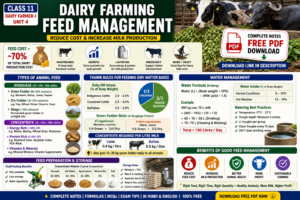
Dairy Farming Feed Management (Class 11)
Reduce Cost & Increase Milk Production
Dairy Farmer-I | Unit 4 | Sessions 1–4 | Story-Style Notes with Corrections
Introduction: Dairy Farming Feed Management Class 11
Dairy Farming Feed Management Class 11 Reduce Cost & Increase Milk Production- यह नोट्स विशेष रूप से हिन्दी माध्यम के विद्यार्थियों को ध्यान में रखकर तैयार किए गए हैं, ताकि वे डेयरी फार्मिंग के महत्वपूर्ण विषयों को सरल और व्यवस्थित तरीके से समझ सकें। अक्सर छात्रों को सही और स्पष्ट अध्ययन सामग्री नहीं मिल पाती, जिससे तैयारी कठिन हो जाती है।
इसी समस्या को ध्यान में रखते हुए यहाँ पर आपको पूरी यूनिट के विस्तृत, त्रुटि-सुधारित और परीक्षा-उपयोगी नोट्स दिए गए हैं। सबसे अच्छी बात यह है कि इन नोट्स का एक Complete Free PDF भी उपलब्ध है, जिसका डाउनलोड लिंक नीचे दिया गया है। विद्यार्थी इस PDF को अपने मोबाइल या कंप्यूटर में सेव करके कभी भी ऑफलाइन पढ़ सकते हैं और अपनी परीक्षा की तैयारी को मजबूत बना सकते हैं।
What is Animal Feed and Why It Matters in Dairy Farming?
Feed is the single largest cost in dairy farming — accounting for approximately 70% of total production expenses. Choosing the right feed, in the right quantity and at the right time, is the key to reducing costs while increasing milk yield.
|
Key Fact Feed cost = ~70% of total dairy production cost. Smart feeding = Lower cost + Higher milk production. |
Animals need feed for five main purposes:
- Maintenance — to keep the body functioning normally
- Growth — extra nutrients to build body size and weight
- Lactation — extra energy and protein for milk production
- Pregnancy — supporting foetal development (especially in last 3 months)
- Work / Draft — for bullocks doing heavy field work
SESSION 1 Feed Basics — Types, Composition & Quality
Types of Animal Feed: Roughage vs Concentrates Explained
All animal feedstuffs are classified into two broad groups based on Crude Fibre (CF) and Total Digestible Nutrients (TDN) content:
|
Category |
CF % |
TDN % |
Examples |
|
Roughage — Wet (Green Fodder) |
>18% |
<60% |
Berseem, maize, jowar, napier grass (moisture 60–90%) |
|
Roughage — Dry Fodder |
>18% |
<60% |
Hay, wheat straw, stovers, husk (moisture 10–15%) |
|
Roughage — Silage |
>18% |
<60% |
Fermented maize/sorghum in airtight silo (moisture ~70%) |
|
Concentrate — Energy Rich |
<18% |
>60% |
Maize, barley, bajra, wheat bran, molasses (<18% CP) |
|
Concentrate — Protein Rich |
<18% |
>60% |
Mustard cake, soybean cake, fish meal (>18% CP) |
|
Concentrate — Vitamins & Minerals |
<18% |
>60% |
Mineral mixtures, vitamin supplements |
|
IMPORTANT — Silage is Roughage, NOT Concentrate Silage = preserved roughage made by fermenting green fodder (e.g. maize) in an airtight silo. Lactic acid is produced which preserves the feed. It is classified as roughage, not concentrate. |
Characteristics of Good Quality Animal Feed (BCEFOP+R)
A good animal feed must have all of these qualities — remember the mnemonic BCEFOP+R:
|
Letter |
Quality |
What it means |
|
B |
Bulky |
High fibre content — fills the rumen, aids digestion |
|
C |
Clean and Fresh |
Free from mould, dust, contamination |
|
E |
Economical |
Buy during harvest season at low price; store properly |
|
F |
Free from Toxins |
No poisonous substances, no pesticide residues |
|
O |
Optimum Quantity |
Feed the right amount — not too little, not too much |
|
P |
Palatable |
Animals should find it tasty and eat willingly |
|
+R |
Regular Timing |
Feed at consistent times daily for better productivity |
|
B |
Balanced in Nutrients |
All essential nutrients — protein, energy, minerals, vitamins |
Composition of Animal Feed: CP, CF, EE, NFE & Minerals
Every feed can be analysed into 6 major chemical components:
|
Component |
What it Contains |
Example substances |
|
Moisture (Water) |
Water + volatile substances |
Free water in green fodder |
|
Crude Protein (CP) |
True protein + amino acids + non-protein nitrogen (NPN) |
Albumin, casein, urea |
|
Ether Extract / EE (Crude Fat) |
Fats, complex lipids, sterols, fatty acids, fat-soluble pigments |
Vegetable oils, waxes |
|
Crude Fibre (CF) |
Cellulose + lignin (structural fibre) |
Cell walls of plants |
|
Nitrogen-Free Extract (NFE) |
Soluble carbohydrates (starch, sugars) + pectin + some soluble fractions |
Starch in grains |
|
Inorganic Matter (Ash) |
Minerals — calcium, phosphorus, potassium, sodium |
Bone, soil minerals |
|
INCORRECT: NFE = soluble carbohydrates, hemicelluloses, lignin, pectin, tannin CORRECT: NFE = soluble carbohydrates (starch, sugars), pectin, and some soluble fractions only NOTE: Hemicelluloses and lignin are structural components of Crude Fibre (CF), not NFE. |
TDN Formula and Its Importance in Dairy Nutrition
TDN (Total Digestible Nutrients) measures how much energy-providing nutrition an animal can actually digest and absorb from a feed. It is expressed as a percentage.
|
TDN (%) = Digestible CF (%) + Digestible CP (%) + (Digestible EE x 2.25) + Digestible NFE (%)
Why multiply EE by 2.25? Fat provides 2.25x more energy per gram than carbohydrates. Minerals and vitamins are NOT included in TDN calculation. |
TDN requirements change with life stage:
- Dry cow (not milking) → lower TDN needed
- Lactating cow (milking) → higher TDN needed for milk synthesis
- Young growing heifer → higher TDN than adult maintenance
Nutritive Value of Common Feeds (Grains, Fodder, Silage)
Table 4.2 — Average Nutritive Value on Fresh Weight Basis:
|
Category |
Feed Name |
Moisture % |
CP % |
TDN % |
Key Note |
|
Grains |
Maize |
10 |
9.0 |
82 |
Highest energy grain |
|
Grains |
Gram (Chana) |
10 |
14.4 |
80 |
High CP grain |
|
Grains |
Wheat |
10 |
12.8 |
80 |
Good energy + protein |
|
Grains |
Barley |
10 |
9.5 |
75 |
Good energy |
|
Grains |
Bajra |
10 |
6.6 |
65 |
Common local grain |
|
Oil Cakes |
Sesame cake |
10 |
45.6 |
78 |
Highest CP of all |
|
Oil Cakes |
Mustard cake |
10 |
36.0 |
74 |
Common protein source |
|
Oil Cakes |
Cotton seed |
10 |
21.6 |
70 |
Moderate protein |
|
Agro By-products |
Wheat bran |
10 |
15.0 |
60 |
Energy + moderate protein |
|
Agro By-products |
Rice polish |
10 |
12.0 |
67 |
Energy + moderate protein |
|
Animal By-products |
Fish meal |
7 |
55.0 |
65 |
Best protein source |
|
Animal By-products |
Meat & bone meal |
5 |
40.0 |
69 |
High protein |
|
Green Fodders |
Berseem |
85 |
2.4 |
13 |
Leguminous; excellent quality |
|
Straws |
Wheat straw |
10 |
3.0 |
40 |
Low nutrition; dry roughage |
|
Straws |
Rice straw |
10 |
2.0 |
40 |
Low nutrition; dry roughage |
|
Silage |
Maize silage |
70 |
1.2 |
18 |
Roughage; preserved green fodder |
SESSION 2 Feeding Dairy Animals — Requirements & Standards
Feeding Requirements of Dairy Animals (Maintenance, Growth, Lactation)
Different life stages require different feed allowances:
|
Purpose |
Extra Feed Needed |
Key Notes |
|
Maintenance |
Base ration only |
Minimum nutrients to maintain normal body functions |
|
Growth (0–3 years) |
+20% above maintenance |
Young growing animals have higher nutrient density needs |
|
Growth (3–4 years) |
+10% above maintenance |
Still growing but at a reduced rate |
|
Growth (4+ years) |
Maintenance only |
Growth is essentially complete |
|
Lactation |
Extra CP + TDN per litre milk |
0.4 kg concentrate per litre (cattle); 0.5 kg (buffalo) |
|
Pregnancy (last 3 months) |
+1.25–1.75 kg concentrate |
Foetus and placenta grow rapidly in final trimester |
|
Work / Draft |
Extra as per work load |
Depends on type and duration of field work |
Dry Matter (DM) Intake and Thumb Rules for Feeding
Dry Matter (DM) = Feed weight minus all moisture. It is the actual nutritive portion of feed.
|
DM intake per day: Indigenous cattle → 2.0 to 2.5% of body weight Crossbred cattle → 2.5 to 3.0% of body weight Buffaloes → 2.5 to 3.0% of body weight (same as crossbred)
DM includes BOTH roughage + concentrate portions combined. |
Concentrate vs Fodder split of total DM:
- 1/3 of total DM from concentrate
- 2/3 of total DM from fodder/roughage
Green fodder ratio within the roughage portion:
- If leguminous (berseem, lucerne): 1/4 green + 3/4 dry fodder
- If non-leguminous (maize, jowar): 1/3 green + 2/3 dry fodder
Concentrate and Fodder Ratio for Dairy Animals
Table 4.3 — Thumb Rule: Daily concentrate and straw requirements per animal:
|
Animal Type |
Straw / Dry Fodder |
Maintenance (kg) |
Per Litre Milk |
Pregnancy (kg) |
Growth (kg) |
|
Indigenous cattle |
4–5 kg |
1.25 |
0.4 kg/litre |
1.25 |
1.00 |
|
Crossbred cattle |
4–6 kg |
2.00 |
0.4 kg/litre |
1.75 |
1.00 |
|
Buffaloes |
4–6 kg |
2.00 |
0.5 kg/litre |
1.75 |
1.00 |
|
Breeding bull |
Free choice |
2.50 |
— |
— |
— |
|
Working bullock |
Free choice |
3.00 |
— |
— |
— |
|
Note In addition to concentrate and dry fodder, give 15–20 kg fresh green fodder daily to all dairy animals. |
Scientific Feeding Standards (ICAR, NRC, ARC) Explained
|
Standard |
Full Name |
Country |
Use in India |
|
ICAR |
Indian Council of Agricultural Research |
India |
PRIMARY standard — used in all Indian dairy farms and exams |
|
NRC |
National Research Council |
USA |
Reference standard for research |
|
ARC |
Agricultural Research Council |
UK |
Reference standard for research |
|
Exam Tip India follows ICAR standards. Always answer ICAR for Indian feeding standards in exams. |
How to Increase Milk Production Through Proper Feeding
- Feed lactating cows 0.4 kg concentrate per litre of milk (cattle) or 0.5 kg (buffalo)
- Ensure 15–20 kg quality green fodder daily — good berseem can partially replace concentrate
- Never reduce water — dehydration directly reduces milk yield (milk is ~87% water)
- Feed major ration at night during summer — cooler temperature improves feed conversion
- Mix chopped green fodder + dry straw + concentrate for better palatability and utilisation
- Monitor feed intake daily — any drop signals a health issue requiring prompt attention
SESSION 3 Feed Preparation — Mixing, Processing & Storage
Chaff Cutter: Importance and Benefits in Feed Preparation
Green fodder must be chopped into small pieces before feeding. This process is called chaffing. Dry fodder (wheat straw) can be fed whole, but green fodder must always be chaffed.
|
Benefit of Chaff Cutting |
Explanation |
|
More palatable |
Chopped feed has a better texture and smell — animals eat it more willingly |
|
Less wastage in manger |
Whole long stalks are dragged out; short pieces stay in the trough |
|
Better digestibility |
Smaller particle size increases surface area for digestive enzymes |
Types of chaff cutters:
- Manual (hand-operated) — suitable for small and marginal farmers
- Electrically operated — suitable for large commercial dairy farms
How to Prepare Concentrate Mixture for Dairy Animals
Farm-made concentrate is cheaper, purer, and customisable compared to market-bought feed. Follow these 5 steps:
- Calculate the actual quantity of each ingredient needed per day
- Grind maize, oil cakes and other hard ingredients (grinding increases digestibility)
- Mix all ground ingredients in a feed mixer until homogenous
- Store prepared feed in a dry, cool, sealed storage area
- Distribute feed to animals as per their individual requirements
|
Critical Warning — Rancidity Grind maize and grains just before use. Once ground, oils are released and the feed turns rancid within days to weeks, making it unpalatable and potentially harmful. |
Ingredients Used in Animal Feed (Cereals, Oil Cakes, By-products)
Typical concentrate mixture composition:
|
Ingredient Group |
Common Examples |
Proportion in Mix |
|
Cereals (energy) |
Maize, wheat, barley, sorghum, millet |
35–40% |
|
Oil cakes (protein) |
Soybean, groundnut, mustard, sesame, cotton seed cake |
32–35% |
|
Agro by-products |
Wheat bran, rice bran, rice polish, broken rice, dal chunnies |
25–28% |
|
Mineral mix + vitamins |
Di-calcium phosphate, limestone, oyster shells |
2% |
|
Salt (sodium source) |
Common salt (NaCl) |
1% |
|
INCORRECT: Rice bran and wheat bran are energy sources — they contain NO protein (T/F answer listed as True) CORRECT: Wheat bran and rice bran are primarily energy sources BUT also contain moderate protein NOTE: Better classification: both are agro by-products providing moderate energy AND moderate protein. They are NOT high-protein sources like oil cakes, but they are not protein-free either. |
Storage of Animal Feed: Methods, Structures and Safety Tips
Proper storage prevents losses from moisture, rodents, insects and fungal growth. Key rules:
|
Storage Rule |
Details |
|
Moisture limit |
Keep stored feed below 12% moisture — higher moisture promotes fungal and bacterial growth |
|
Stacking height |
Do not stack bags more than 5 metres high on concrete floors |
|
Separate new and old |
Always store new stock separately from old stock to prevent contamination |
|
Site selection |
Raised, well-drained, sheltered location away from standing water |
|
Fumigation |
Fumigate storage structure before filling; seal all cracks and gaps |
|
Aeration |
Ventilate in dry weather; CLOSE all ventilation during rainy season |
|
Bag hygiene |
Prefer new gunny bags; wash second-hand bags in boiling disinfectant |
|
Rodent control |
Active rodent control programme; use sealed metal bins where possible |
Types of storage structures:
|
Type |
Structures |
|
Traditional |
Mud bin, Thekka, Bamboo reed bin, Metal drums |
|
Improved / Modern |
Improved bins, Brick-built godowns, Silos |
How to Prevent Feed Loss and Maintain Feed Quality
|
Stage of Feed Loss |
Cause |
Prevention |
|
Storage |
Insects, rodents, moisture |
Sealed containers, rodent programme, keep DM <12% |
|
Processing |
Careless grinding and mixing |
Careful handling; grind only what is needed immediately |
|
Feeding |
Animals spill or pull feed out |
Improve manger design; use properly sized troughs |
|
In manger |
Saliva wets feed → spoilage |
Clean manger daily; remove stale leftover feed |
|
Selective eating |
Animals eat preferred parts only |
Group feeding in continuous manger by size/age |
SESSION 4 Feed & Water Management — Planning & Best Practices
Planning Feed and Water Supply in Dairy Farming (3Ms Strategy)
Three essential resources must always be available without interruption on a dairy farm:
|
M |
Resource |
Examples |
|
Material |
Feedstuff + Water |
Concentrate ingredients, dry fodder, silage, drinking water |
|
Man |
Labour / Workers |
Feeding staff, cleaning crew, farm managers |
|
Machinery |
Equipment |
Water pump, chaff cutter, feed grinder, feed mixer, storage bins |
|
Critical Point If ANY one of the 3 Ms is disrupted, feed and water supply will stop — directly affecting animal health and milk production. |
Broad planning strategy by feedstuff type:
|
Feedstuff |
Planning Strategy |
|
Concentrate ingredients |
Buy in bulk during harvest season (cheapest price); store properly |
|
Dry fodder (wheat straw) |
Buy at harvest when cheap; bale and store for year-round use |
|
Hay and silage |
Prepare on-farm; use when green fodder is scarce |
|
Green fodder crops |
Plan year-round cultivation with staggered sowing dates |
|
Feed supplements |
Add after regular nutritional evaluation of the ration |
Water Requirements of Dairy Animals (Calculation & Factors)
Water is the most critical nutrient. An adult animal’s body contains approximately 65% water and milk contains approximately 87% water. Deprivation of water can be fatal far more quickly than deprivation of feed.
|
DRINKING WATER FORMULA: Water (litres) = (Body weight x 10%) + (Daily milk yield x 1.5)
Example: 400 kg lactating cow producing 10 litres milk per day: Drinking water = (400 x 10%) + (10 x 1.5) = 40 + 15 = 55 litres + Cleaning shed and washing animal = 70 to 75 litres TOTAL daily water requirement = approximately 130 litres |
|
INCORRECT: Fill-in-the-blank answer: ‘Adult cattle need about 130 litres daily’ (stated as universal) CORRECT: 40–80 litres drinking water is the general range for adult non-lactating cattle NOTE: 130 litres is specific to a 400 kg lactating cow producing 10 litres milk. The general fill-in-the-blank answer should be 40–80 litres for normal adult cattle. |
Factors that INCREASE water requirement:
- High daily milk yield — milk is 87% water
- High protein diet — protein metabolism requires more water for urea excretion
- Hot summer months — evaporative losses from skin and lungs increase
- Absence of succulent green fodder — green fodder supplies significant water
|
Condition |
Water intake as % of body weight |
|
Normal (temperate) conditions |
8 to 10% of body weight per day |
|
Hot summer conditions |
13 to 14% of body weight per day |
Best Practices for Watering Dairy Animals
- Provide water multiple times per day — animals drink frequently in small amounts
- 30–40% of total daily intake is consumed within 1 hour after milking
- Maintain water temperature between 17 and 27 degrees C — avoid very cold or very hot water
- Water trough depth: minimum 3 inches so animals can submerge their muzzle 1–2 inches
- Provide at least 2 watering troughs per group — dominant animals may block single troughs
- Ensure 24/7 access to clean drinking water; increase supply in hot weather
- Clean water troughs every 15 days; apply lime paint inside to prevent algae growth
Feed and Water Management Tips for Dairy Farms
- Train all farm workers in proper feeding hygiene and cleanliness protocols
- Divide the total daily feed quantity into at least 2 equal feeding sessions
- Always mix chopped green fodder, dry straw, and concentrate before feeding
- Sick animals must be fed only on veterinarian’s recommendation
- In summer, give the larger feed portion at night when temperatures are cooler
- Monitor feeding and drinking patterns daily — any change may indicate illness
- Clean the feeding manger every day; remove and dispose of any stale leftover feed
- Service and clean all feeding machinery (grinder, mixer, chaff cutter) regularly
- Give special attention to young calves, sick animals, and advanced-pregnant cows
Common Causes of Feed Wastage and How to Prevent Them
|
Point of Loss |
Cause |
Solution |
|
Storage |
Rodents, insects, moisture damage |
Sealed bins, fumigation, moisture control (<12%) |
|
Processing |
Careless grinding or mixing |
Grind just before use; careful handling of feed |
|
Feeding (spillage) |
Animals push feed out of manger |
Use properly designed, deep mangers |
|
In manger (spoilage) |
Saliva wets feed; bacterial growth |
Clean manger daily; remove stale feed immediately |
|
Selective eating |
Animals eat only preferred ingredients |
Group feeding in continuous manger; mix feed well |
REVISION & EXAM Formulas, Numbers & Quick Reference
Important Formulas and Numbers for Exams (Quick Revision)
|
70% Feed as % of total dairy cost |
|
2.25 EE multiplier in TDN formula |
|
16% Nitrogen assumed in crude protein |
|
2.0–2.5% Daily DM — indigenous cattle (% body wt) |
|
2.5–3.0% Daily DM — crossbred / buffalo (% body wt) |
|
1/3 Concentrate portion of total DM |
|
0.4 kg/L Concentrate per litre milk — cattle |
|
0.5 kg/L Concentrate per litre milk — buffalo |
|
20% extra Feed extra for growth (animals ≤ 3 years) |
|
10% extra Feed extra for growth (animals 3–4 years) |
|
65% Water in adult animal body |
|
87% Water in milk |
|
8–10% Water intake % body weight (normal) |
|
13–14% Water intake % body weight (hot weather) |
|
17–27°C Preferred water temperature for cattle |
|
3 inches Minimum water trough depth |
|
15 days Water trough cleaning frequency |
|
12% Maximum moisture in stored feed |
|
5 metres Maximum stacking height on concrete floor |
|
130 litres Total water: 400 kg + 10 L milk cow (example) |
Complete Summary of Dairy Feed and Nutrition (Class 11)
|
Session |
Topic |
Key Memory Trick |
|
Session 1 |
Feed types: Roughage vs Concentrate |
CF >18% = Roughage | CF <18% = Concentrate |
|
Session 1 |
Feed quality — 8 characteristics |
BCEFOP+R (Bulky, Clean, Economical, Free from toxins, Optimum, Palatable, Regular, Balanced) |
|
Session 1 |
TDN formula |
TDN = CF + CP + (EE x 2.25) + NFE — Minerals NOT included |
|
Session 2 |
Feed purposes |
MGLPW: Maintenance, Growth, Lactation, Pregnancy, Work |
|
Session 2 |
DM thumb rule |
Desi 2–2.5%; Crossbred/Buffalo 2.5–3% body weight |
|
Session 2 |
Concentrate ratio |
1/3 concentrate + 2/3 fodder of total DM |
|
Session 2 |
Indian standard |
ICAR for India | NRC for USA | ARC for UK |
|
Session 3 |
Chaff cutting benefit |
Palatable + Less waste + Better digestion |
|
Session 3 |
Concentrate mix |
Cereals 35–40% | Oil cakes 32–35% | By-products 25–28% |
|
Session 3 |
Storage |
Moisture <12% | Max 5 m height | Separate new/old stocks |
|
Session 4 |
Planning resources |
3 Ms: Material, Man, Machinery |
|
Session 4 |
Water formula |
(Body wt x 10%) + (Milk litres x 1.5) = drinking water |
|
Session 4 |
Watering rules |
17–27°C | 3 inch depth | 2 troughs per group | Clean every 15 days |
Frequently Asked Questions (MCQs, Fill in the Blanks, True/False)
Session 1 — MCQs with Corrected Answers
Q1. Why do animals need feed?
(a) Maintenance (b) Growth (c) Lactation (d) All of these
Ans: (d — All of these)
Q2. Which of the following is NOT considered under Crude Protein?
(a) Pure protein (b) Non-protein nitrogen compounds (c) Amino acids (d) Lignin
Ans: (d — Lignin (it is part of Crude Fibre, not Crude Protein))
Q3. In TDN estimation, which component is NOT included?
(a) Crude Fibre (b) Ether Extract (c) Minerals (d) Crude Protein
Ans: (c — Minerals (they provide no energy and are not digested in the same way))
Q4. Which is a characteristic of good feed?
(a) Bulky (b) Rich in protein (c) Free from toxins (d) All of these
Ans: (d — All of these (all are valid characteristics))
Session 1 — Fill in the Blanks
|
# |
Question |
Answer |
|
1 |
Feed constitutes about ___ % of total cost of animal production. |
70% |
|
2 |
Wheat straw contains TDN of about ___ %. |
40% |
|
3 |
In TDN calculation, digestible EE is multiplied with ___. |
2.25 |
|
4 |
EE has ___ times greater energy density than carbohydrate or protein. |
2.25 |
|
5 |
Crude protein content assumes proteins contain approximately ___ % nitrogen. |
16% |
Session 1 — True or False
|
Statement |
Answer |
Explanation |
|
TDN requirements change according to life stage. |
TRUE |
Lactating cow needs more TDN than dry cow |
|
Silage is considered a concentrate feed. |
FALSE |
Silage is preserved roughage, not concentrate |
|
A good animal feed has high carbohydrate content. |
FALSE |
Good feed is balanced — not just high carbohydrate |
|
Concentrate feed is more expensive than roughage. |
TRUE |
Higher energy density = higher cost per kg |
|
Inorganic matter in feed is categorised as minerals. |
TRUE |
Ash fraction = mineral content |
Session 2 — Fill in the Blanks
|
# |
Question |
Answer |
|
1 |
Dairy animals consume two types of feeds: concentrate and ___. |
Fodder / Roughage |
|
2 |
Minimum nutrients to maintain normal body functions are called ___. |
Maintenance ration |
|
3 |
Feed after removing all water is called ___. |
Dry Matter (DM) |
|
4 |
___ are substances added in small quantities to stimulate growth and health. |
Feed supplements |
|
5 |
In buffaloes, 1 kg concentrate is needed for every ___ litres of milk. |
2 litres (0.5 kg per litre) |
Session 2 — True or False (With Corrections)
|
Statement |
Answer |
Explanation |
|
Fodder is always available in green form. |
FALSE |
Fodder includes both green and dry forms |
|
Nutritive value of good green fodder = concentrate mixture. |
TRUE |
Quality berseem can substitute some concentrate |
|
All feeds contain some amount of water. |
TRUE |
Even dry feeds have 5–15% moisture |
|
A single ingredient can meet total nutrient needs of young animal. |
FALSE |
Balanced ration requires multiple ingredients |
|
Feed supplements are non-nutritive in nature. |
FALSE — CORRECTED |
Supplements CAN be nutritive (vitamins, minerals) OR non-nutritive (binders, flavours). This statement is incorrect. |
Session 3 — True or False (With Corrections)
|
Statement |
Answer |
Explanation |
|
Rice polish and wheat bran are used as protein source in concentrate. |
FALSE |
They are primarily energy sources (agro by-products); they contain moderate protein but are not classified as protein-rich ingredients |
|
All feed ingredients need to be ground before mixing. |
FALSE |
Only hard grains like maize and oil cakes need grinding; others can be used as-is |
|
Chaffed fodder is less palatable. |
FALSE — CORRECTED |
Chaffed (chopped) fodder is MORE palatable than whole fodder |
|
Good ration is balanced and economical. |
TRUE |
Both quality and cost must be considered |
|
Feed storage platform is high to avoid theft. |
FALSE — CORRECTED |
Platform is high to prevent moisture seepage from ground, not to prevent theft |
BONUS Advanced Farming Tips for Maximum Profit
How to Reduce Feed Cost in Dairy Farming
- Buy concentrate ingredients in bulk during the post-harvest period when prices are lowest
- Prepare concentrate on-farm — eliminates dealer markup and adulterants
- Grow your own green fodder (berseem, lucerne) — reduces concentrate requirement significantly
- Use silage and hay as low-cost alternatives when green fodder is not available
- Feed animals in groups by production level — high producers get more, dry cows get less
- Minimise feed wastage: improve manger design, clean daily, remove stale feed promptly
- Buy mineral supplements in bulk — small quantities are expensive per unit
Best Feeding Strategy for Maximum Milk Yield
- Provide 15–20 kg fresh berseem or maize fodder daily — reduces need for expensive concentrate
- Ensure adequate water at all times — dehydration reduces milk by 10–20% almost immediately
- Feed twice daily at fixed times — this creates a routine that animals respond well to
- Mix chopped green fodder + dry straw + concentrate before feeding — improves intake
- In summer: feed 60% of the ration at night (cooler temperature = better feed conversion)
- Monitor body condition score (BCS) monthly — thin cows produce less; over-fat cows have calving problems
- Transition dry cows to lactation ration gradually (over 2–3 weeks) to avoid digestive upset
Low Cost Animal Feed Planning for Small Farmers
- Sow berseem in October — one acre produces enough green fodder for 2–3 animals through winter
- Stagger sowing of different crops: berseem (winter), maize (kharif), cowpea (summer)
- Use locally available agro by-products — wheat bran, rice bran, mustard cake are economical protein-energy sources
- Form farmer groups to purchase concentrate ingredients in bulk — better price negotiation
- Use molasses (cheap energy source) mixed with straw to improve palatability of low-quality roughage
- Store wheat straw at harvest — it costs 30–50% less than off-season purchased straw
- A balanced homemade concentrate can cost 20–30% less than branded commercial feed of equivalent quality
Complete Summary of Dairy Feed and Nutrition (Class 11)
Glossary of Key Terms
|
Term |
Definition |
|
Concentrate |
Feed with CF <18% and TDN >60% — high energy, highly digestible |
|
Roughage / Fodder |
Feed with CF >18% and TDN <60% — fibrous, bulky; includes green fodder, dry straw and silage |
|
TDN |
Total Digestible Nutrients — energy measure: CF + CP + (EE x 2.25) + NFE |
|
Crude Protein (CP) |
Total nitrogen in feed x 6.25 — includes true protein + non-protein nitrogen |
|
Ether Extract (EE) |
Crude fat — fats, oils, and fat-soluble substances |
|
Crude Fibre (CF) |
Structural plant fibre — cellulose and lignin |
|
NFE |
Nitrogen-Free Extract — soluble carbohydrates: starch, sugars, pectin |
|
Dry Matter (DM) |
Feed weight minus all moisture — actual nutritive portion |
|
Silage |
Green fodder preserved by anaerobic fermentation in an airtight silo; classified as roughage |
|
Chaff |
Chopped green fodder prepared using a chaff cutter |
|
Maintenance Ration |
Minimum feed needed to maintain normal body functions with no production |
|
Rancidity |
Spoilage of ground grains — oils oxidise and become unpalatable after grinding |
|
Fumigation |
Application of gaseous pesticides to kill insects and pests in feed storage structures |
|
ICAR |
Indian Council of Agricultural Research — India’s official livestock feeding standards body |
Dairy Farming Feed Management Class 11 — Full Notes in Hindi Medium [Download Hindi Medium PDF]
Dairy Farming Feed Management Class 11 — Full Notes in English Medium [Download Hindi Medium PDF]

Dairy Farmer-I | Class XI | Unit 4 — Providing Feed and Water for Livestock
Teacher: Om Sikarwar | CLASS ORB.COM | Complete Revised Notes with Corrections
