

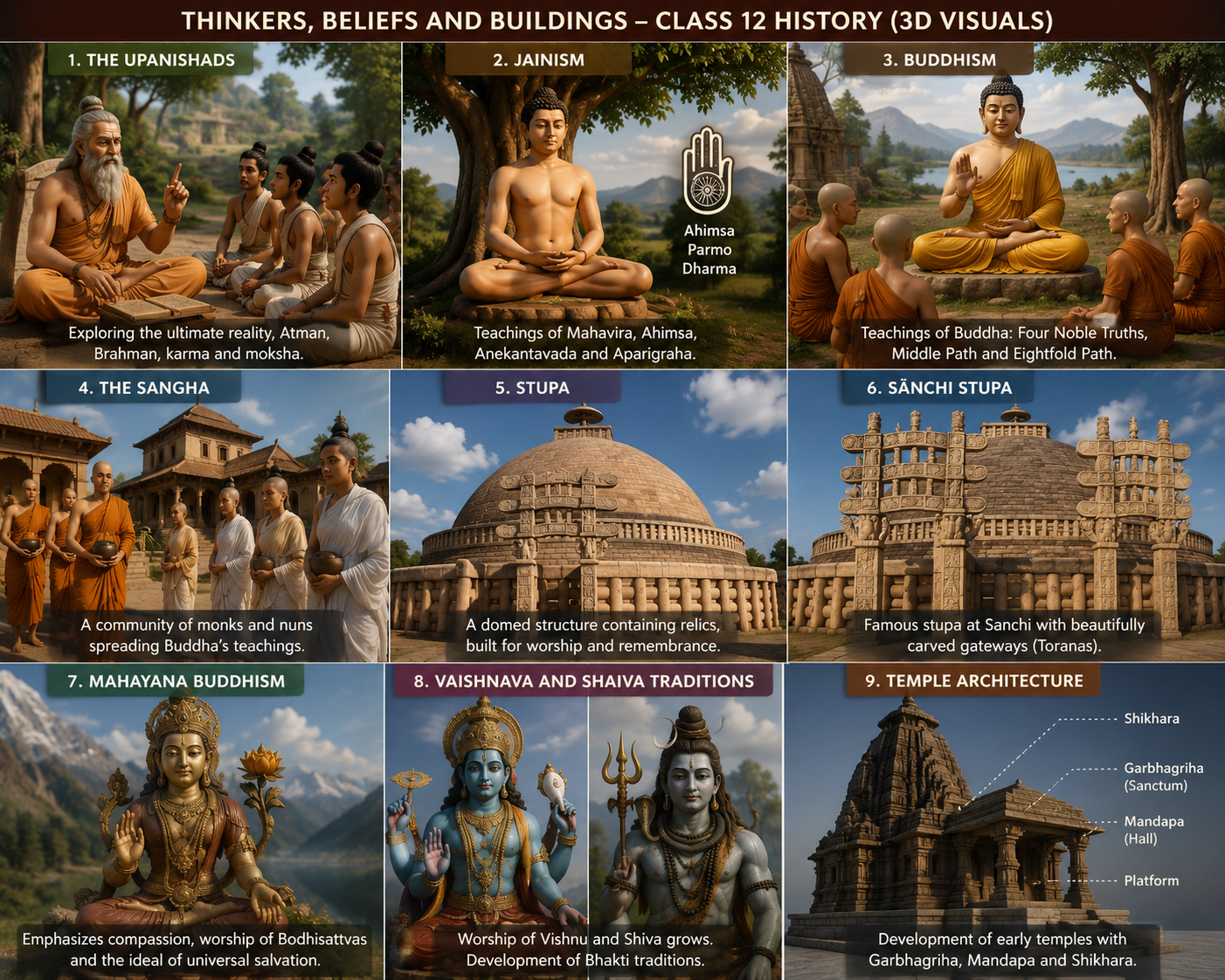
Thinkers, Beliefs and Buildings Notes Class 12 PDF | NCERT History Chapter 4 Explained in Hindi
NCERT Class XII History
Theme 4
Thinkers, Beliefs and Buildings
सोच, आस्था और इमारतें
Cultural Developments (c. 600 BCE – 600 CE)
CBSE Board + UPSC Preparation | Bilingual Notes with Solved Exercises
1. Chapter Introduction — परिचय
Thinkers, Beliefs and Buildings Notes Class 12 NCERT History Chapter 4 का एक महत्वपूर्ण अध्याय है, जिसमें उपनिषद, जैन धर्म, बौद्ध धर्म, साँची स्तूप, महायान बौद्ध धर्म तथा वैष्णव और शैव परम्पराओं के विकास का विस्तृत अध्ययन किया जाता है। यदि आप Thinkers Beliefs and Buildings Notes PDF, Class 12 History Chapter 4 Notes in Hindi, English Medium Notes, Important Questions and Answers, FAQs, Revision Notes, या MP3 Audio Notes खोज रहे हैं, तो यह लेख आपके लिए एक सम्पूर्ण अध्ययन सामग्री प्रदान करता है।
यहाँ आपको Chapter Summary, Exam-Oriented Notes, NCERT Solutions, PDF Notes in Hindi and English Medium, तथा आसान भाषा में तैयार किए गए MP3 Notes मिलेंगे, जो CBSE Board Exam, School Exams और Competitive Exams की तैयारी में आपकी सहायता करेंगे। इस लेख की मदद से आप पूरे अध्याय को कम समय में समझ सकते हैं और दोहरा सकते हैं।
इस chapter में हम मुख्यतः तीन things देखेंगे: (1) Religious and philosophical ideas — Upanishads, Jainism, Buddhism; (2) Sangha — the community of monks; और (3) Monuments — stupas and temples जो आज भी खड़े हैं और उस era की greatness की गवाही देते हैं।
|
Chapter Ka Central Theme — याद रखो! |
|
[object Object]Buddhist, Jaina, and Brahmanical texts — plus monuments and inscriptions |
|
[object Object]Stupa at Sanchi (Madhya Pradesh) — UNESCO World Heritage Site |
|
[object Object]c. 600 BCE – 600 CE — roughly 1200 years |
|
[object Object]यह period India’s three major religious traditions को shape करता है — Vedic/Brahmanical, Jainism, Buddhism |
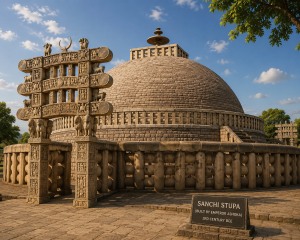
2. A Glimpse of Sanchi — साँची की झलक
2.1 What is Sanchi?
Sanchi एक छोटी सी hill पर बसा है, Bhopal से करीब 20 miles north-east में। यहाँ बौद्ध धर्म की सबसे magnificent structures हैं — stupas, gateways, और sculptures जो 2000 साल पहले बनाए गए थे।
Shahjehan Begum (ruled Bhopal, 1868-1901) और उनकी successor Sultan Jehan Begum ने Sanchi के preservation के लिए बहुत पैसा दिया। उन्होंने वह museum fund किया जहाँ John Marshall रहे और अपनी famous volumes लिखीं। उनकी kindness की वजह से ही आज Sanchi है!
2.2 The Significance of Sanchi — साँची क्यों महत्वपूर्ण है?
Sanchi की discovery ने early Buddhism को समझने में revolution ला दी। यहाँ की stone railings, gateways (toranas), और sculptures एक visual encyclopaedia हैं — जिसमें Buddha की life, Jataka tales, और donors के नाम सब कुछ carved है।
|
Teacher’s Tip: Sanchi vs Amaravati — दोनों को compare करो |
|
Sanchi: Survived! क्योंकि scholars ने in situ preservation की value समझी। |
|
Amaravati (Andhra Pradesh): 1796 में local raja ने ruins discover किये। 1854 में Walter Elliot ने sculptures को Madras ले गये (Elliot Marbles)। Slabs को Calcutta, Madras, London भेजा गया। |
|
H.H. Cole (archaeologist) ने protest किया: ‘It is suicidal and indefensible to allow the country to be looted of original works of ancient art.’ |
|
Sanchi survived कारण: 1818 में discovery के time तीन gateways खड़े थे — scholars ने value realise की और preservation chose की। |
3. The Background: Sacrifices and Debates — पृष्ठभूमि: यज्ञ और बहस
3.1 The Sacrificial Tradition — यज्ञ परम्परा
बच्चों, 600 BCE से पहले India में Vedic tradition dominant थी। Rigveda (c. 1500–1000 BCE) में हम देखते हैं Agni, Indra, Soma जैसे deities की prayers। यज्ञ (sacrifices) initially collective थे, बाद में household heads perform करते थे, और elaborate yajnas जैसे Rajasuya और Ashvamedha kings के लिए Brahmin priests conduct करते थे।
3.2 New Questions — Upanishads
6th century BCE onwards, Upanishads में नये questions उठे: rebirth, karma, moksha, the nature of ultimate reality (Brahman/Atman). Upanishads ने यज्ञ की supremacy को challenge किया।
|
Source 1: A Prayer to Agni (Rigveda) — NCERT Source |
|
‘Bring, O strong one, this sacrifice of ours to the gods; Bestow on us, O priest, abundant food.’ |
|
Teacher: इस prayer में material gains माँगे जा रहे हैं — cattle, sons, health। यही early Vedic religion की characteristic है। |
|
UPSC Angle: Vedic religion से Upanishadic philosophy की shift — ritual से introspection की ओर। |
3.3 Debates and Discussions — The Intellectual Ferment
Buddhist texts mention 64 sects or schools of thought जो kutogarashalas (हट जहाँ mendicants रुकते थे) में debate करते थे। Teachers place-to-place travel करते थे। Supporters किसी sect को grow or shrink कर सकते थे।
Mahavira और Buddha ने Vedas की authority को challenge किया। उन्होंने कहा: men and women can attain liberation through individual agency — birth से नहीं, karma और action से। यह Brahmanical position के बिल्कुल विपरीत था।
|
Source 3: Fatalists and Materialists — NCERT Source |
|
Makkhali Gosala (Ajivika tradition): Fatalist — everything is predetermined, karma matters not. |
|
Ajita Kesakambali (Lokayata): Materialist — no afterlife, no soul; human body dissolves into four elements at death. |
|
Teacher: इन texts का कोई original नहीं बचा — हम इन्हें सिर्फ Buddhist texts के through जानते हैं। यही historians की challenge है! |
|
UPSC MCQ Point: Lokayatas = Charvakas = Materialists. Ajivikas = Fatalists. |
4. Beyond Worldly Pleasures — Jainism
4.1 Core Philosophy of Jainism
Vardhamana Mahavira (6th century BCE) — Jainism का systematiser। लेकिन याद रखो, Jain tradition कहती है Mahavira से पहले 23 other tirthankaras थे (जो ‘guide men and women across the river of existence’)।
|
Jainism ke 5 Core Principles — Remember These! |
|
1. Ahimsa (Non-violence): Most important — entire world is animated, even stones and rocks. |
|
2. Satya (Truth): Do not lie. |
|
3. Asteya (Non-stealing): Do not steal. |
|
4. Brahmacharya (Celibacy): Jain monks and nuns observe celibacy. |
|
5. Aparigraha (Non-possession): Do not own property. |
|
EXTRA: Cycle of birth and rebirth through KARMA — Asceticism and penance break the karma chain. |
|
Monastic existence is a NECESSARY condition of salvation in Jainism. |
4.2 Spread of Jainism
Jainism gradually spread across India। Jain scholars ने Prakrit, Sanskrit, and Tamil में literature produce की। Manuscripts को libraries in temples में preserve किया गया। Earliest stone sculptures में Jain tirthankaras की images मिलती हैं।
|
Source 4: The World Beyond the Palace (Uttaradhyayana Sutta) |
|
Queen Kamalavati ने अपने husband को renounce world करने की कोशिश की: |
|
‘If the whole world and all its treasures were yours, you would not be satisfied… dhaamma alone will save you.’ |
|
Teacher: Notice — Jain texts में women भी wisdom और renunciation की advocate हैं। |
|
UPSC Angle: यह source Jain literature की nature — oral tradition, stories, persuasion — दिखाता है। |
5. The Buddha and the Quest for Enlightenment — बुद्ध
5.1 The Life of the Buddha
Siddhartha Gautama — the Buddha — was the son of a chief of the Sakya clan (c. 6th century BCE)। Palace में sheltered upbringing के बाद, एक day charioteer के साथ बाहर गये। पहली बार देखा: an old man, a sick man, and a corpse. Realisation: ‘The decay and deterioration of the human body is inevitable.’
उन्होंने palace छोड़ा। Bodily mortification की, near-death experience हुई। फिर — middle path। Several days of meditation। Enlightenment attained — became the Buddha, the Enlightened One. Rest of life: teaching dhamma (path of righteous living)।
5.2 The Teachings of the Buddha — बुद्ध की शिक्षाएँ
बच्चों, Buddha की teachings सबसे पहले Sutta Pitaka में preserved हैं। कुछ stories उनके miracles describe करती हैं, लेकिन more importantly — वे reason और persuasion से convince करते थे, supernatural power से नहीं।
|
Key Concept |
Explanation |
|
Anicca (Transience) |
World is transient (anicca) and constantly changing |
|
Anatta (Soullessness) |
World is soulless — there is nothing permanent or eternal in it |
|
Dukkha (Sorrow) |
Sorrow is intrinsic to human existence |
|
Middle Path |
Path of moderation between severe penance and self-indulgence |
|
Individual Agency |
Human beings can rise above worldly troubles through action |
|
God’s Existence |
In earliest Buddhism — whether or not god existed was IRRELEVANT |
|
Source 5: Buddhism in Practice (Sutta Pitaka) — NCERT Source |
|
Buddha’s advice to wealthy householder Sigala — 5 ways a master should look after servants and employees: assign work according to strength, supply food and wages, tend them in sickness, share delicacies, grant leave at times. |
|
Teacher: यह source दिखाता है कि Buddhism सिर्फ monks के लिए नहीं था — ordinary household life को भी ethical बनाने की कोशिश थी। |
|
Also: advice to sramanas (renouncers), to parents, teachers, and wife। |
|
UPSC Angle: Buddhist ethics = practical, social, applicable to everyday life। |
5.3 Why Did Buddhism Grow So Rapidly?
Buddhism grew rapidly both during the Buddha’s lifetime and after his death। यह appeal किया: (1) people dissatisfied with existing religious practices, (2) people confused by rapid social changes। Key values: metta (fellow feeling) and karuna (compassion) — especially for the younger and weaker। Buddha ने social world को divine origin नहीं माना — human creation माना। इसीलिए social transformation possible था।
6. Followers of the Buddha — बुद्ध के अनुयायी (Sangha)
6.1 The Sangha — संघ
Buddha ने एक sangha की स्थापना की — monks का organisation जो dhamma के teachers बने। These monks were called bhikkhus (living on alms, bowl to receive food once a day)।
Initially only men were allowed। Later, women were also admitted — through Ananda’s mediation। Buddha’s foster mother Mahapajapati Gotami was the first woman to be ordained as bhikkhuni। Many women who entered sangha became teachers of dhamma — known as theris (respected women who had attained liberation)।
|
Source 6: The Therigatha — NCERT Source |
|
A unique Buddhist text — part of the Sutta Pitaka — verses composed by bhikkhunis. |
|
Story of Punna (a dasi/slave woman): went daily to river for master’s water. Saw Brahmana performing bathing rituals. |
|
Punna challenged him: ‘Whoever told you you are freed from evil by washing in the water? In that case frogs and turtles would go to heaven!’ |
|
Teacher: This is RADICAL! एक दासी एक Brahmin को philosophical challenge दे रही है। यह Buddhism का egalitarian character दिखाता है। |
|
UPSC Angle: Therigatha = women’s voices in early Buddhism. Important for gender history questions. |
6.2 Rules for Monks and Nuns — Vinaya Pitaka
|
Source 7: Rules for Monks and Nuns (Vinaya Pitaka) — NCERT Source |
|
When a new felt (blanket/rug) is made by a bhikkhu, it must be kept for at least 6 years. |
|
Bhikkhu at a family residence may accept max 2-3 bowlfuls of food. |
|
Bhikkhu must not leave bedding belonging to sangha without putting it away. |
|
Teacher: ये rules बहुत practical हैं — community life को organised और disciplined रखने के लिए। Non-attachment to material things का principle हर rule में है। |
|
UPSC Angle: Vinaya Pitaka = monastic rules. Sutta Pitaka = Buddha’s teachings. Abhidhamma Pitaka = philosophical matters. |
6.3 Who Were the Buddha’s Followers?
Buddha के followers came from many social groups: wealthy men, gahapatis, humble folk — workers, slaves, craftspeople। Once within sangha, all were regarded as equal — shedding earlier social identities। Internal functioning = traditions of ganas and sanghas — consensus through discussion, voting if consensus failed।
7. Stupas — स्तूप
7.1 Origins of Sacred Sites
बच्चों, from earliest times, people tended to regard certain places as sacred — sites with special trees, unique rocks, awe-inspiring natural beauty। These sites with small shrines were called chaityas (may be derived from ‘chita’ meaning funeral pyre — hence a funerary mound)।
7.2 Why Were Stupas Built? — स्तूप क्यों बनाये गये?
|
Source 8: Why Were Stupas Built? (Mahaparinibbana Sutta) |
|
Ananda asked the dying Buddha: ‘What are we to do Lord with the remains of the Tathagata?’ |
|
Buddha replied: ‘Hinder not yourselves Ananda by honouring the remains of the Tathagata. Be zealous, be intent on your own good.’ |
|
When pressed: ‘At the four crossroads they should erect a thupa (stupa) to the Tathagata. And whosoever shall place garlands or perfume… shall long be to them for a profit and joy.’ |
|
Teacher: यह source दो things बताता है: (1) Buddha originally didn’t want elaborate rituals; (2) gradually relic worship developed as a community practice। |
|
UPSC Key Fact: The tradition may have been pre-Buddhist. Since they contained relics, stupas became venerated as an emblem of both the Buddha and Buddhism. |
Asoka distributed portions of the Buddha’s relics to every important town and ordered stupas to be built। By the 2nd century BCE, stupas at Bharhut, Sanchi, and Sarnath had been built।
7.3 How Were Stupas Built? — स्तूप कैसे बनाये गये?
Inscriptions on railings and pillars of stupas record donations: by kings (Satavahanas), by guilds (ivory workers funded one gateway at Sanchi), by hundreds of women and men — mentioning their names, occupations, place of origin। Bhikkhus and bhikkhunis भी contributed।
7.4 The Structure of the Stupa — स्तूप की संरचना
|
Part |
Meaning / Function |
|
Anda |
Semi-circular mound of earth (the main dome) |
|
Harmika |
Balcony-like structure on top — represented the abode of the gods |
|
Yashti |
A mast rising from the harmika |
|
Chhatra |
An umbrella surmounting the yashti |
|
Vedika |
Stone railings resembling bamboo/wooden fence |
|
Torana |
Richly carved gateways at the four cardinal points |
Worshippers entered through the eastern gateway और mound को clockwise direction में walk करते थे — imitating the sun’s course through the sky।
8. ‘Discovering’ Stupas — खोज और संरक्षण
8.1 The Fate of Amaravati
1796: A local raja found Amaravati ruins while wanting to build a temple। He decided to use the stone। 1854: Walter Elliot (Commissioner of Guntur) visited and collected sculpture panels — these came to be called Elliot Marbles. Slabs were taken to Calcutta, Madras, London। The Amaravati stupa was one of the largest and most magnificent Buddhist stupas — it was essentially destroyed by colonial period.
8.2 Why Did Sanchi Survive While Amaravati Did Not?
Sanchi was ‘discovered’ in 1818. Three of its four gateways were still standing। The French और English both wanted to take the eastern gateway — fortunately satisfied with plaster-cast copies. The rulers of Bhopal — Shahjehan Begum and Sultan Jehan Begum — provided money for preservation। John Marshall dedicated his important volumes on Sanchi to Sultan Jehan।
|
H.H. Cole’s Famous Statement — UPSC/CBSE Quote |
|
‘It seems to me a suicidal and indefensible policy to allow the country to be looted of original works of ancient art.’ |
|
Cole believed museums should have plaster-cast facsimiles, whereas the originals should remain where they were found (IN SITU). |
|
Teacher: यह quote बहुत important है — यह colonial India में heritage preservation की debate को represent करता है। |
9. Sculpture — मूर्तिकला
9.1 Stories in Stone — पत्थर में कहानियाँ
Sanchi की sculptures actually Jataka tales (stories from Buddha’s previous lives) depict करती हैं। उदाहरण: Figure 4.13 — पहली नजर में rural scene लगता है, लेकिन art historians ने identify किया — यह Vessantara Jataka है: a generous prince who gave away everything to a Brahmana, and went to live in forest with wife and children।
9.2 Symbols of Worship — Buddha के प्रतीक
Early Buddhist sculptors ने Buddha को human form में नहीं दिखाया। Instead, उन्होंने symbols use किये। क्यों? शायद Buddha की greatness को human form में represent करना adequate नहीं लगा।
|
Symbol |
Represents |
|
Empty seat |
Meditation of the Buddha |
|
Stupa |
Mahaparinibbana (death of Buddha) |
|
Wheel (Dharmachakra) |
First sermon at Sarnath |
|
Bodhi Tree |
Enlightenment (not just a tree — symbolises an event) |
|
Footprints |
Presence of the Buddha |
9.3 Popular Traditions — लोकप्रिय परम्पराएँ
Some sculptures at Sanchi were NOT directly inspired by Buddhist ideas. Famous example: Shalabhanjika — a woman whose touch caused trees to flower and bear fruit। यह pre-Buddhist tradition से है — an auspicious symbol integrated into the decoration।
Animals at Sanchi: elephants (strength and wisdom), horses, monkeys, cattle. Jataka tales में animal stories हैं। James Fergusson (earliest modern art historian) considered Sanchi to be a centre of tree and serpent worship — he had NOT read Buddhist literature! Teacher: यह एक important lesson है — art cannot always be understood without textual knowledge।
9.4 Paintings from the Past — Ajanta
Stone sculptures survive longer than paintings। But paintings भी थे — on cave walls। Most famous: Ajanta paintings (Maharashtra). These depict Jataka stories, courtly life, processions, men and women at work, festivals। Artists used shading technique to give a three-dimensional quality।
10. New Religious Traditions — नई धार्मिक धाराएँ
10.1 The Development of Mahayana Buddhism
By 1st century CE, changes in Buddhist ideas occurred। Early: Buddha = human being who attained enlightenment through his own efforts। New idea: the Buddha = a saviour figure who could ensure salvation। Simultaneously: Bodhisatta concept developed — deeply compassionate beings who accumulated merit but used it not to attain nibbana for themselves, but to help others।
|
Mahayana vs Hinayana/Theravada — UPSC MCQ Point |
|
Mahayana = ‘Great vehicle’ — salvation for all, Buddha as saviour, Bodhisattas |
|
Hinayana = ‘Lesser vehicle’ — term used by Mahayana supporters for the older tradition |
|
Theravada = ‘Those who followed the path of old, respected teachers, the theras’ — term used by followers of the older tradition THEMSELVES (not derogatory) |
|
Key: Followers of older tradition did NOT call themselves Hinayana — they called themselves Theravada. |
Arts Stream Jobs List with Salary in India 2026: 12वीं के बाद सरकारी और प्राइवेट नौकरियां
10.2 The Growth of Puranic Hinduism
The notion of a saviour was not unique to Buddhism। Similar ideas developed in Vaishnavism (principal deity: Vishnu) और Shaivism (chief god: Shiva)। Growing emphasis on: bhakti — love and devotion between devotee and god।
In Vaishnavism: cults developed around Vishnu’s ten avatars (forms assumed to save the world from disorder and evil)। Different avatars were probably popular in different parts of the country। Recognising each local deity as a form of Vishnu = creating a more unified religious tradition।
Shiva was symbolised by the linga, although occasionally represented in human form too। These sculptures depicted complex ideas about deities through symbols: head-dresses, ornaments, ayudhas (weapons or auspicious objects the deities hold)।
|
The Puranas — महत्वपूर्ण तथ्य |
|
Compiled by Brahmanas, c. middle of 1st millennium CE. |
|
Contained stories about gods and goddesses, composed in simple Sanskrit verse. |
|
Meant to be read aloud to everybody — including women and Shudras who did not have access to Vedic learning. |
|
Content evolved through interaction amongst people — priests, merchants, ordinary men and women travelling from place to place. |
|
Example: Vasudeva-Krishna worship — first important in Mathura region, then spread elsewhere. |
|
UPSC Key: Puranas are a PRIMARY source for understanding the growth of Vaishnavism and Shaivism. |
10.3 Building Temples — मन्दिर निर्माण
Around the time stupas at Sanchi were acquiring their present form, the first temples were also being built। Early temple = small square room called garbhagriha with a single doorway for the worshipper to enter and worship the image। Gradually: tall structure called shikhara was built over the central shrine।
Later temples became far more elaborate — assembly halls, huge walls and gateways, arrangements for supplying water। Some were hollowed out of huge rocks (artificial caves) — tradition going back to 3rd century BCE (Barabar caves in Bihar, built on Asoka’s orders for the Ajivika sect)।
This tradition culminated in 8th century CE in the carving of an entire temple — Kailashnatha Temple at Ellora — from a single piece of rock। A copperplate inscription records the amazement of the chief sculptor: ‘Oh how did I make it!’
11. Can We ‘See’ Everything? — क्या हम सब कुछ समझ सकते हैं?
11.1 Grappling with the Unfamiliar
19th-century European scholars first saw some sculptures of gods and goddesses। They were horrified by ‘grotesque’ figures with multiple arms and heads, or combinations of human and animal forms। They compared Indian sculpture with Greek art — favouring Greek art। They were excited by Buddha and Bodhisatta images from northwest (Taxila, Peshawar) because these looked more like Greek statues — from Indo-Greek kingdoms of 2nd century BCE।
Teacher: यह एक classic example है of ethnocentrism — judging one culture’s art by another culture’s standards। We should understand art within its own cultural context।
11.2 If Text and Image Do Not Match
Famous example: Rock-cut sculptural panel at Mahabalipuram (Tamil Nadu) (Figure 4.30)। It is clearly a vivid depiction of a story। But which story? Art historians are sharply divided:
- Some feel it depicts the descent of the river Ganga from heaven (natural cleft through rock = the river)
- Others feel it represents a story from the Mahabharata: Arjuna doing penance on the river bank to acquire arms — pointing to the central figure of an ascetic
Arts Stream Jobs List with Salary in India 2026: 12वीं के बाद सरकारी और प्राइवेट नौकरियां
Teacher: यह example दिखाता है कि एक ही sculpture के multiple interpretations हो सकते हैं। Art history = detective work! Text और image दोनों को साथ में study करना होता है।
|
NCERT Key Insight: Not Everything is Recorded! |
|
Many rituals, religious beliefs and practices were NOT recorded in a permanent visible form — as monuments, or sculpture, or even paintings. |
|
These included daily practices, as well as those associated with special occasions. |
|
Many communities and peoples may not have felt the need for keeping lasting records. |
|
The spectacular instances we have focused on in this chapter are JUST THE TIP OF THE ICEBERG. |
|
Teacher: इस paragraph को याद रखो! यह UPSC mains के लिए perfect opening line है। |
12. Important Timelines — समयरेखाएँ
12.1 Timeline 1: Major Religious Developments
|
Period |
Development |
|
c. 1500–1000 BCE |
Early Vedic traditions |
|
c. 1000–500 BCE |
Later Vedic traditions |
|
c. sixth century BCE |
Early Upanishads; Jainism, Buddhism |
|
c. third century BCE |
First stupas |
|
c. second century BCE |
Development of Mahayana Buddhism, Vaishnavism, Shaivism and goddess cults |
|
c. third century CE |
Earliest temples |
12.2 Timeline 2: Landmarks in Discovery and Preservation
|
Year |
Event |
|
1814 |
Founding of the Indian Museum, Calcutta |
|
1834 |
Publication of Essay on the Architecture of the Hindus by Ram Raja; Cunningham explores stupa at Sarnath |
|
1835–42 |
James Fergusson surveys major archaeological sites |
|
1851 |
Establishment of the Government Museum, Madras |
|
1854 |
Alexander Cunningham publishes Bhilsa Topes (on Sanchi) |
|
1878 |
Rajendra Lala Mitra publishes Buddha Gaya: The Heritage of Sakya Muni |
|
1880 |
H.H. Cole appointed Curator of Ancient Monuments |
|
1888 |
Passing of the Treasure Trove Act — giving government right to acquire all objects of archaeological interest |
|
1914 |
John Marshall and Alfred Foucher publish The Monuments of Sanchi |
|
1923 |
John Marshall publishes the Conservation Manual |
|
1955 |
Prime Minister Jawaharlal Nehru lays the foundation stone of the National Museum, New Delhi |
|
1989 |
Sanchi declared a World Heritage Site |
13. Solved NCERT Exercises — हल किए गये अभ्यास प्रश्न
बच्चों, नीचे सभी NCERT exercise questions के detailed answers दिये गये हैं। Answer in 100–150 Words section और Write a Short Essay (about 500 Words) section — दोनों को cover किया गया है।
A. Answer in 100–150 Words
|
Q1. Were the ideas of the Upanishadic thinkers different from those of the fatalists and materialists? Give reasons for your answer. |
|
Ans. Ans. हाँ, Upanishadic thinkers, fatalists, और materialists के ideas बिल्कुल अलग थे। Upanishadic Thinkers believed in the existence of an individual soul (atman) and a universal soul (Brahman). They sought to understand the relationship between atman and Brahman as the path to liberation (moksha). Rebirth, karma, and the cycle of samsara were central to their thought. The Upanishads encouraged introspection and philosophical inquiry. Fatalists (Ajivikas, led by Makkhali Gosala) believed that everything is predetermined. Neither karma nor effort can change one’s destiny. Pleasure and pain are measured out as it were in a ball of string — they will run their course. Materialists (Lokayatas/Charvakas, like Ajita Kesakambali) denied the existence of the soul, afterlife, or any spiritual reality. They believed the human body is made of four elements. There is no karma, no rebirth, no merit in giving gifts. In contrast, Upanishadic thinkers affirmed both the soul and the possibility of liberation through knowledge. Fatalists denied individual agency; Upanishadic thinkers affirmed it. Materialists denied metaphysical reality; Upanishadic thinkers affirmed it. |
Complete NCERT Class 12 History Chapter 2: Kings Farmers and Towns Notes in Hindi | UPSC & PSC
|
Q2. Summarise the central teachings of Jainism. |
|
Ans. Ans. Jainism की central teachings Mahavira ने 6th century BCE में systematise कीं, though the tradition is older। 1. Ahimsa (Non-violence): The entire world is animated — stones, rocks, water, fire have life. Non-injury to all living beings is central. 2. Karma and Rebirth: The cycle of birth and rebirth is shaped through karma. Actions determine future existence. 3. Asceticism and Penance: Required to free oneself from the cycle of karma. Monastic existence is a necessary condition of salvation. 4. Five Vows for Monks/Nuns: (i) Ahimsa — non-killing; (ii) Satya — non-lying; (iii) Asteya — non-stealing; (iv) Brahmacharya — celibacy; (v) Aparigraha — non-possession. 5. Individual Salvation through Own Effort: No god can help; liberation comes only through renunciation of the world and one’s own penance. Jainism spread gradually across India, with scholars producing literature in Prakrit, Sanskrit, and Tamil. |
|
Q3. Discuss the role of the begums of Bhopal in preserving the stupa at Sanchi. |
|
Ans. Ans. The begums of Bhopal played a crucial role in preserving Sanchi for future generations. Shahjehan Begum (ruled 1868–1901) and her successor Sultan Jehan Begum provided money for the preservation of the ancient site of Sanchi. When 19th-century Europeans — both French and English — wanted to take away the eastern gateway (the best preserved) to museums in France and London respectively, the begums ensured both were satisfied with plaster-cast copies. The original remained at the site as part of the Bhopal state. Sultan Jehan Begum funded the museum that was built at Sanchi, the guesthouse where John Marshall lived and wrote his volumes, and the publication of his important work. John Marshall dedicated his volumes on Sanchi to Sultan Jehan. Their patronage was crucial: without it, the stupa complex might have been dismantled like Amaravati. Today, Sanchi stands as a World Heritage Site, a testament to their wise stewardship. |
Complete NCERT Class 12 History Chapter 2: Kings Farmers and Towns Notes in Hindi | UPSC & PSC
|
Q4. Read this short inscription and answer:’In the year 33 of the maharaja Huvishka (a Kushana ruler), in the first month of the hot season on the eighth day, a Bodhisatta was set up at Madhuvana by the Mikkhuni Dhanavati, the sister’s daughter of the Mikkhuni Buddhamita, who knows the Tipitaka, the female pupil of the bhikkhu Bala, who knows the Tipitaka, together with her father and mother.'(a) How did Dhanavati date her inscription? (b) Why do you think she installed an image of the Bodhisatta? (c) Who were the relatives she mentioned? (d) What Buddhist text did she know? (e) From whom did she learn this text? |
|
Ans. (a) How did Dhanavati date her inscription? Dhanavati dated her inscription by the regnal year of the ruler, maharaja Huvishka (a Kushana king): ‘In the year 33 of the maharaja Huvishka.’ She also specified the month (first month of the hot season) and the day (eighth day). This is a typical dating method in ancient Indian inscriptions — regnal year dating. (b) Why do you think she installed an image of the Bodhisatta? Dhanavati likely installed the image of the Bodhisatta as an act of devotion and piety, to accumulate merit (punya). In Mahayana Buddhist tradition, the Bodhisatta was regarded as a compassionate being who could help devotees attain liberation. Installing such an image at a sacred place (Madhuvana) would be seen as a meritorious act benefitting herself and her family. It was also a way of publicly expressing her Buddhist identity and learning. (c) Who were the relatives she mentioned? Dhanavati mentioned: (i) her maternal aunt — Mikkhuni Buddhamita (a bhikkhuni who knew the Tipitaka); (ii) her father; (iii) her mother. (d) What Buddhist text did she know? She knew the Tipitaka — the three baskets of Buddhist literature: Vinaya Pitaka (monastic rules), Sutta Pitaka (Buddha’s teachings), and Abhidhamma Pitaka (philosophical matters). (e) From whom did she learn this text? She learnt the Tipitaka from bhikkhu Bala — who is described as a male monk also knowledgeable in the Tipitaka. This is significant because it shows a female disciple learning from a male teacher — cross-gender transmission of knowledge within the Buddhist community. It also shows women had access to high-level Buddhist education. |
|
Q5. Why do you think women and men joined the sangha? |
|
Ans. Ans. Several reasons drew both women and men to the Buddhist sangha: For Men: (i) Dissatisfaction with existing Brahmanical religious practices that emphasised birth-based hierarchy; (ii) The Buddhist emphasis on individual agency and equality within the sangha; (iii) The appeal of metta (fellow feeling) and karuna (compassion) as values; (iv) The rapid social changes of the period created uncertainty, and the sangha offered a structured, purposeful community life. For Women (like Punna, Mahapajapati Gotami): (i) The sangha offered liberation from the restrictive social roles imposed on women in Brahmanical society; (ii) Women could become bhikkhunis (ordained nuns), achieve learning, and even become theris (respected teachers of dhamma); (iii) The Therigatha shows that women composed learned verses and could challenge even Brahmanas in philosophical debate; (iv) A dasi (slave woman) like Punna could find social equality and spiritual dignity in the sangha that was impossible outside it. The sangha was genuinely radical for its time: it accepted people from all social groups and treated them as equals once within the community. |
Harappan Civilisation Notes Class 12: NCERT Chapter Summary with PYQs
B. Write a Short Essay (about 500 Words)
|
Q6. To what extent does knowledge of Buddhist literature help in understanding the sculpture at Sanchi? |
|
Ans. Ans. (Short Essay — approximately 500 words) Introduction: The sculpture at Sanchi is one of the richest visual archives of ancient India. At first glance, many of these sculptures appear to be mere decorative panels — depicting rural scenes, animals, women at trees, and processions. However, knowledge of Buddhist literature transforms our understanding of these sculptures entirely, revealing them as carefully coded narratives. Symbols That Need Textual Interpretation: One of the most crucial contributions of Buddhist textual knowledge is the ability to decode symbols. Early Buddhist sculptors did not depict the Buddha in human form. Instead, they used symbols: an empty seat (meditation), a stupa (mahaparinibbana), a wheel/dharmachakra (first sermon at Sarnath), a bodhi tree (enlightenment), and footprints (presence). Without knowledge of the Sutta Pitaka and hagiographies, a viewer would see a tree, a wheel, or an empty throne — and not understand what they represent. Jataka Tales and Narrative Panels: Many narrative panels at Sanchi depict Jataka tales — stories of the Buddha’s previous lives. Figure 4.13, for instance, appears to show a rural scene with thatched huts and trees. But art historians, using knowledge of the Jataka literature, identified it as the Vessantara Jataka — the story of a generous prince who gave away everything to a Brahmana. Without this literary background, the sculpture would remain a pleasant countryside scene, its deeper meaning entirely lost. Popular Traditions and Their Textual Backdrop: Some sculptures at Sanchi draw not from Buddhist texts but from pre-Buddhist popular traditions. The shalabhanjika (a woman whose touch causes trees to flower) is an example of an auspicious symbol from folk traditions integrated into Buddhist art. James Fergusson, the earliest modern art historian to study Sanchi, concluded it was a centre of tree and serpent worship because he had not read Buddhist literature. This error illustrates the risk of interpreting art without textual knowledge. Limitations: Not Everything Can Be Decoded: At the same time, knowledge of Buddhist literature does not always resolve interpretive debates. The famous rock-cut panel at Mahabalipuram remains disputed: some scholars, drawing on the Puranas and epics, see the descent of the Ganga; others, drawing on the Mahabharata, see Arjuna doing penance. Both readings are textually supported. This shows that while literature guides interpretation, it does not always produce a single definitive answer. Conclusion: Knowledge of Buddhist literature is essential for understanding Sanchi’s sculpture, from decoding symbolic representations of the Buddha to identifying Jataka narratives and understanding the integration of popular traditions. However, scholars must also be aware that (i) popular traditions that were NOT recorded in texts also shaped art; (ii) multiple texts may support multiple readings; and (iii) as the NCERT aptly notes, the monuments we study are merely ‘the tip of the iceberg’ of a much richer religious and artistic life that left no permanent record. |
Harappan Civilisation Notes Class 12: NCERT Chapter Summary with PYQs
|
Q8. Discuss the development in sculpture and architecture associated with the rise of Vaishnavism and Shaivism. |
|
Ans. Ans. (Short Essay) Introduction: The rise of Vaishnavism and Shaivism from c. second century BCE onwards was accompanied by remarkable developments in sculpture and temple architecture. These new religious traditions required physical spaces for worship and visual representations of their deities, leading to innovative artistic traditions. Sculptural Representation: Vishnu was depicted in various avatar forms. The ten avatars included figures like the Varaha (boar) avatar — Vishnu rescuing the earth goddess — depicted in a magnificent sculpture at Aihole, Karnataka (c. sixth century CE). Shiva was symbolised primarily by the linga, though he was also depicted in human form. Complex iconographic conventions developed: deities were identified through specific head-dresses, ornaments, and ayudhas (weapons or auspicious objects). For example, Vishnu holds the chakra and shankha; Shiva is identifiable by the trishul and matted hair. Durga and Goddess Cults: Images of Durga at Mahabalipuram (Tamil Nadu, c. sixth century CE) show the growth of goddess cults. These sculptures depicted complex ideas about divine power through movement, proportion, and symbolic attributes. Temple Architecture: The first temples to house images of gods and goddesses were small structures with a garbhagriha (a small square room for the deity’s image) and a single entrance. Gradually, a shikhara was added over the central shrine. The Deogarh temple (Uttar Pradesh, c. fifth century CE) is an excellent example of early temple architecture with a shikhara. Temple walls were decorated with sculpture. Later Developments: Temples became increasingly elaborate with assembly halls, huge walls and gateways, and arrangements for supplying water. Cave temples were also built — initially for Ajivikas in Barabar (Bihar, 3rd century BCE), and later the magnificent Kailashnatha Temple at Ellora (8th century CE), carved entirely from a single rock. Conclusion: The development of Vaishnavism and Shaivism thus transformed the visual and architectural landscape of India, creating a rich tradition of iconography and temple building that continues to influence Indian art to this day. |
|
Q9. Discuss how and why stupas were built. |
|
Ans. Ans. (Short Essay) Why Stupas Were Built: Stupas originated from a pre-Buddhist tradition of regarding certain natural sites as sacred. They came to be especially associated with Buddhism because they contained relics of the Buddha — his bodily remains or objects used by him. These mounds became venerated as emblems of both the Buddha and Buddhism. According to the Ashokavadana, Asoka distributed portions of the Buddha’s relics to every important town and ordered construction of stupas over them. By the second century BCE, stupas at Bharhut, Sanchi, and Sarnath had been built. Stupas were also built over the remains of other revered teachers and at places associated with events in the Buddha’s life (Lumbini, Bodh Gaya, Kusinagara, Sarnath). How Stupas Were Built: Inscriptions on railings and pillars record a wide range of donors: kings (Satavahanas contributed several gateways), guilds (ivory workers financed part of a gateway at Sanchi), and hundreds of ordinary women and men who mentioned their names, occupations, and places of origin. Bhikkhus and bhikkhunis also contributed. This diversity of donors shows that stupa building was a truly community enterprise, with people from many social groups participating. Structure: The stupa began as a simple semi-circular mound (anda) of earth. Over time it evolved: above the anda was the harmika (representing the abode of the gods), from which rose a yashti (mast) surmounted by a chhatra (umbrella). Around the mound was a vedika (stone railing) resembling bamboo/wooden fences, with richly carved toranas (gateways) at the four cardinal points. Worshippers entered through the eastern gateway and circumambulated the mound clockwise, imitating the sun’s course. Conclusion: Stupas were thus built as acts of devotion and merit-making, drawing on a mix of pre-Buddhist sacred site traditions and specifically Buddhist relic veneration. They are among the most important monuments of early Indian history. |
14. Glossary — शब्दकोश
|
Term |
Meaning |
|
Ahimsa (अहिंसा) |
Non-violence — central to Jainism |
|
Anda (अण्ड) |
The dome of a stupa |
|
Atman (आत्मन्) |
Individual soul — Upanishadic concept |
|
Ayudha (आयुध) |
Weapons/auspicious objects held by deities in sculpture |
|
Bhakti (भक्ति) |
Devotion and love towards a god — central to Vaishnavism and Shaivism |
|
Bhikkhu (भिक्खु) |
Buddhist monk (male) |
|
Bhikkhuni (भिक्खुनी) |
Buddhist nun (female) |
|
Bodhisatta (बोधिसत्त) |
In Mahayana: compassionate being who helps others attain liberation |
|
Brahman (ब्रह्मन्) |
Universal soul/ultimate reality — Upanishadic concept |
|
Chaitya (चैत्य) |
Sacred site; funerary mound; Buddhist sacred building |
|
Dharma/Dhamma (धर्म/धम्म) |
Path of righteous living (used in Buddhism) |
|
Dukkha (दुक्ख) |
Sorrow — intrinsic to human existence in Buddhist thought |
|
Garbhagriha (गर्भगृह) |
The inner sanctum/shrine room of a temple |
|
Harmika (हर्मिका) |
Balcony-like structure atop a stupa representing the abode of the gods |
|
Hagiography (हागियोग्राफी) |
Biography of a saint or religious leader |
|
In Situ (इन सीटू) |
Latin: on the spot — preserving artefacts where they were found |
|
Jataka (जातक) |
Stories of the Buddha’s previous lives |
|
Karma (कर्म) |
Action; determines cycle of rebirth |
|
Karuna (करुणा) |
Compassion — a key Buddhist value |
|
Kutogarashala |
Hut with a pointed roof; where travelling mendicants halted for debates |
|
Linga (लिंग) |
Symbol of Shiva |
|
Mahaparinibbana |
The death (and final liberation) of the Buddha |
|
Metta (मेत्ता) |
Fellow feeling — a key Buddhist value |
|
Moksha (मोक्ष) |
Liberation from the cycle of rebirth |
|
Nibbana/Nirvana (निब्बान) |
Extinguishing of ego and desire; liberation |
|
Sangha (संघ) |
Community of Buddhist monks and nuns |
|
Shalabhanjika (शालभञ्जिका) |
A woman whose touch causes trees to flower — auspicious pre-Buddhist motif |
|
Shikhara (शिखर) |
Tall tower built over the central shrine of a temple |
|
Sutta Pitaka (सुत्त पिटक) |
Buddhist scripture containing the Buddha’s teachings |
|
Theri (थेरी) |
Respected women bhikkhunis who attained liberation |
|
Tipitaka (तिपिटक) |
The three baskets — the canon of Buddhist literature |
|
Tirthankara (तीर्थंकर) |
Jain teachers — literally ‘those who guide men and women across the river of existence’ |
|
Torana (तोरण) |
Richly carved gateway to a stupa |
|
Vedika (वेदिका) |
Stone railing around a stupa |
|
Vinaya Pitaka (विनय पिटक) |
Buddhist scripture containing monastic rules |
|
Yashti (यष्टि) |
Mast rising from the harmika of a stupa |
15. Quick Memory Aids — Mnemonics
15.1 The Three Pitakas — ‘VSA’
|
VSA = Vinaya, Sutta, Abhidhamma |
|
V = Vinaya Pitaka — Monastic Rules (V for Very disciplined monks) |
|
S = Sutta Pitaka — Buddha’s Teachings (S for Stories/Suttas) |
|
A = Abhidhamma Pitaka — Philosophical Matters (A for Abstract philosophy) |
15.2 Jain Five Vows — ‘ASSAB’
|
ASSAB = Ahimsa, Satya, Steya (asteya), Abstinence (brahmacharya), Aparigraha |
|
A = Ahimsa (non-violence) |
|
S = Satya (truth) |
|
S = Asteya (non-stealing) |
|
A = Aparigraha (non-possession) |
|
B = Brahmacharya (celibacy) |
15.3 Key UPSC/CBSE Points to Never Forget
- Sanchi survived; Amaravati did not.
- H.H. Cole advocated IN SITU preservation.
- Shahjehan Begum and Sultan Jehan Begum of Bhopal preserved Sanchi.
- Stupas were built with donations from kings, guilds, ordinary people, and monks.
- Early Buddhist sculpture did NOT show Buddha in human form — used symbols.
- Therigatha = Buddhist text with verses by bhikkhunis (women monks).
- Mahayana = new form of Buddhism with Buddha as saviour + Bodhisatta concept.
- Theravada = what Hinayana followers called THEMSELVES (not a derogatory term).
- Garbhagriha = inner sanctum of temple. Shikhara = tower above garbhagriha.
- Kailashnatha at Ellora = carved from a SINGLE piece of rock, 8th century CE.
- Puranas = compiled by Brahmanas, 1st millennium CE, in simple Sanskrit, for all, including women and Shudras.
Faq Questions and Answers of Thinkers, Beliefs and Buildings (Class 12 History Chapter 4
1. Thinkers, Beliefs and Buildings अध्याय किस बारे में है?
उत्तर:
बच्चों, यह अध्याय लगभग 600 ईसा पूर्व से 600 ईस्वी तक भारत में हुए धार्मिक, दार्शनिक और सांस्कृतिक परिवर्तनों को समझाता है। इसमें उपनिषदों, जैन धर्म, बौद्ध धर्म, स्तूपों, मंदिरों और धार्मिक विचारों के विकास का अध्ययन किया गया है।
2. उपनिषदों का मुख्य संदेश क्या था?
उत्तर:
उपनिषदों में आत्मा, ब्रह्म, कर्म, पुनर्जन्म और मोक्ष जैसे महत्वपूर्ण विषयों पर चर्चा की गई है। इनके विचारकों का मानना था कि केवल यज्ञ करने से नहीं, बल्कि ज्ञान और आत्मचिंतन से जीवन के सत्य को समझा जा सकता है।
3. महावीर कौन थे और उनका योगदान क्या था?
उत्तर:
महावीर जैन धर्म के 24वें तीर्थंकर थे। उन्होंने अहिंसा, सत्य, अस्तेय, ब्रह्मचर्य और अपरिग्रह जैसे सिद्धांतों पर जोर दिया। उनके उपदेशों ने जैन धर्म को व्यवस्थित रूप दिया और लोगों को सादगी तथा आत्मसंयम का मार्ग दिखाया।
4. गौतम बुद्ध को ज्ञान कैसे प्राप्त हुआ?
उत्तर:
राजकुमार सिद्धार्थ गौतम ने संसार के दुःखों को देखकर राजमहल छोड़ दिया। कई वर्षों तक साधना और ध्यान करने के बाद उन्हें बोधगया में ज्ञान प्राप्त हुआ। इसके बाद वे ‘बुद्ध’ कहलाए और लोगों को धम्म का उपदेश देने लगे।
5. बुद्ध की प्रमुख शिक्षाएँ क्या थीं?
उत्तर:
बुद्ध ने बताया कि संसार में दुःख है, लेकिन उससे मुक्ति भी संभव है। उन्होंने मध्यम मार्ग, करुणा, अहिंसा और आत्मानुशासन पर बल दिया। उनका मानना था कि मनुष्य अपने कर्मों और प्रयासों से जीवन को बेहतर बना सकता है।
6. बौद्ध संघ (Sangha) क्या था?
उत्तर:
संघ बौद्ध भिक्षुओं और भिक्षुणियों का संगठन था। इसका उद्देश्य बुद्ध के उपदेशों का प्रचार करना और अनुशासित धार्मिक जीवन जीना था। संघ में विभिन्न सामाजिक वर्गों के लोगों को स्थान मिलता था।
7. स्तूप क्यों बनाए जाते थे?
उत्तर:
स्तूप बौद्ध धर्म के महत्वपूर्ण स्मारक थे। इनमें बुद्ध या अन्य पूजनीय व्यक्तियों के अवशेष सुरक्षित रखे जाते थे। श्रद्धालु इनकी पूजा करते थे और इन्हें श्रद्धा तथा स्मरण के प्रतीक के रूप में देखते थे।
8. साँची स्तूप का ऐतिहासिक महत्व क्या है?
उत्तर:
साँची भारत के सबसे प्रसिद्ध बौद्ध स्थलों में से एक है। यहाँ के स्तूप, तोरण द्वार और मूर्तिकला प्राचीन भारतीय कला और वास्तुकला के उत्कृष्ट उदाहरण हैं। यही कारण है कि साँची को विश्व धरोहर स्थल का दर्जा प्राप्त है।
9. महायान बौद्ध धर्म क्या है?
उत्तर:
महायान बौद्ध धर्म की वह शाखा है जिसमें बुद्ध को एक महान उद्धारकर्ता के रूप में देखा गया। इस परंपरा में बोधिसत्त्वों की भूमिका महत्वपूर्ण मानी जाती है, जो दूसरों की मुक्ति में सहायता करने का प्रयास करते हैं।
10. वैष्णव और शैव परम्पराओं के विकास से क्या परिवर्तन हुए?
उत्तर:
वैष्णव और शैव परम्पराओं के विकास के साथ मंदिर निर्माण और मूर्तिकला का तेजी से विकास हुआ। विष्णु, शिव और अन्य देवी-देवताओं की प्रतिमाएँ बनाई गईं तथा भक्ति की भावना को विशेष महत्व मिला। इससे भारतीय कला और संस्कृति को नई दिशा मिली।
Thinkers, Beliefs and Buildings Notes Class 12 PDF H.M Download
Thinkers, Beliefs and Buildings Notes Class 12 PDF EM Download
All the Best! — आपको शुभकामनाएँ!