


Structure of Atom Class 11 Notes in Hindi | Atomic Structure NCERT for NEET & JEE
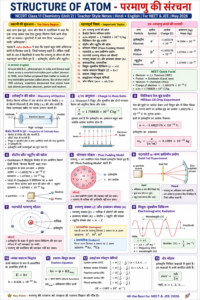
Structure of Atom Class 11 – परमाणु की संरचना
Book DOWNLOAD
Let’s understand atoms like a story. सोचो कि हर चीज़ LEGO के छोटे-छोटे टुकड़ों से बनी है।
In British English: Imagine everything around you is made of tiny building blocks called atoms. पुराने ज़माने में लोग सोचते थे कि atom को तोड़ा नहीं जा सकता। But later we found atoms have their own small parts inside.
उप-परमाणु कणों की खोज | Discovery of Sub-Atomic Particles
Electron की कहानी | Story of Electron
परमाणु की संरचना – Structure of Atom
NCERT Class 11 Chemistry Unit 2 के आधार पर
Teacher Style Notes – Hindi (Devanagari) + British English
Word Count: ~3000 | For Bhopal Students | May 2026
कहानी की शुरुआत – Structure of Atom Class 11
बेटा, आज हम एक बहुत छोटी सी दुनिया की सैर पर चलते हैं। इतनी छोटी कि तुम्हारी आँख उसे देख ही नहीं सकती।
मान लो तुम एक सेब को चाकू से काट रहे हो। आधा किया, फिर उस आधे का आधा, फिर उसका भी आधा।
क्या तुम इसे हमेशा काटते रह सकते हो? 400 साल ईसा पूर्व, भारत और ग्रीस के दार्शनिकों ने कहा – नहीं!
एक जगह आकर एक ऐसा टुकड़ा मिलेगा जिसे आगे तोड़ा नहीं जा सकता। यूनानियों ने उसे नाम दिया ‘atomos’ – यानी ‘अविभाज्य’।
लेकिन कहानी यहीं खत्म नहीं हुई।1808 में अंग्रेज़ वैज्ञानिक John Dalton ने एक नया विचार प्रस्तुत किया। उन्होंने कहा कि पदार्थ बहुत छोटे अविभाज्य कणों से मिलकर बना है, जिन्हें परमाणु कहते हैं।। उन्होंने कहा, ‘परमाणु एक ठोस, सबसे छोटी गेंद है।
एक तत्व के सारे परमाणु एक जैसे होते हैं।’ उनका नियम चल गया। पर फिर 19वीं सदी के अंत में वैज्ञानिकों ने शीशे की ट्यूब में बिजली दौड़ाई,
और पता चला – अरे! परमाणु तो खुद भी टूटता है। वैज्ञानिकों ने पाया कि परमाणु के भीतर भी तीन महत्वपूर्ण कण छिपे हुए हैं — इलेक्ट्रॉन, प्रोटॉन और न्यूट्रॉन।
आज हम इन तीनों उप-परमाणु कणों की खोज और गुणों को समझेंगे।
Story in British English
Let us begin our journey, dear student, into a world so tiny that your eyes cannot see it.
Imagine you are cutting an apple with a knife. You halve it, then halve the half, and so on.
Can you keep cutting forever? Around 400 B.C., philosophers in India and Greece said ‘No!’
There comes a smallest piece that cannot be divided further. The Greeks named it ‘atomos’, meaning ‘indivisible’.
But the tale did not end there. In 1808, a schoolteacher named John Dalton proposed that atoms are solid, indivisible spheres.
All atoms of one element are identical, he said. His idea explained many things. Yet, towards the end of the 19th century,
scientists passed electricity through glass tubes and discovered something shocking – the atom itself has pieces inside it.
Three sub-atomic particles were hiding: the electron, the proton, and the neutron. Today, we shall investigate these three.
महत्वपूर्ण विषय – Important Topics
- 1. उप-परमाणु कणों की खोज – Discovery of Electron, Proton, Neutron
- 2. कैथोड किरण नलिका प्रयोग – Cathode Ray Tube Experiment by J.J. Thomson
- 3. आवेश/द्रव्यमान अनुपात e/m = 1.758820 × 10^11 C/kg
- 4. मिलिकन तेल बूंद प्रयोग – Charge of electron = 1.602176 × 10^-19 C
- 5. प्रोटॉन और न्यूट्रॉन की खोज – Canal rays, Chadwick 1932
- 6. थॉमसन मॉडल – Plum Pudding Model
- 7. रदरफोर्ड α-कण प्रकीर्णन प्रयोग – Gold Foil Experiment
- 8. रदरफोर्ड परमाणु मॉडल – Nucleus concept, Drawbacks
- 9. परमाणु संख्या Z और द्रव्यमान संख्या A – Atomic Number & Mass Number
- 10. समस्थानिक, समभारिक – Isotopes, Isobars
- 11. विद्युत-चुंबकीय विकिरण – Electromagnetic Radiation, c=νλ और: ν~=λ1
- 12. प्लांक क्वांटम सिद्धांत – E = hν, h = 6.626 × 10^-34 Js
- 13. प्रकाश-विद्युत प्रभाव – Photoelectric Effect, Einstein Equation
- 14. हाइड्रोजन स्पेक्ट्रम – Lyman, Balmer, Paschen, Brackett, Pfund Series
- 15. बोर मॉडल – Bohr’s Model, mvr = n h/2π
1. इलेक्ट्रॉन की खोज – Discovery of Electron
साल 1850 के आस-पास, वैज्ञानिक एक खाली काँच की नली लेते थे, जिसे ‘कैथोड किरण नलिका’ कहते हैं।
इसके दो सिरों पर धातु की प्लेट लगाते थे – एक को कैथोड (ऋण सिरा) और दूसरे को ऐनोड (धन सिरा)।
जब हवा निकालकर बहुत कम दाब पर तेज़ बिजली दी गई, तो कैथोड से एक किरण निकली और ऐनोड की तरफ भागी।
जब रास्ते में जिंक सल्फाइड की स्क्रीन लगाई, तो वहाँ चमक पैदा हो गई।
Around 1850, scientists used a partially evacuated glass tube called a ‘cathode ray discharge tube’.
It had two metal plates: the cathode, negative, and the anode, positive. At very low pressure and high voltage,
rays started from the cathode and moved towards the anode. When a zinc sulphide screen was placed, a bright spot appeared.
कैथोड किरणों के गुण – Properties of Cathode Rays
- कैथोड से निकलकर ऐनोड की तरफ चलती हैं – They travel from cathode to anode.
- सीधी रेखा में चलती हैं – They travel in straight lines.
- विद्युत और चुंबकीय क्षेत्र में ऋण आवेशित कण की तरह मुड़ती हैं – Deflected by electric and magnetic fields like negative particles.
- ये कण इलेक्ट्रॉन हैं – These particles are electrons.
- इलेक्ट्रॉन सभी परमाणुओं का मूल भाग है – Electrons are a basic constituent of all atoms.
2. इलेक्ट्रॉन का e/m अनुपात – Charge to Mass Ratio
1897 में ब्रिटिश वैज्ञानिक J.J. Thomson ने सोचा – ‘अगर ये किरणें कण हैं, तो इनका आवेश और द्रव्यमान कितना है?’
उन्होंने विद्युत और चुंबकीय क्षेत्र दोनों लगाए और किरण को संतुलित किया। नापने पर मिला: e/m = 1.758820 × 10^11 C/kg।
इसका मतलब इलेक्ट्रॉन बहुत हल्का है, पर आवेश बहुत ज़्यादा।
3. इलेक्ट्रॉन का आवेश – Millikan Oil Drop Experiment
R.A. Millikan ने 1906-1914 में तेल की छोटी बूंदों को हवा में लटकाया। ऊपर धन प्लेट, नीचे ऋण प्लेट।
X-ray से बूंदों पर आवेश आया। विद्युत क्षेत्र बदलकर बूंद को स्थिर किया। हिसाब लगाया तो हर बार आवेश 1.6 × 10^-19 C का गुणज आया।
इससे सिद्ध हुआ कि आवेश ‘quantised’ है। इलेक्ट्रॉन का आवेश = -1.602176 × 10^-19 C। फिर द्रव्यमान निकाला: me = e / (e/m) = 9.1094 × 10^-31 kg।
4. प्रोटॉन और न्यूट्रॉन – Protons and Neutrons
जब कैथोड किरण नलिका में छेद वाला कैथोड लगाया, तो एनोड के पीछे दूसरी किरण दिखी। ये धन आवेशित किरणें थीं — इन्हें ‘कैनाल किरणें’ कहा गया।
इनका द्रव्यमान गैस पर निर्भर करता था। हाइड्रोजन से सबसे हल्का धन कण मिला – प्रोटॉन, आवेश +1.602176 × 10^-19 C, द्रव्यमान 1.67262 × 10^-27 kg।
1932 में Chadwick ने बेरिलियम पर α-कण मारे। एक बिना आवेश का कण निकला – न्यूट्रॉन, द्रव्यमान 1.67493 × 10^-27 kg।
तीनों कणों की तुलना – Table 2.1 Properties of Fundamental Particles
|
Name नाम |
Symbol प्रतीक |
Absolute charge/C |
Relative charge |
Mass/kg |
Mass/u |
|
Electron इलेक्ट्रॉन |
e |
-1.602176×10^-19 |
-1 |
9.109382×10^-31 |
0.00054 |
|
Proton प्रोटॉन |
p |
+1.602176×10^-19 |
+1 |
1.6726216×10^-27 |
1.00727 |
|
Neutron न्यूट्रॉन |
n |
0 |
0 |
1.674927×10^-27 |
1.00867 |
5. थॉमसन मॉडल – Thomson Model of Atom
J.J. Thomson ने 1898 में कहा: ‘Plum Pudding Model में परमाणु को धन आवेशित गोले की तरह माना गया जिसमें इलेक्ट्रॉन छोटे-छोटे कणों के रूप में embedded थे। लाल गूदा धन आवेश है, और काले बीज इलेक्ट्रॉन हैं।’
इसे ‘Plum Pudding Model’ भी कहते हैं। इसमें धन आवेश पूरे गोले में फैला है और इलेक्ट्रॉन उसमें धँसे हैं।
यह मॉडल परमाणु को उदासीन तो बताता है, पर रदरफोर्ड के प्रयोग में फेल हो गया।
6. रदरफोर्ड का प्रयोग – Rutherford Gold Foil Experiment
Rutherford ने पतली सोने की पन्नी पर α-कण, जो हीलियम के नाभिक हैं और धन आवेशित हैं, बरसाए।
सोचा था कि थॉमसन मॉडल के अनुसार सारे कण सीधे निकल जाएँगे। पर परिणाम चौंकाने वाला था:
1. अधिकतर α-कण सीधे निकल गए – मतलब परमाणु का ज़्यादातर भाग खाली है।
2. कुछ कण थोड़े कोण से मुड़े – मतलब कहीं धन आवेश केंद्रित है।
3. 20000 में से 1 कण वापस टकराकर आ गया – मतलब धन आवेश और द्रव्यमान बहुत छोटी जगह में है।
इससे जन्म हुआ ‘नाभिक’ का। नाभिक का आकार 10^-15 m, जबकि परमाणु 10^-10 m। यानी अगर नाभिक क्रिकेट बॉल हो, तो परमाणु 5 km का स्टेडियम होगा।
In Rutherford’s famous experiment, α-particles were fired at a very thin gold foil.
According to Thomson’s model, they should pass straight through. But observations were:
1. Most α-particles passed undeflected – the atom is mostly empty space.
2. A few were deflected by small angles – a concentrated positive charge exists.
3. 1 in 20,000 bounced back – the mass and positive charge are in a tiny nucleus.
Thus, nucleus radius ≈ 10^-15 m, atom radius ≈ 10^-10 m.
रदरफोर्ड मॉडल की कमियाँ – Drawbacks
- Maxwell के अनुसार, त्वरित आवेशित कण ऊर्जा विकिरित करता है। इलेक्ट्रॉन नाभिक के चारों ओर घूमते हुए ऊर्जा खो देगा और नाभिक में गिर जाएगा। पर परमाणु स्थिर हैं।
- यह मॉडल रेखीय स्पेक्ट्रम की व्याख्या नहीं कर सका – Electrons should emit continuous spectrum, but we see line spectrum.
7. परमाणु संख्या और द्रव्यमान संख्या – Atomic Number Z & Mass Number A
परमाणु संख्या Z = प्रोटॉनों की संख्या = उदासीन परमाणु में इलेक्ट्रॉनों की संख्या।
द्रव्यमान संख्या A = प्रोटॉन + न्यूट्रॉन = न्यूक्लियॉनों की संख्या।
उदाहरण: ⁸⁰₃₅Br में Z=35, A=80। तो प्रोटॉन=35, इलेक्ट्रॉन=35, न्यूट्रॉन=80-35=45।
समस्थानिक और समभारिक – Isotopes and Isobars
समस्थानिक Isotopes: समान Z, अलग A। जैसे ¹H Protium, ²H Deuterium, ³H Tritium। रासायनिक गुण समान, भौतिक गुण अलग।
समभारिक Isobars: समान A, अलग Z। जैसे ¹⁴C और ¹⁴N।
8. विद्युत-चुंबकीय विकिरण – Electromagnetic Radiation
James Maxwell 1870 में बताया कि त्वरित आवेशित कण से विद्युत और चुंबकीय क्षेत्र बनते हैं जो एक-दूसरे के लंबवत हैं।
ये तरंगें ‘विद्युत-चुंबकीय तरंगें’ कहलाती हैं। इन्हें माध्यम नहीं चाहिए। निर्वात में चाल c = 3.0 × 10^8 m/s।
संबंध: c = νλ। जहाँ ν = आवृत्ति Hz, λ = तरंगदैर्घ्य m।
तरंग संख्या wave number ṽ = 1/λ, मात्रक m^-1 या cm^-1।
9. प्लांक क्वांटम सिद्धांत – Planck Quantum Theory
काला वस्तु Black Body जब गर्म होता है तो सभी आवृत्तियों का विकिरण निकालता है।
Classical Physics यह समझा नहीं पाई। 1900 में Max Planck ने कहा: ‘ऊर्जा सतत नहीं, बल्कि छोटे पैकेट में निकलती है।’
एक पैकेट = क्वांटम। प्रकाश के लिए इसे फोटॉन कहते हैं। ऊर्जा E = hν। h = प्लांक नियतांक = 6.626 × 10^-34 Js।
10. प्रकाश-विद्युत प्रभाव – Photoelectric Effect
1887 में Hertz ने देखा कि UV प्रकाश जब पोटैशियम पर डालो तो इलेक्ट्रॉन निकलते हैं। नियम:
1. आवृत्ति ν > ν₀ threshold होनी चाहिए, तभी इलेक्ट्रॉन निकलेंगे। तीव्रता बढ़ाने से कुछ नहीं होगा।
2. गतिज ऊर्जा आवृत्ति बढ़ाने से बढ़ती है, तीव्रता से नहीं।
3. इलेक्ट्रॉन तुरंत निकलते हैं, समय नहीं लगता।
Einstein 1905: hν = hν₀ + ½mv²। hν₀ = Work Function W₀।
11. हाइड्रोजन स्पेक्ट्रम – Hydrogen Spectrum
जब हाइड्रोजन गैस में बिजली पास करते हैं, तो वह रेखीय स्पेक्ट्रम देती है।
Rydberg सूत्र: ṽ = 109,677 (1/n₁² – 1/n₂²) cm^-1।
n₁=1 Lyman Series UV, n₁=2 Balmer Visible, n₁=3 Paschen IR, n₁=4 Brackett IR, n₁=5 Pfund IR।
Balmer Series की चार रेखाएँ दृश्य क्षेत्र में हैं: 656 nm लाल, 486 nm नीली-हरी, 434 nm नीली, 410 nm बैंगनी।
12. बोर मॉडल – Bohr Model of Hydrogen
1913 में Niels Bohr ने Rutherford + Planck को मिलाया। अभिधारणाएँ:
1. इलेक्ट्रॉन नाभिक के चारों ओर निश्चित त्रिज्या और ऊर्जा की कक्षा में घूमता है – ‘स्थायी कक्षा’।
2. इन कक्षाओं में घूमते हुए इलेक्ट्रॉन ऊर्जा नहीं खोता।
3. कक्षा का कोणीय संवेग mvr = n h/2π, n=1,2,3…
4. ऊर्जा अवशोषण या उत्सर्जन तब होता है जब इलेक्ट्रॉन कक्षा बदलता है: ΔE = E₂ – E₁ = hν।
हाइड्रोजन के लिए त्रिज्या rₙ = 52.9 × n² pm। ऊर्जा Eₙ = -13.6 / n² eV।
NCERT प्रश्न-उत्तर – Solved Book Exercises
Problem 2.1
Calculate the number of protons, neutrons and electrons in ⁸⁰₃₅Br.
हल Solution: Z = 35, so protons = 35. Atom is neutral, so electrons = 35. Neutrons = A – Z = 80 – 35 = 45. उत्तर: 35 p, 35 e, 45 n.
Problem 2.2
The number of electrons, protons and neutrons in a species are equal to 18, 16, 16. Assign proper symbol.
हल: Protons = 16, so element is Sulphur S. Electrons = 18, so 2 extra electrons, charge = -2. Neutrons = 16, so mass number = 16+16 = 32. Symbol: ³²₁₆S²⁻.
Problem 2.3
Vivid Bharati station broadcasts at 1368 kHz. Calculate wavelength.
हल: ν = 1368 kHz = 1368 × 10³ Hz. λ = c/ν = 3.00×10⁸ / 1368×10³ = 219.3 m. यह रेडियो तरंग क्षेत्र में है।
Problem 2.4
Wavelength range of visible light 400 nm to 750 nm. Convert to frequency.
हल: For 400 nm: ν = c/λ = 3×10⁸ / 400×10⁻⁹ = 7.50×10¹⁴ Hz. For 750 nm: ν = 3×10⁸ / 750×10⁻⁹ = 4.00×10¹⁴ Hz. Range: 4.0×10¹⁴ to 7.5×10¹⁴ Hz.
Problem 2.6
Calculate energy of one mole of photons with ν = 5×10¹⁴ Hz.
हल: E per photon = hν = 6.626×10⁻³⁴ × 5×10¹⁴ = 3.313×10⁻¹⁹ J. For 1 mole: × 6.022×10²³ = 199.5 kJ mol⁻¹.
Problem 2.7
100 W bulb emits 400 nm light. Calculate photons per second.
हल: Energy per photon = hc/λ = 6.626×10⁻³⁴×3×10⁸ / 400×10⁻⁹ = 4.969×10⁻¹⁹ J. Photons per sec = 100 J/s / 4.969×10⁻¹⁹ = 2.012×10²⁰.
Problem 2.8
300 nm light falls on Na. KE of emitted electron = 1.68×10⁵ J mol⁻¹. Find min energy to remove electron and max wavelength.
हल: Energy of photon = hc/λ = 6.626×10⁻³⁴×3×10⁸ / 300×10⁻⁹ = 6.626×10⁻¹⁹ J per photon. For mole: ×6.022×10²³ = 3.99×10⁵ J mol⁻¹. KE = 1.68×10⁵ J mol⁻¹. So Work function W₀ = 3.99-1.68 = 2.31×10⁵ J mol⁻¹. Per electron: 2.31×10⁵/6.022×10²³ = 3.84×10⁻¹⁹ J. Max λ = hc/W₀ = 6.626×10⁻³⁴×3×10⁸ / 3.84×10⁻¹⁹ = 517 nm, green light.
Problem 2.9
Threshold ν₀ = 7.0×10¹⁴ Hz. If ν = 1.0×10¹⁵ Hz hits, calculate KE.
हल: KE = h(ν-ν₀) = 6.626×10⁻³⁴ × (1.0×10¹⁵ – 7.0×10¹⁴) = 6.626×10⁻³⁴ × 3.0×10¹⁴ = 1.988×10⁻¹⁹ J.
सारांश – Summary in Story Style
तो बेटा, हमने देखा कि परमाणु को छोटे सौर मंडल से तुलना की जा सकती है। केंद्र में नाभिक सूर्य है, और इलेक्ट्रॉन ग्रहों की तरह चक्कर लगाते हैं।
पर ये ग्रह किसी भी कक्षा में नहीं, बल्कि तयशुदा कक्षाओं में रहते हैं, जैसे सीढ़ी के पायदान।
नीचे से ऊपर जाते हैं तो ऊर्जा पीते हैं, ऊपर से नीचे आते हैं तो रोशनी के रूप में ऊर्जा देते हैं।
इसी से रंग-बिरंगा स्पेक्ट्रम बनता है। याद रखना: e/m, Millikan, Rutherford, Bohr – ये चार नाम और चार प्रयोग बहुत ज़रूरी हैं।
In British English: The atom is a miniature solar system, but with quantised orbits. Electrons absorb energy to jump up,
and emit light when falling down. This explains the line spectrum. Remember the four key experiments for your exam.
Revision Checklist – दोहराने के लिए
- e/m का मान और Millikan का आवेश मान याद करो।
- Rutherford के प्रकीर्णन प्रयोग के तीन निष्कर्ष।
- Z, A, समस्थानिक, समभारिक के उदाहरण।
- c = νλ, E = hν, hν = W₀ + KE।NCERT Class 11 Chemistry chapter 2
- Lyman, Balmer, Paschen की n₁ मान।
- Bohr की त्रिज्या और ऊर्जा सूत्र।
Free NCERT Books Downlod karne ke liye yahan Click kare
Structure of Atom Class 11 Notes in Hindi | Atomic Structure NCERT for NEET & JEE free Download
