

Water Resources Class 10 Notes PDF: NCERT Solutions, Questions & Answers
Class 10 Geography (Contemporary India – II) CHAPTER 3: WATER RESOURCES जल संसाधन
Teacher: OM SIKARWAR
नमस्ते बच्चों!
Class 10 Geography का Chapter 3: Water Resources आपकी बोर्ड परीक्षा के लिए बहुत महत्वपूर्ण है। अक्सर हमें लगता है कि पानी तो हर जगह है, फिर इसकी कमी क्यों? इसी उलझन को सुलझाने के लिए हमने तैयार किए हैं Water Resources Class 10 Notes PDF: NCERT Solutions, Questions & Answers।
एक टीचर के नाते मेरा सुझाव है कि आप सिर्फ रट्टा न मारें, बल्कि जल संरक्षण (Water Conservation) के महत्व को समझें। इन नोट्स में हमने Multi-purpose projects से लेकर Rainwater harvesting तक सब कुछ बहुत ही सरल भाषा में समझाया है। इसमें दिए गए NCERT Solutions और Important Questions आपको उत्तर लिखने का सही तरीका सिखाएंगे। तो बस, नीचे दिए गए लिंक से Water Resources Class 10 Notes PDF डाउनलोड करें और अपनी तैयारी को पक्का करें!
यह Chapter किसके लिए है?
✅ CBSE Board Exam (Class 10) ✅ UP / MP / Rajasthan State Board ✅ UPSC / UPPSC Prelims & Mains ✅ NEET / IIT-JEE (General Awareness)
Water Resources Class 10 Notes Audio Part 1
TOPIC 1: INTRODUCTION of Water Resources Class 10 Notes — पानी है तो जीवन है!
Classroom Scene
सुबह के ठीक 8 बजे थे। Teacher Om Sikarwar क्लासरूम में घुसे ही थे कि टीवी पर Assam की भयंकर बाढ़ की खबर चल रही थी।
Sir ने रुककर बोर्ड की तरफ देखा और पूछा: “अरे Arjun, Priya… देख रहे हो? Assam में बाढ़ ने सब कुछ तबाह कर दिया। वहीं Rajasthan में लोग पानी भरने के लिए किलोमीटरों पैदल चलते हैं। एक ही देश में इतना बड़ा अंतर क्यों?”
Rohan ने तुरंत हाथ उठाया: “Sir, Earth का तो तीन-चौथाई हिस्सा पानी से ढका हुआ है, फिर पानी की कमी क्यों?”
Sonu भी बीच में बोल पड़ा: “हाँ सर! समुद्र का पानी तो पीने लायक है ही नहीं…”
Teacher Om मुस्कुराए और बोले: “बहुत अच्छे सवाल हैं। आज इसी को अच्छे से समझते हैं।”
Water — A Renewable Resource
(जल — एक नवीकरणीय संसाधन)
“देखो बच्चों, पानी को हम Renewable Resource कहते हैं। क्यों? क्योंकि यह पृथ्वी पर Hydrological Cycle (जल चक्र) के जरिए लगातार नवीनीकृत होता रहता है।
सूरज की गर्मी से समुद्र, नदियाँ और झीलों का पानी भाप बनकर ऊपर उठता है, बादल बनते हैं, बारिश होती है और पानी फिर से धरती पर वापस आ जाता है। इस चक्र की वजह से पानी कभी खत्म नहीं होता — बस अपना रूप बदलता रहता है।”
Water Distribution — जल का वितरण
Teacher Om ने बोर्ड पर एक साधारण डायग्राम बनाया और समझाया:
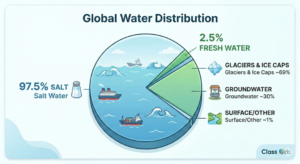
“पृथ्वी का 71% हिस्सा पानी से ढका हुआ है। लेकिन इसमें से 97.5% पानी खारा (salt water) है — जो न पीने के काम आता है, न खेती के।
बचा हुआ सिर्फ 2.5% ही fresh water (मीठा पानी) है। और इस 2.5% में से भी ज़्यादातर पानी glaciers और ice caps (हिमनदों और ध्रुवीय बर्फ) में जमा हुआ पड़ा है, जो हमारे रोज़मर्रा के इस्तेमाल के लिए आसानी से उपलब्ध नहीं होता।
हमारे काम आने वाला fresh water बहुत कम मात्रा में ही उपलब्ध है। यह हमें मुख्य रूप से surface run-off (नदियों और झीलों का पानी) और groundwater (भूजल) से मिलता है।
सबसे अच्छी बात यह है कि यह पानी Hydrological Cycle के जरिए लगातार रिचार्ज और renew होता रहता है।”
Sir की बात को सरल शब्दों में याद रखने का तरीका:
- कुल पानी → 71%
- खारा पानी (समुद्र) → 97.5%
- मीठा पानी → सिर्फ 2.5%
- उसमें से भी ज़्यादातर → glaciers और ice caps में
- हमारे रोज़ के काम का पानी → बहुत थोड़ा!
Note for Students: इस टॉपिक को अच्छे से समझ लो, क्योंकि आगे हम भारत में पानी की उपलब्धता, पानी की समस्या और उसका समाधान पढ़ेंगे।
Water Resources Class 10 Notes Audio Part 2
TOPIC 2: WATER SCARCITY — जल की कमी
Classroom Scene
Priya ने हाथ उठाया और पूछा: “Sir, अगर पानी renewable resource है, तो फिर जल की कमी (water scarcity) क्यों होती है?”
Teacher Om मुस्कुराए और बोले: “Priya, बहुत अच्छा और intelligent सवाल है! देखो, scarcity हमेशा इसलिए नहीं होती कि पानी बिल्कुल नहीं है। कई बार पानी तो है, लेकिन वो इस्तेमाल करने लायक नहीं रह जाता। कभी population इतनी बढ़ जाती है कि उपलब्ध पानी कम पड़ने लगता है। समझ आई?”
Water Scarcity के मुख्य कारण (Causes of Water Scarcity)
Teacher Om ने बोर्ड पर चार बड़े पॉइंट्स लिखे और बोले:
“बच्चों, water scarcity के 4 मुख्य कारण याद रखो — ये बोर्ड एग्जाम में बार-बार आते हैं:”
| क्र.सं. | कारण (Cause) | Explanation (सरल भाषा में) |
|---|---|---|
| 1️⃣ | Over-exploitation (अत्यधिक दोहन) | खेती के लिए ट्यूबवेल से बिना सोचे-समझे पानी निकालना। भूजल स्तर तेजी से नीचे जा रहा है। |
| 2️⃣ | Excessive Use (बहुत ज्यादा उपयोग) | शहरों, फैक्टरियों और उद्योगों में पानी का बेतहाशा इस्तेमाल। |
| 3️⃣ | Unequal Access (असमान वितरण) | कुछ अमीर इलाकों में AC, swimming pool और cooler चल रहे हैं, वहीं गरीब इलाकों में एक बूंद पानी के लिए तरसना पड़ता है। |
| 4️⃣ | Pollution (प्रदूषण) | कारखानों का कचरा, केमिकल और सीवर का गंदा पानी नदियों और भूजल को जहरीला बना देता है। |
Do You Know? / क्या आप जानते हैं?
- 2025 तक दुनिया के लगभग 2 अरब लोग absolute water scarcity में जीने वाले हैं।
- सिंचित खेती (Irrigated Agriculture) पानी की सबसे बड़ी consumer है — ये 70% से ज्यादा पानी इस्तेमाल करती है।
- Jal Jeevan Mission (JJM) का लक्ष्य है कि हर ग्रामीण परिवार को रोजाना 55 लीटर साफ पानी मिले।
- Rajasthan की महिलाएँ आज भी पानी लाने के लिए कई किलोमीटर पैदल चलती हैं। यही असली जल संकट है!
EXAM CORNER — Board Exam + Competitive Exams की तैयारी
Important Questions:
Q1. Water scarcity के मुख्य कारण क्या हैं? (CBSE 3 marks) Answer: Water scarcity के मुख्य कारण हैं —
- Over-exploitation of water resources
- Excessive use by the industries and the domestic sector
- Unequal distribution of water
- Water pollution
Q2. ‘Water is renewable but still scarce.’ Explain. (UPSC/Board type) Answer: पानी renewable जरूर है क्योंकि hydrological cycle से यह लगातार renew होता रहता है। लेकिन फिर भी scarcity होती है क्योंकि:
- पानी का वितरण समय और स्थान के अनुसार असमान है।
- बढ़ती जनसंख्या, अत्यधिक उपयोग, प्रदूषण और असमान पहुंच के कारण उपलब्ध उपयोगी पानी कम हो जाता है।
Note for Students: इन चार कारणों को अच्छे से याद कर लो। एग्जाम में अक्सर इन्हीं पर 3 या 5 मार्क्स के सवाल आते हैं।
TOPIC 3: MULTI-PURPOSE RIVER PROJECTS — बहुउद्देशीय नदी परियोजनाएँ
|
Rohan बोला… |
|
Rohan: “Sir, dam बनाने से क्या-क्या फ़ायदे होते हैं?” Teacher Om: “अरे Rohan — dam सिर्फ पानी रोकता नहीं है। वो एक साथ कई काम करता है — इसीलिए ‘Multi-Purpose’ कहते हैं! Nehru जी ने dams को ‘modern India के मंदिर’ कहा था — क्यों? आओ समझते हैं।” |
Dam क्या होता है?
A dam is a barrier across flowing water that obstructs, directs or retards the flow — creating a reservoir, lake या impoundment। इसमें एक spillway या weir होता है जिससे अतिरिक्त पानी निकल सके।
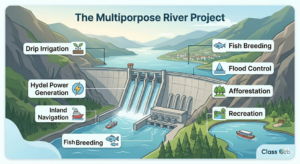
▸ Multi-Purpose Projects के फ़ायदे (Advantages)
✅ Benefits of Multi-Purpose Projects |
|
Irrigation — Dry-season farming के लिए पानी → food security Electricity Generation — Hydel power → Industries को बिजली Water Supply — घरों और industries को पानी Flood Control — नदियों का पानी reservoir में रोकना Inland Navigation — नावों के लिए जलमार्ग Fish Breeding — fishermen को रोज़गार Afforestation — आसपास की ज़मीन हरी-भरी होती है Recreation — tourist spots बनते हैं |
प्रमुख Multi-Purpose Projects (Important Dams)
|
Dam/Project |
River |
State |
Main Use |
|---|---|---|---|
|
भाखड़ा-नांगल |
Sutlej-Beas |
Punjab/Himachal |
Hydel Power + Irrigation |
|
हीराकुड |
Mahanadi |
Odisha |
Flood control + Power |
|
सरदार सरोवर |
Narmada |
Gujarat/MP/MH/RJ |
Irrigation + Power (Drought areas) |
|
नागार्जुन सागर |
Krishna |
Andhra Pradesh |
Largest artificial lake |
|
टिहरी |
Bhagirathi |
Uttarakhand |
Largest dam in India |
|
इंदिरा सागर |
Narmada |
Madhya Pradesh |
Power + Irrigation |
Do You Know? / क्या आप जानते हैं? |
|
Sardar Sarovar Dam — India के सबसे बड़े water resource projects में से एक है 4 states: Maharashtra, Madhya Pradesh, Gujarat और Rajasthan को benefit देता है 18.45 lakh hectare ज़मीन की irrigation — 3112 villages और 15 districts को पानी Hirakud Dam — Mahanadi river पर Odisha में, यह दुनिया के सबसे लंबे dams में है Atal Bhujal Yojana — 8220 water-stressed Gram Panchayats में implement हो रही है 7 states: Gujarat, Haryana, Karnataka, MP, Maharashtra, Rajasthan, UP |
Water Resources Class 10 Notes Audio Part 3
TOPIC 4: DAMS के नुकसान — दूसरा पहलू भी जानो!
|
Sonu ने सवाल उठाया… |
|
Sonu: “Sir, अगर dams इतने अच्छे हैं तो लोग protest क्यों करते हैं?” Teacher Om: “Wah Sonu! तूने आज सबसे important question पूछा। हर चीज़ के दो पहलू होते हैं। Dams ने development दिया, पर साथ में कुछ छीना भी। Narmada Bachao Andolan याद है? वो इसीलिए था। आओ दोनों sides देखते हैं।” |
Problems with Multi-Purpose Projects / Dams |
|
Poor Sediment Flow — Dams नदी का natural sediment flow रोक देते हैं → rocky stream beds, poor aquatic habitat Flooding of Forest & Villages — Reservoir बनने से जंगल, गाँव, खेती सब डूब जाते हैं Large-scale Displacement — लाखों लोगों को अपना घर-गाँव छोड़ना पड़ता है (mostly Adivasis, Dalits, farmers — सबसे गरीब तबका सबसे ज़्यादा affected) Soil Degradation — Reservoir area की soil degrade हो जाती है → land decomposition Earthquakes — कुछ cases में dams से seismic activity बढ़ती है Water-borne Diseases — Stagnant water → mosquitoes → malaria, dengue Inter-State Water Disputes — Cauvery (Karnataka vs Tamil Nadu), Krishna-Godavari (AP vs Maharashtra) — states झगड़ते हैं Cropping Pattern Change — Farmers water-intensive crops उगाने लगते हैं → soil salinisation → land barren हो जाती है Flood Control की failure — Big dams excessive rainfall के समय बेकार साबित हुए! Silt भरने से reservoir capacity कम हो जाती है। |
Do You Know? / क्या आप जानते हैं? |
|
Sardar Sarovar Dam ने Gujarat के drought-prone और desert areas को irrigation दी Krishna-Godavari dispute — Karnataka और Andhra Pradesh के बीच है Maharashtra द्वारा Koyna पर ज़्यादा water divert करने के objection पर Pradhan Mantri Krishi Sinchayee Yojana — ‘हर खेत को पानी’ — every farm को protective irrigation access देने का programme है |
EXAM CORNER — Board + UPSC/UPPSC तैयारी |
|
Q: Multi-purpose projects के advantages और disadvantages compare करो। (CBSE 5 marks) → दोनों column में कम से कम 3-3 points लिखो + example (Bhakra, Hirakud, Sardar Sarovar) Q: Narmada Bachao Andolan क्यों हुआ? (UPSC/UPPSC) → Sardar Sarovar Dam से thousands of Adivasi families displaced हुईं। Medha Patkar ने यह movement lead किया — rehabilitation की demand थी। Q: Inter-state water disputes का एक example दो। → Cauvery Water Dispute (Karnataka vs Tamil Nadu) — सबसे famous example |
TOPIC 5: RAINWATER HARVESTING — पुरखों की WISDOM!
|
Priya बोली — ‘Sir, पहले ज़माने में तो dams नहीं थे, फिर पानी कैसे?’ |
|
Teacher Om खुश हो गए: “Priya — बहुत sharp question! हमारे पुरखे बहुत समझदार थे। उन्होंने हर region की ज़रूरत के हिसाब से अलग-अलग तरीके बनाए। यह हमारी traditional wisdom है — और आज भी इसकी ज़रूरत है!” |
A. Ancient Hydraulic Structures (प्राचीन जल संरचनाएँ)
Archaeological और historical records दिखाते हैं कि India में हमेशा से sophisticated hydraulic structures बनाए जाते थे:
★ 1st Century BC — Sringaverapura (Allahabad के पास) में flood water harvesting system था
★ Chandragupta Maurya के ज़माने में dams, lakes और irrigation systems extensively built थे
★ Kalinga (Odisha), Nagarjunakonda (AP), Bennur (Karnataka), Kolhapur (Maharashtra) में sophisticated irrigation के evidence मिले हैं
★ 11th Century — Bhopal Lake — उस समय के largest artificial lakes में से एक!
★ 13th-14th Century — Delhi में Alauddin Khilji ने Hauz Khas बनाया — Siri Fort के लिए water supply
B. Region-wise Traditional Methods (क्षेत्रवार पारंपरिक तरीके)
|
Region / क्षेत्र |
Traditional Method / पारंपरिक तरीका |
|---|---|
|
Hill & Mountainous Regions(पहाड़ी इलाके) |
Diversion channels / ‘guls’ या ‘kuls'(Western Himalayas में rainwater harvesting) |
|
Flood Plains of Bengal(बंगाल के मैदान) |
Inundation channels — flood water से खेतों की irrigation |
|
Arid & Semi-Arid Regions(राजस्थान जैसे सूखे इलाके) |
Agricultural fields को rain-fed storage structures में convert किया’Khadins’ (Jaisalmer) और ‘Johads’ (Rajasthan) — soil को moisture देते थे |
|
Bikaner, Phalodi, Barmer(राजस्थान) |
Underground ‘Tankas’ — छत के पानी को collect करते थे। एक घर में tank 6.1 m गहरा, 4.27 m लंबा, 2.44 m चौड़ा हो सकता था! |
TOPIC 6: MODERN RAINWATER HARVESTING — आज की ज़रूरत
|
Arjun बोला — ‘Sir, Rajasthan में Indira Gandhi Canal के बाद तो सब ठीक हो गया होगा?’ |
|
Teacher Om ने कहा: “Arjun — उल्टा हो गया! Canal आई, लोगों को लगा अब तो पानी है — तो पुराने tankas क्यों रखें? लेकिन canal का पानी sweet नहीं लगता था local लोगों को। और अब canal पर depend हो गए। यही problem है जब हम अपनी traditional wisdom भूल जाते हैं!” |
▸ Rooftop Rainwater Harvesting (छत से पानी जमा करना)
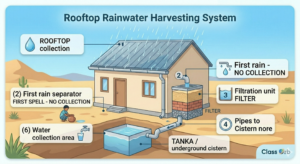
यह modern adaptation है traditional tanka system का। Rain roof पर गिरती है → pipe से नीचे जाती है → underground tanka में store होती है। पहली बारिश collect नहीं करते (roof और pipe clean होने के लिए) — बाद की बारिश collect करते हैं।
Interesting Examples — देश भर के innovative examples |
|
Shillong, Meghalaya — Rooftop rainwater harvesting सबसे common practice (यह interesting है क्योंकि Cherrapunjee — सिर्फ 55km दूर — highest rainfall in world) (फिर भी Shillong में water scarcity! Canal नहीं, tanka system ने बचाया) Gendathur, Mysuru (Karnataka) — Remote backward village 200 households ने rooftop system install किया Net rainwater harvested annually = 1,00,000 litres! Village अब ‘rain-rich’ village के नाम से जाना जाता है Tamil Nadu — First state in India to make rooftop rainwater harvesting COMPULSORY for all houses across the state! Legal provisions to punish defaulters. Rajasthan — Thar region में rooftop harvesting common था — अब Indira Gandhi Canal के कारण decline पर, क्योंकि ‘tap water’ मिलने लगा |
Water Resources Class 10 Notes Audio Part 4
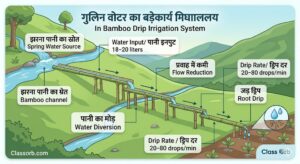
Bamboo Drip Irrigation (बाँस से drip irrigation) — Meghalaya की 200 साल पुरानी तकनीक
|
Bamboo Drip Irrigation System |
|
Location: Meghalaya (पहाड़ी राज्य) Age of system: 200 years old! How it works: • Hillside perennial springs और stream water को divert करते हैं — bamboo pipes से • 18-20 litres पानी enter करता है system में • Hundreds of metres transport होता है bamboo channels से • Finally reduces to 20-80 drops per minute — plant roots तक! • Reduced channel sections और diversion units — last stage में water को roots के पास drop करते हैं ✅ यह है true ‘drip irrigation’ — बिना electricity, बिना machine के! |
Do You Know? क्या आप जानते हैं? |
|
Tankas में पानी — गर्मियों में सबसे pure natural water माना जाता है लोग इसे ‘palar pani’ कहते हैं — बेहतरीन drinking water! Gendathur में 80% collection efficiency — 200 घरों से 1,00,000 litres/year harvest Kul system — Western Himalayas में diversion channels — Flood water को fields तक लाते हैं |
EXAM CORNER — Board + UPSC/UPPSC तैयारी |
|
Q: Rainwater harvesting के traditional methods explain करो — with examples। (CBSE 5 marks, UPPSC) → Tankas (Rajasthan), Kuls/Guls (Himalayas), Johads (Rajasthan), Inundation channels (Bengal), Rooftop harvesting (Meghalaya, Tamil Nadu), Bamboo drip (Meghalaya) Q: Rooftop rainwater harvesting system कैसे काम करता है? (3 marks) → Rain → Roof → Pipe → Filter (sand & bricks) → Underground tanka First spell छोड़ते हैं (roof clean करने के लिए) → बाद की बारिश collect Q: Tamil Nadu का rainwater harvesting में क्या योगदान है? → First state to make rooftop RWH compulsory by law — with punishment for defaulters Q: Bamboo drip irrigation system किस state में है? कैसे काम करता है? → Meghalaya — 200 years old system — bamboo pipes से spring water को plant roots तक |
TOPIC 7: QUICK REVISION — एक नज़र में पूरा CHAPTER!
|
KEY TERMS — Glossary |
|
• Hydrological Cycle — पानी का evaporation → cloud → rain → back cycle • Water Scarcity — पानी की कमी — या तो कम है या इतना polluted है कि use न हो सके • Multi-purpose Project — एक ही dam से multiple uses — irrigation, power, flood control… • Reservoir — dam के पीछे बना कृत्रिम lake / तालाब • Spillway/Weir — dam का वो हिस्सा जहाँ से extra water निकलता है • Tanka — Rajasthan का underground cistern जो छत का पानी store करता है • Kul/Gul — Himalayan diversion channels for flood water harvesting • Johad — Rajasthan का traditional small water reservoir • Khadins — Jaisalmer area में agricultural fields जो water storage का काम करती हैं • Palar Pani — rainwater का local name — purest natural water माना जाता है • Bamboo Drip — Meghalaya का 200-year-old bamboo pipe irrigation system • Inundation Channel — Bengal में flood water से irrigation के लिए channel |
NCERT Exercise — सभी Questions के Answers (Summary) |
|
MCQ 1(i): Ans → (b) Region with high annual rainfall and large population [पानी है, पर लोग ज़्यादा → per capita कम → scarcity] MCQ 1(ii): Ans → (c) Multi-purpose projects lead to large-scale displacements [यह argument ‘in favour of’ नहीं है — यह तो नुकसान है!] MCQ 1(iii) — False statements identify करके rewrite: (a) Wrong: Urban centres increase water demand (not help utilise better) (b) Wrong: Regulating/damming DOES affect the river’s natural flow and sediment (c) Wrong: RWH popularity declined in western Rajasthan (Indira Gandhi Canal आने से) 2(i): Water renewable कैसे? → Hydrological cycle द्वारा continuously renew होता है 2(ii): Water scarcity? Causes? → Over-exploitation, unequal access, pollution, population 2(iii): Multi-purpose projects — advantages: irrigation, power, flood control, navigation , Disadvantages: displacement, sediment flow disruption, inter-state disputes 3(i): Semi-arid Rajasthan में RWH — Tankas (underground cisterns), Johads, Khadins Rooftop → pipe → tanka → purest drinking water in summers 3(ii): Modern adaptations — Rooftop RWH (Shillong, Tamil Nadu compulsory), Bamboo Drip (Meghalaya), Abandoned dugwell recharge |
SECTION A: MULTIPLE CHOICE QUESTIONS (MCQs)
Instructions: Choose the BEST answer from the options given. Read each question carefully before
selecting. Answers are given after each question for self-checking.
Q1. Three-fourths of the Earth’s surface is covered with water. What percentage of this is
Freshwater that can actually be used by us?
a) About 71%
b) About 25%
c) Less than 3%
d) About 50%
✔ Ans: c) Less than 3% — Most water is saline (oceans). Of the tiny freshwater fraction, most
is locked in glaciers.
Q2. Water is described as a ‘renewable resource’. Which of the following best explains why?
a) It can be manufactured in factories
b) The hydrological cycle continuously renews and recharges freshwater
c) The oceans never run out of water
d) Rain falls every year in all parts of India
✔ Ans: b) The hydrological cycle continuously renews and recharges freshwater —
evaporation → clouds → precipitation → surface/groundwater.
Q3. By the year 2025, approximately how many people worldwide are predicted to live in conditions of absolute water scarcity?
a) 500 million
b) 1 billion
c) 2 billion
d) 4 billion
✔ Ans: c) 2 billion — This alarming figure is given in the NCERT textbook.
Q4. Which of the following is the LARGEST consumer of water resources in India?
a) Domestic use (drinking and cooking)
b) Industrial use
c) Irrigated agriculture
d) Hydroelectric power generation
✔ Ans: c) Irrigated agriculture — It accounts for approximately 70% of total freshwater use.
Q5. A region receives high annual rainfall. Yet it suffers from water scarcity. Which is the MOST likely reason?
a) The region has very low population
b) The region has high annual rainfall but a very large and dense population
c) The region has low annual rainfall and low population
d) Rain falls only in one season and there are no storage systems
✔ Ans: b) A large and dense population increases per-capita demand, causing scarcity despite high rainfall.
Q6. Jawaharlal Nehru proudly proclaimed dams as the ‘temples of modern India’. He said this because dams:
a) Were beautiful architectural structures
b) Would integrate the development of agriculture and the village economy with rapid industrialisation
c) Helped India win independence
d) Were built only in rural areas
✔ Ans: b) Nehru saw multi-purpose river projects as engines that would simultaneously
boost agriculture, industry and urban growth.
Q7. Which of the following is NOT an advantage of multi-purpose river projects?
a) Irrigation for agriculture
b) Generation of hydroelectric power
c) Large-scale displacement of local communities
d) Inland navigation and flood control
✔ Ans: c) Large-scale displacement is a serious DISADVANTAGE, not an advantage.
Q8. The Bhakra-Nangal Project is built across which river?
a) Mahanadi
b) Narmada
c) Sutlej-Beas
d) Damodar
✔ Ans: c) Sutlej-Beas — Bhakra-Nangal is one of India’s largest multi-purpose hydel
projects.
Q9. The Hirakud Dam is situated on which river?
a) Krishna
b) Godavari
c) Mahanadi
d) Chambal
✔ Ans: c) Mahanadi — Hirakud Dam in Odisha is one of the longest dams in the world.
Q10. The Sardar Sarovar Project on the Narmada River benefits how many states?
a) Two states
b) Three states
c) Four states
d) Five states
✔ Ans: c) Four states — Maharashtra, Madhya Pradesh, Gujarat and Rajasthan.
Q11. In recent years, multi-purpose projects have faced opposition mainly because:
a) They produce too much electricity
b) They regulate river flow, cause sedimentation problems, displace communities and disrupt
ecosystems
c) They are too expensive to visit as tourist spots
d) They bring too much water to farming areas
✔ Ans: b) All these ecological and social problems have fuelled widespread opposition to
large dams.
Q12. What does ‘tanka’ refer to in the context of Rajasthan’s traditional water harvesting?
a) A large river dam
b) An underground cylindrical cistern to store rainwater collected from rooftops
c) A canal system
d) A type of irrigation pump
✔ Ans: b) Tanka is an underground cistern — a traditional rooftop rainwater harvesting
system common in semi-arid Rajasthan.
Q13. The rainwater stored in tankas is locally referred to as ‘palar pani’. Why is it considered so special?
a) It is hot and good for cooking
b) It is considered the purest form of natural water
c) It comes directly from rivers
d) It contains natural minerals
✔ Ans: b) Palar pani — pure rainwater — is considered the purest natural water, especially valuable in dry summers.
Q14. Which state in India was the FIRST to make rooftop rainwater harvesting COMPULSORY for all houses?
a) Rajasthan
b) Maharashtra
c) Karnataka
d) Tamil Nadu
✔ Ans: d) Tamil Nadu — It made rooftop rainwater harvesting compulsory by law, with legal
provisions to punish defaulters.
Q15. The Bamboo Drip Irrigation System is a 200-year-old traditional practice found in which state?
a) Assam
b) Meghalaya
c) Manipur
d) Sikkim
✔ Ans: b) Meghalaya — It uses bamboo pipes to divert stream and spring water directly to
plant roots.
Q16. In the Bamboo Drip Irrigation System, the water is finally delivered at the plant site and is reduced to approximately:
a) 10–15 litres per minute
b) 5–10 litres per minute
c) 20–80 drops per minute
d) 100 drops per minute
✔ Ans: c) 20–80 drops per minute — reduced channel sections ensure slow, precise drip
delivery to roots.
Q17. Rooftop rainwater harvesting is the most common water conservation practice in Shillong,
Meghalaya. This is surprising because:
a) Shillong has a very dry climate
b) Cherrapunji and Mawsynram nearby receive the highest rainfall on Earth, yet Shillong faces water
scarcity
c) Shillong has no rivers
d) The government has banned the use of tap water
✔ Ans: b) Despite Cherrapunji (55 km away) recording the world-highest rainfall, Shillong’s
urban area faces water shortage — showing that high rainfall alone does not guarantee water
security.
Q18. The ‘khadins’ and ‘johads’ are traditional water harvesting structures found mainly in:
a) Northeast India
b) Rajasthan
c) Kerala
d) Andhra Pradesh
✔ Ans: b) Rajasthan — Khadins (Jaisalmer) and Johads are traditional structures that store
water and moisten the soil.
Q19. In which century was the Hauz Khas water tank in Delhi constructed by Alauddin Khilji?
a) 7th–8th century
b) 11th century
c) 13th–14th century
d) 16th century
✔ Ans: c) 13th–14th century — Built to supply water to the Siri Fort area.
Q20. Sringaverapura, a sophisticated water harvesting site dating back to the 1st century BC, is located near which modern city?
a) Varanasi
b) Allahabad (Prayagraj)
c) Lucknow
d) Agra
✔ Ans: b) Allahabad (Prayagraj) — One of the earliest known examples of sophisticated
water harvesting in ancient India.
Q21. What is the main purpose of the Jal Jeevan Mission (JJM) launched by the Government of India?
a) To construct large dams across all rivers
b) To provide 55 litres per capita per day of piped potable water to every rural household
c) To build swimming pools in every district
d) To privatise water supply in cities
✔ Ans: b) JJM aims to ensure an assured supply of potable piped water at 55 litres/person/day
to all rural households.
Q22. Which of the following is TRUE about irrigation and water use in India?
a) Less than 10% of freshwater is used for irrigation
b) Irrigation has helped stop soil salinisation completely
c) Water-intensive cropping patterns promoted by irrigation have in many regions led to soil salinisation
d) Drip irrigation is mandatory across all states
✔ Ans: c) Shift to water-intensive crops combined with over-irrigation has led to salinisation
of soil in many regions.
Q23. The ‘kuls’ or ‘guls’ are diversion channels used for water harvesting. They are found in:
a) Deccan Plateau
b) Western Himalayas
c) Coastal Andhra Pradesh
d) Gangetic Plain
✔ Ans: b) Western Himalayas — These channels divert flood water from streams to fields in
mountainous areas.
Q24. Inundation channels for irrigation were traditionally used in the flood plains of which region?
a) Rajasthan
b) Punjab
c) Bengal
d) Tamil Nadu
✔ Ans: c) Bengal — Flood plains of Bengal used inundation channels to irrigate fields using
monsoon floodwater.
Q25. What is the significance of the village Gendathur in Mysuru, Karnataka?
a) It has the largest dam in Karnataka
b) About 200 households have installed rooftop rainwater harvesting and harvest around 1,00,000 litres
annually
c) It is famous for bamboo drip irrigation
d) It is the driest village in India
✔ Ans: b) Gendathur is a model village — 200 households collectively harvest 1,00,000 litres
of rainwater annually.
Q26. The Krishna-Godavari water dispute involves which states?
a) Karnataka and Tamil Nadu
b) Rajasthan and Gujarat
c) Karnataka, Andhra Pradesh and Maharashtra
d) UP and Bihar
✔ Ans: c) Karnataka and Andhra Pradesh (objecting to Maharashtra diverting more water at
Koyna for a multi-purpose project).
Q27. The Pradhan Mantri Krishi Sinchayee Yojana (PMKSY) aims to:
a) Build new dams on every major river
b) Ensure physical access of water on the farm and expand cultivable area under assured irrigation (‘Har
Khet Ko Pani’)
c) Provide free electricity to all farmers
d) Distribute water tankers to drought-hit villages
✔ Ans: b) PMKSY’s goal is ‘Har Khet Ko Pani’ — assured protective irrigation for all
agricultural lands.
Q28. Atal Bhujal Yojana is being implemented in approximately how many Gram Panchayats across India?
a) 1,000
b) 4,000
c) 8,220
d) 15,000
✔ Ans: c) 8,220 Gram Panchayats in 229 administrative blocks across 80 districts in 7 states.
Q29. Which of the following correctly identifies a false statement about dams?
a) Dams help in flood control by regulating river flow
b) Big dams have mostly been successful in controlling floods during excessive rainfall
c) Dams are used for recreational purposes like water sports
d) Dams provide water for domestic and industrial supply
✔ Ans: b) FALSE — Big dams have largely FAILED to control floods during excessive rainfall
due to siltation reducing reservoir capacity.
Q30. Which popular Bhadu song is associated with the flooding of the Damodar River, once
called the ‘River of Sorrow’?
a) ‘We will fill Bhadu in Ganga’
b) ‘We have sown the crops in Asar / We will bring Bhadu in Bhadra / Floods have swollen the Damodar’
c) ‘Rain falls on the mountains’
d) ‘The river runs to the sea’
✔ Ans: b) This folk song captures the suffering of people of the Damodar valley due to
repeated devastating floods.
CLASS ORB.COM | Class 10 Geography Chapter 3: Water Resources | Question Bank
Teacher: OM SIKARWAR | CLASS ORB.COM Page 9
SECTION B: FILL IN THE BLANKS
Q1. About ________ of the Earth’s surface is covered with water, but freshwater available for use
is less than ________.
✔ Answer: three-fourths (71%); 3%
Q2. Freshwater is a ________ resource because it is continuously renewed through the
________ cycle.
✔ Answer: renewable; hydrological
Q3. The immediate image of water scarcity is regions with ________ rainfall, such as the deserts
of ________.
✔ Answer: low; Rajasthan
Q4. Irrigated agriculture is the ________ consumer of water.
✔ Answer: largest
Q5. Multi-purpose river projects serve purposes such as irrigation, electricity generation,
________ control, and inland navigation.
✔ Answer: flood
Q6. Jawaharlal Nehru called dams the ‘________ of modern India’.
✔ Answer: temples
Q7. The Bhakra-Nangal Project is built across the ________ river.
✔ Answer: Sutlej-Beas
Q8. The Sardar Sarovar Dam is built on the ________ River and benefits ________ states.
✔ Answer: Narmada; four
CLASS ORB.COM | Class 10 Geography Chapter 3: Water Resources | Question Bank
Teacher: OM SIKARWAR | CLASS ORB.COM Page 10
Q9. The Hirakud Dam is built on the ________ river in the state of ________.
✔ Answer: Mahanadi; Odisha
Q10. Regulating and damming of rivers affects their natural flow causing poor ________ flow
and excessive sedimentation.
✔ Answer: sediment
Q11. Underground cylindrical cisterns used in Rajasthan for storing rooftop rainwater are called
________.
✔ Answer: tankas
Q12. Rainwater stored in tankas is locally called ‘________’, which means it is considered the
purest form of natural water.
✔ Answer: palar pani
Q13. Tamil Nadu is the first state in India to make rooftop rainwater harvesting ________ for all
houses.
✔ Answer: compulsory
Q14. The Bamboo Drip Irrigation System is a ________-year-old method found in ________.
✔ Answer: 200; Meghalaya
Q15. The traditional water harvesting channels in the Western Himalayas are called ‘________’ or
‘________’.
✔ Answer: kuls; guls
Q16. In Bengal, people developed ________ channels to irrigate their fields using floodwater.
✔ Answer: inundation
Q17. ‘Khadins’ and ‘johads’ are found in ________ and are used to ________ the soil by storing
water.
✔ Answer: Rajasthan; moisten
CLASS ORB.COM | Class 10 Geography Chapter 3: Water Resources | Question Bank
Teacher: OM SIKARWAR | CLASS ORB.COM Page 11
Q18. The ancient water harvesting site at Sringaverapura near Allahabad dates back to the
________ century BC.
✔ Answer: 1st
Q19. The Jal Jeevan Mission aims to provide ________ litres per capita per day of potable piped
water to every rural household.
✔ Answer: 55
Q20. In Gendathur village, Mysuru, about ________ households have installed rooftop
Water Resources Class 10 Notes PDF Download (H.M)
Water Resources Class 10 Notes PDF Download (E.M)
water resources class 10 notes PDF solutions, questions and answers,