

The Rattrap Class 12 English – Summary, NCERT Solutions & Analysis
The Rattrap Class 12 English – Summary, NCERT Solutions & Analysis and MP3 Audio
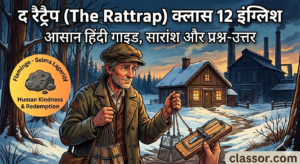
अगर आप The Rattrap Class 12 English को आसान भाषा में समझना चाहते हैं, तो यह गाइड आपके लिए है।
यह अध्याय Flamingo का महत्वपूर्ण हिस्सा है और बोर्ड एग्जाम में अक्सर पूछा जाता है।
यह कहानी हमें सिखाती है कि दुनिया एक जाल (Rattrap) की तरह है, लेकिन प्यार और दया किसी भी इंसान को बदल सकती है।
लेखिका: Selma Lagerlöf
Chapter Name: The Rattrap
Book: Flamingo (Class 12)
Theme: Human Kindness & Redemption
Genre: Short Story (Moral Based)
The Rattrap Class 12 Chapter 4: Summary, Questions, and Answers in Simple Language with MP3 Audio
अगर आप क्लास 12 फ्लेमिंगो के चैप्टर “द रैट्रैप” को रटने के बजाय समझना चाहते हैं, तो आप सही जगह पर आए हैं। स्वीडिश राइटर सेल्मा लेगरलोफ की यह कहानी हमें सिखाती है कि दुनिया में कितनी भी बुराई क्यों न हो, प्यार और अपनापन किसी को भी बदल सकता है।
इसमें आपको क्या मिलेगा?
कहानी की आसान समरी: पूरी कहानी एक मूवी जैसी है।
NCERT सवाल और जवाब: बोर्ड एग्जाम की तैयारी के लिए।
MP3 ऑडियो: चलते-फिरते लेसन सुनने के लिए।
The Rattrap Class 12 English – Comprehensive Guide: Summary
This story begins in the mines of Sweden, rich in iron ore, which are mentioned in the history and legends of that country. This story is told in the form of a fairy tale.
Once upon a time, there was a man who travelled around selling wire rattraps. He made them in difficult times, using materials he borrowed from stores and large farms. But even so, the business wasn’t profitable, so he had to resort to both begging and petty theft to survive. Yet, his clothes were tattered, his cheeks were sunken, and hunger shone in his eyes.
One can’t imagine how sad and monotonous the life of such a beggar, wandering the streets lost in his own thoughts, could be. But one day, he thought of something that struck him as truly amusing. He was thinking about his cages when suddenly the thought came to him that the whole world around him—all the world, with its land and sea, cities and villages was nothing more than a big cage.
It was never created for any other purpose than to trap people. It offered wealth and pleasure, shelter and food, warmth and clothing, just as a rat’s cage offered cheese and meat, and as soon as someone was tempted by it and touched it, it imprisoned them, and then everything was over.
The world had certainly never been kind to him, so thinking about it this way gave him a unique pleasure. It had become his favorite pastime, during many long walks, to think about those who had entangled themselves in dangerous traps, and about others who were still circling around temptation.
He reached a small hut that night. The old man’s thoughts were like a celebration, and he was delighted to hear his words. He offered him food and tobacco for his pipe. The two sat by the fire, chatting, and eating dinner. Finally, he pulled out old cards, and they played “Mjölner” until they fell asleep.
The old man was as generous about his beliefs as he was about his porridge and tobacco. The guest was immediately told that in his prime, his host had owned a small piece of land and worked at the Ramsjö Ironworks. Now that he was no longer able to do the day’s work, his cow was his only support. Yes, that cow was extraordinary. She could milk the creamery every day, and last month he had received thirty kroner in exchange for it.
The stranger must have found this incredible, because the old man got up and went to the window. There, he took down a leather bag hanging on the windowsill and took out three crumpled ten kroner notes. He held the notes before his guest’s eyes, nodded knowingly, and then put them back in the bag.
The next day, both men woke early. The crofter was in a hurry to milk his cow, and the other man was probably thinking he shouldn’t stay in bed when the owner of the house was up. They left the hut together. The crofter locked the door and put the key in his pocket. The cage-seller said goodbye and thanked him, then went on his way.
But half an hour later, the cage-seller was standing in front of the door again. He didn’t try to get in. He simply went to the window, broke a pane of glass, put his hand inside, and grabbed the bag containing thirty kroner. He took out the money and put it in his pocket. Then, he carefully hung the leather bag back in its place and left.
As he left with the money in his pocket, he was pleased with his cleverness. He must have realized that he shouldn’t have ventured onto the public road at first, but instead turned into the forest. For the first few hours, he had no difficulty. But things later worsened, as he entered a vast and confusing forest. He tried to walk in a certain direction, but the paths twisted strangely back and forth. He continued walking, but the forest never ended.
Finally, he realized that he was circling the same part of the forest. Suddenly, he remembered his thoughts about the world and the cage. Now it was his turn. He had fallen into a trap and was caught. The entire forest, with its trunks and branches, bushes and fallen logs, closed around him like an impenetrable prison, from which he could never escape.
It was late December. Darkness had already descended on the forest. This increased the danger, and so did the sadness and despair in his heart. Finally, he saw no way out, and he sank to the ground, exhausted, thinking his end had come. Just as he laid his head on the ground, he heard a sound—a sharp, regular sound of blows. There was no doubt what it was. He picked himself up. “These are hammer strikes in an iron mill,” he thought. “There must be people nearby.” He mustered all his strength, stood up, and staggered in the direction of the sound.
The Ramsey Ironworks, now closed, was until recently a large factory, with furnaces, a rolling mill, and a blacksmith’s shop. In summer, long boats laden with heavy goods glided down the canal, leading to a large inland lake, and in winter, the roads near the mill were blackened by coal dust blown from the large charcoal boxes.
On a long, dark evening shortly before Christmas, the head blacksmith and his assistant sat in the dark smithy near the furnace, waiting for the raw iron that had been put into the fire to be ready to be placed on the anvil. Occasionally, one of them would get up to stir the pile of glowing metal with a long iron rod, and within moments, he would return drenched in sweat. As was customary, he wore only a long shirt and wooden shoes.
A variety of sounds could be heard in the smithy all the time. The huge bellows groaned, and the burning coal crackled. The boy shovelled coal into the furnace mouth, making a lot of noise. Outside, the waterfall roared, and a strong north wind lashed the rain against the brick roof.
The furnace, constantly running, produced a multitude of sounds. The large bellows groaned, and the burning coal crackled. The fireboy was about to shovel charcoal into the hearth of the furnace. Outside, a waterfall roared, and a strong north wind pelted the rain against the brick roof.
It was because of this noise that the blacksmith didn’t notice a man opening the gate and entering the forge until he stood beside the furnace.
Of course, it wasn’t unusual for poor wanderers, without better shelter to spend the night, to come to the forge, attracted by the glow of the light, and warm themselves by the fire. The blacksmiths gave the man who came from outside only a simple, sad glance. He looked as people like him often do—tall, dusty, shaggy, with a bunch of rat-catching cages hanging from his chest.
He asked the legislators for permission, and the chief blacksmith arrogantly agreed, nodding his head, without giving him a single word of respect.
The wanderer said nothing either. He had come there not to chat, but to warm himself and sleep.
In those days, the owner of the Ramsøy Iron Mill was a renowned ironmaster whose great goal was to ship good iron into the market. He watched day and night to ensure the work was done as efficiently as possible, and just then, he came to the forge to inspect it at night.
Naturally, the first person he saw was the tall, ragged man, who had come to the furnace to rest, steam rising from his wet clothes. The ironmaster did not follow the blacksmiths, who had not even been kind enough to look at the stranger. He came up to him, looked at him carefully, then took off his visor hat to get a better look at his face.
“But it must be you, Niels Olof!” he said. “How do you look!”
The local man had never seen the ironmaster in Ramsey before and didn’t even know his name. But it occurred to him that if the gentleman thought he was an old acquaintance, he might give him two kroner. So he didn’t want to dispel his suspicions immediately.
“Yes, God knows I’m having a hard time,” he said.
“You shouldn’t have resigned from the regiment,” the ironmaster said. “That was your mistake. If I had still been in service, this would never have happened. Well, now you’ll come home with me.”
The thought of accompanying the landlord to his house and being greeted by the owner like an old regimental comrade did not appeal to the wanderer.
“No, I can’t even imagine that,” he said, looking completely wary.
He thought about the thirty kroner. Going to the landlord’s house would be like putting himself in a lion’s den. He wanted a chance to spend the night in the forge and then leave as quietly as possible.
The ironmaster understood that he was hesitant because of his tattered clothes.
“Please don’t think my house is so magnificent that you can’t show yourself there,” he said. “Elizabeth is dead, as you’ve probably heard. My boys are abroad, and it’s only my eldest daughter and I at home. We were just saying how sad it is that no one is with us for Christmas. Now come with me and help us finish Christmas dinner early.”
But the stranger repeatedly refused, and the ironmaster saw that he would have to give in.
“It seems Captain von Staehle would like to stay with you tonight, Stjernstrom,” he said to the chief blacksmith and turned and left.
But he was laughing to himself as he left, and the blacksmith, who knew him, understood that he hadn’t said his last words.
A short while later, they heard the sound of cartwheels outside the forge, and a new guest entered, but this time it wasn’t the ironmaster. He had sent his daughter, perhaps hoping she would have more persuasion power than he.
She entered, followed by a servant with a large fur coat draped over her arm. She wasn’t exactly beautiful, but she seemed modest and quite reserved. Everything in the forge was as it had been earlier that evening. The head blacksmith and his assistant were still sitting at their benches, and the smell of iron and coal filled the air.
The chief blacksmith and his assistant were still sitting at their bench, and the iron and charcoal still glowed in the furnace. The stranger had stretched himself out on the floor and was lying with a large piece of cast iron under his head.
His hat was pulled down over his eyes. As soon as the young girl noticed him, she went over and lifted his hat. The man was probably used to sleeping with one eye open. He sat up suddenly and looked quite frightened.
“My name is Edla Williamson,” the young girl said. “My father came home and said you wanted to sleep in this forge, and then I asked permission to come here and take you with me. I’m so sorry, Captain, that you’re having such a hard time.”
She looked at him sympathetically with her heavy eyes, and then she felt the man become frightened. “Either he’s stolen something or he’s escaped from prison,” she thought, and quickly added, “You can rest assured, Captain, that you’ll be able to leave us as freely as you came in. Just please spend Christmas Eve with us.”
She said this so friendly that the mousetrap seller believed her.
“I never thought you’d take the trouble for me, Miss,” he said. “I’ll go with you immediately.”
He accepted the fur coat the servant offered him with a deep bow, put it on over his tattered clothes, and followed the young girl to the carriage, without looking at the surprised blacksmiths.
But as he walked toward the mansion, dark thoughts were running through his mind.
“Why did I take that man’s money?” he thought. “Now I’m trapped and I’ll never be able to escape.”
The next day was Christmas Eve, and when the Iron Master came into the dining room for breakfast, he thought with satisfaction of his old regimental comrade, whom he had met so unexpectedly.
“First, we must see to it that he gets some flesh on his bones,” he said to his daughter, who was busy at the table. “And then we must see to it that he finds some other work besides going around the country selling mousetraps.”
Exercise The Rattrap Class 12 English – Comprehensive Guide: Summary & NCERT Solutions MP3
INTEXT QUESTIONS
1. From where did the peddler get the idea of the world being a rattrap?
फेरी लगाने वाले को यह विचार कहाँ से आया कि पूरा संसार एक चूहेदान है?
Ans. The peddler was a rattrap seller. He was naturally thinking of his rattraps when suddenly he was struck by an idea that the whole world was nothing but a big rattrap.
2. Why was he amused by this idea?
वह इस विचार से खुश क्यों था?
Ans. The world had never been kind to him. He always thought ill of it. So, he was amused by the idea of the world being a big rattrap. It gave him an unwanted joy.
3. Did the peddler expect the kind of hospitality that he received from the crofter?
क्या फेरीवाले को उस मेहमाननवाजी की उम्मीद थी जो उसे बाड़े के मालिक से मिली?
Ans. No, the peddler did not expect such kind hospitality that he received from the crofter.
4. Why was the crofter so talkative and friendly with the peddler?
बाड़े का मालिक इतना बातूनी और दोस्ताना व्यवहार क्यों कर रहा था फेरी वाले के साथ?
Ans. The crofter was living alone in his cottage. He was happy to find someone to talk to in his loneliness. So he was so talkative and friendly with the peddler.
5. Why did he show the thirty kroner to the peddler?
उसने फेरीवाले को 30 क्रोनर क्यों दिखाए?
Ans. The crofter was a credulous man. He was generous with his confidence. So, he showed thirty kroner to the peddler. He did not have doubt that he was a thief.
6. Did the peddler respect the confidence reposed in him by the crofter?
क्या फेरीवाले ने उस विश्वास का सम्मान किया जो बाड़े के मालिक ने उसमें दिखाया था?
Ans. No, the peddler did not respect the confidence which the crofter had shown him. He showed him 30 kronor, and the peddler stole them.
6. What made the peddler think that he had indeed fallen into a rattrap?
फेरी वाले ने क्यों सोचा कि वह पिंजरे में फँस चुका है?
Ans. The peddler stole 30 Kronor from the crofter’s cottage and walked along. He thought himself smart. He avoided the public highway and turned into the woods. It was a big and confusing forest which he got into. He tried to walk in a definite direction. But he failed. He realised that he was walking around in the same part of the forest. The whole forest seemed to him a big prison.
7. Why did the ironmaster speak kindly to the peddler and invite him home?
आयरन मास्टर ने फेरीवाले से दयालुता से बात क्यों की और उसको अपने घर में आमंत्रित क्यों किया?
Ans. Iron master mistook the peddler for his old acquaintance, with whom he had been in the regiment. So he spoke to him in kindly manner and invited him to his house to celebrate Christmas Eve
8.Why did the peddler decline the invitation? फेरीवाला निमंत्रण को छोड़ना क्यों चाहता था?
Ans. The peddler had stolen thirty kronor. If he accepted the invitation to the manor house, it would be like throwing himself into the lion’s den. So, he declined the invitation.
9.What made the peddler accept Edla Willmansson’s invitation? किस कारण से फेरी वाले ने एडला विलमंसन का निमंत्रण स्वीकार किया?
Ans. The iron master sent his daughter to persuade the peddler to come to his house. She noticed that the man was afraid. She thought that either he had stolen something or he had escaped from jail. Then she assured him that he would be allowed to leave their house as freely as he came. She said all this in such a friendly manner that the peddler felt confident in her and accepted the invitation.
10. What doubts did Edla have about the peddler? एडला को फेरीवाले पर क्या शक था?
Ans. Edla doubted that the man had stolen something somewhere, or he might escape from jail. She realised that there was a fear of being caught in him.
11. When did the ironmaster realise his mistake? आयरन मास्टर को अपनी गलती का एहसास कब हुआ?
Ans. At the iron master’s home, the peddler got cleaned and dressed up. The tramp manners had gone away. He was in good-looking clothes. Now the iron master looked at him carefully. Actually, previously he had seen the fellow in uncertain reflection. But in enough light, he realised that the peddler was not his old acquaintance. He had mistaken him for his old acquaintance.
12. What did the peddler say in his defence when it was clear that he was not the person the ironmaster had thought he was? जब यह पता लगा कि घुमक्कड़ वह आदमी नहीं था जो आयरन मास्टर सोच रहा था, तो उसने अपने बचाव में क्या कहा?
Ans. The iron master had realised his mistake. The peddler said that he was not at fault. He had never pretended to be anything but a poor trader. Actually, he had pleaded to stay where he was. So, he was not to be blamed.
13. Why did Edla still entertain the peddler even after she knew the truth about him? फेरीवाले के बारे में सच्चाई जानने के बाद भी एडला उसका अतिथि सत्कार क्यों कर रही थी?
Ans. The iron master had realised that he had invited a wrongman in the house. But Edla said that they should not chase a human being away whom they had asked to come and to whom they had promised Christmas cheer. So, she still entertained him even after the whole truth had come to light.
Why was Edla happy to see the gift left by the peddler? फेरीवाले के द्वारा छोड़ी गई गिफ्ट को देखकर एडला खुश क्यों थी?
Ans. Edla and her father came to know that the peddler had robbed an old crofter. They expected that he would have stolen a silver spoon from their house. But it was not so. Instead, the peddler had left a gift for Edla. It was a rattrap with three ten kronor notes and a letter in it. So, Edla was happy to see that the man had been reformed.
Why did the peddler sign himself as Captain von Stahle? फेरीवाले ने पत्र पर Captain von Stahle के रूप में हस्ताक्षर क्यों किए?
Ans. The peddler signed the letter as Captain von Stahle. He was a robber. But Edla’s respect and confidence had reformed him. He wrote in the letter that he had been raised to Captain by Edla. So he signed the letter as Captain von Stahle.
Exercise The Rattrap Class 12 English – Comprehensive Guide: Summary & NCERT Solutions MP3
UNDERSTANDING THE TEXT
1. How does the peddler interpret the acts of kindness and hospitality shown by the crofter, the ironmaster and his daughter? बूढ़े के मालिक, आयरन मास्टर और उसकी लड़की द्वारा दिखाई गई मेहमान नवाजी का फेरीवाला क्या अर्थ निकालता है?
Ans. In the beginning, the peddler thought that the whole world was a rattrap and it always tempted one to enter in it to be trapped. The crofter showed kindness to him. He was generous to him. But the peddler betrayed him as he stole his money. Next, the ironmaster showed him kindness and invited him to his house to celebrate Christmas. But the peddler interpreted it as a rattrap. But the kindness of the ironmaster’s daughter reformed him. He had changed his outlook towards the world.
2. What are the instances in the story that show that the character of the ironmaster is different from that of his daughter in many ways? कहानी में कौन से ऐसे प्रसंग हैं जो दर्शाते हैं कि आयरन मास्टर का चरित्र उसकी लड़की के चरित्र से कई तरह से भिन्न है?
Ans. Iron master is different from his daughter in a few ways. There are examples in the text showing the difference between the characters of iron master and his daughter. The first example of this is that he could not persuade the peddler to go to his home along with him. But his daughter could do. Later, when the iron master realised that he had brought a wrong person home, he became angry.
However, fault was not of the peddler. But his daughter says that they should not chase a man away whom they themselves had invited in their house. Here also, we find a contrast in the characters of the iron master and his daughter. She does not send the peddler away and offer food to him. When father and the daughter had gone to the church, they came to know that the peddler was a robber. The father was convinced that the peddler had gone away with a silver spoon. But the daughter remained calm and believed that he could not have done so. Thus, we see that there is a marked difference in the characters of the father and the daughter.
3.The story has many instances of unexpected reactions from the characters to others’ behaviour. Pick out instances of these surprises. कहानी में पात्रों की दूसरे पात्रों के व्यवहार के प्रति विस्मयकारी प्रतिक्रियाओं के कई उदाहरण हैं। विस्मय के इन उदाहरणों को छांटिए।
Ans. We find many unexpected reactions of the characters to the behaviour of the other characters in the story. First example of such kind is found when the crofter shows confidence in the peddler and the peddler steals his money. One can not expect such behaviour from someone. In another example, the peddler did not expect the iron master would recognise him as an old acquaintance from the regiment. He invites him to his house but the peddler refuses to go along with him. In another example, the peddler readily goes when iron master’s daughter comes to invite him. There is still another example of surprise. When iron master and his daughter come to know that the peddler is a robber, the iron master is convinced that the peddler would have gone away with some valuable items in the home. But to his surprise nothing was missing. On the otherhand the peddler was a changed man.
What made the peddler finally change his ways? फेरी वाले के तौर तरीके अंत में क्यों बदल गए?
Ans. The peddler was a tramp. He had betrayed the confidence of the crofter who had offered him a night’s stay and his warm hospitality. In turn the peddler stole his money. But finally, he had changed his ways. The Iron master’s daughter was responsible for it. The Iron master took him for his old acquaintance. But soon he realised his mistake. He wanted to inform the sheriff, as he thought that the peddler had cheated him by not telling the truth. But the ironmaster’s daughter still kept confidence in him. She gave him food and a night’s stay in her house. This changed the peddler’s mind. He had been reformed.
How does the metaphor of the rattrap serve to highlight the human predicament? चूहेदान का रूपक मानव की दुर्दशा को कैसे उजागर करता है?
Ans. The peddler did not get good treatment from the world. He propagated the idea that the whole world was a rattrap which tempted a person to enter it and to be trapped. The metaphor of the rattrap in the story highlights the human predicament. The peddler thought himself to be trapped when he got lost in the forest.
When the ironmaster invited him in his home, the peddler took it as a bait which was being used to trap him. His daughter persuaded him to come to her home to celebrate. The peddler’s identity was revealed, and the ironmaster rebuked him. He wanted to hand over the peddler to the sheriff. At this, the peddler really felt trapped. Finally, he was changed. He presented the ironmaster’s daughter a rattrap with three stolen kronor in it. The kronor here symbolises the bait which had lured
| Deep Water Class 12th English Flamingo Chapter 3 easy Summary Q&A MCQ MP3 | CLICK |
| Lost Spring Class 12 NCERT book “Flamingo summary Q&A MCQ | CLICK |
|
The Last Lesson Class 12: easy Summary, Question Answers & MCQ |
CLICK |
The Rattrap Class 12 English – Comprehensive Guide: Summary & NCERT Solutions MP3