CLASS ORB!

"Direct & Bold" approach
Headline: Level Up Your Learning — For Free. Body: Master every subject from Class 6th to 12th with expert-led resources. No subscriptions, no barriers. Just pure knowledge.

Sexual reproduction in flowering plants Easy Notes Class 12

Sexual Reproduction in Flowering Plants Notes Class 12 | Easy Hindi Notes + NEET Important Points

Contents Class 12 biology chapter 1 notes NCERT based

1 Introduction
2 Flower Structure
3 Microsporogenesis
4 Pollen Grain
5 Pistil and Ovule
6 Megasporogenesis
7 Embryo Sac
8 Double Fertilisation
9 Seed Formation
10 Fruit Formation
11 Apomixis
12 Important MCQs

Chapter 1 —Sexual reproduction in flowering plants notes 
पुष्पीय पौधों में लैंगिक जनन

प्रस्तावना (Introduction)

क्या हमें यह जानकर आश्चर्य नहीं होता कि पौधे इतने सुंदर तरीके से लैंगिक जनन करते हैं? जो फूल हम देखकर खुश होते हैं, जिनकी सुगंध हमें मोहित करती है, जिनके रंग हमें आकर्षित करते हैं — ये सब **लैंगिक जनन में सहायता** के लिए बने हैं, सिर्फ हमें खुश करने के लिए नहीं।

सभी पुष्पीय पौधे (Angiosperms) लैंगिक जनन करते हैं। पुष्पक्रम (Inflorescences), पुष्प (Flowers) और पुष्प भागों की विविधता देखकर यह समझ आता है कि प्रकृति ने फल और बीज बनाने के लिए कितने अद्भुत अनुकूलन किए हैं।

1. Flower — A Fascinating Organ of Angiosperms
पुष्प — एंजियोस्पर्म का आकर्षक अंग

मनुष्य और फूलों का रिश्ता बहुत पुराना है। फूल सौंदर्य, सामाजिक, धार्मिक और सांस्कृतिक दृष्टि से महत्वपूर्ण हैं। प्यार, खुशी, दुख, शोक जैसी भावनाओं को फूलों से व्यक्त किया जाता है।

एक जीवविज्ञानी के लिए — फूल आकारिकीय (morphological) और भ्रूणविज्ञानीय (embryological) चमत्कार हैं। ये लैंगिक जनन के स्थल हैं।

NEET Tip फूल के दो सबसे महत्वपूर्ण भाग जहाँ लैंगिक जनन होता है —पुंकेसर (Androecium) और स्त्रीकेसर (Gynoecium)

1.2 Pre-fertilisation: Structures and Events
निषेचन-पूर्व: संरचनाएँ और घटनाएँ

पौधे में फूल आने से पहले ही यह निर्णय हो जाता है कि पौधा फूल देगा। इसके लिए कई हार्मोनल और संरचनात्मक परिवर्तन होते हैं जो पुष्पक्रम प्राइमोर्डियम (Floral Primordium) के विभेदन और विकास को आगे बढ़ाते हैं।

पुष्पक्रम बनते हैं → पुष्प कलिकाएँ बनती हैं → पुष्प खिलते हैं

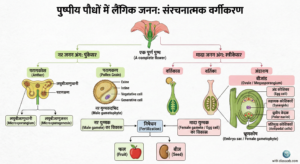
फूल में – नर और मादा जनन-संरचनाएँ अलग-अलग विकसित होती हैं
Androecium (पुंकेसर समूह) = नर जनन अंग
Gynoecium (स्त्रीकेसर/जायांग) = मादा जनन अंग
Embryo sac structure 7 celled 8 nucleate diagram class 12
Sexual reproduction in flowering plants Easy Notes Class 12

1.2.1 Stamen, Microsporangium and Pollen Grain
पुंकेसर, लघुबीजाणुधानी और परागकण

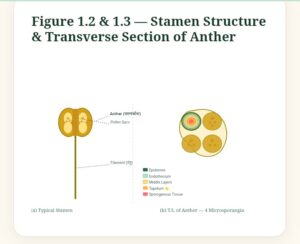
Stamen (पुंकेसर) की संरचना

एक सामान्य पुंकेसर के दो भाग होते हैं:

भाग नाम विशेषता
लम्बा पतला डंठल Filament (तंतु) थैलेमस या पंखुड़ी से जुड़ा होता है
अंतिम द्विपालित संरचना, Anther (परागकोश) परागकण बनाता है

याद रखें: Proximal end of filament → Thalamus/Petal से जुड़ा | Distal end → Anther

Anther (परागकोश) की संरचना

Bilobed (द्विपालित) होता है
– प्रत्येक lobe में दो theca → इसलिए anther को Dithecous (द्विकोशी) कहते हैं
– दोनों theca के बीच एक Longitudinal Groove (अनुदैर्ध्य खांच) होती है
– Anther Tetragonal (चतुर्भुजी) संरचना है
– इसमें 4 Microsporangia होते हैं — प्रत्येक lobe में 2

NEET Most Important: Anther = Dithecous + Tetragonal + 4 Microsporangia
Microsporangium की संरचना

अनुप्रस्थ काट (Transverse section) में microsporangium लगभग गोलाकार दिखता है। इसकी 4 दीवारी परतें होती हैं:
बाहर से अंदर की ओर:
1. Epidermis (बाह्यत्वचा)
2. Endothecium (अंतस्थीसियम)
3. Middle Layers (मध्य परतें)
4. Tapetum (टेपीटम) ← सबसे अंदर

कार्य के अनुसार:
Epidermis + Endothecium + Middle Layers → सुरक्षा और dehiscence (स्फुटन) में सहायता
Tapetum → परागकणों का पोषण करता है

महत्वपूर्ण बात: Tapetum सबसे महत्वपूर्ण परत है! यह developing pollen grains को पोषण देती है। इसकी कोशिकाओं में घना cytoplasm और एक से अधिक nucleus होते हैं।

प्रश्न जो पुस्तक पूछती है: Tapetal cells द्वि-केंद्रकी (bi-nucleate) कैसे बनती हैं?
Ans→ Endomitosis या कोशिका विभाजन के बिना केंद्रक विभाजन से।


Sporogenous Tissue (बीजाणुजनक ऊतक)

जब anther युवा होता है, तब microsporangium के केंद्र में कसकर भरी हुई समरूप कोशिकाओं का समूह होता है → इसे Sporogenous Tissue कहते हैं।

Microsporogenesis (लघुबीजाणुजनन)

परिभाषा: Sporogenous tissue की कोशिकाओं में अर्धसूत्री विभाजन (Meiosis) होता है, जिससे Microspore Tetrads बनते हैं।

Sporogenous Cells
↓ (Meiosis)
Microspore Tetrads (4 Microspores)

Pollen Grains (परागकण)

NEET Important: Microspore tetrad की ploidy = Haploid (n) क्योंकि Meiosis से बनते हैं।
Quick Revision Table (परीक्षा के लिए)


Topic Key Point
Anther shape Bilobed, Dithecous, Tetragonal
Microsporangia per anther  4 (2 per lobe)
Wall layers of microsporangium  4 — Epidermis, Endothecium, Middle layers, Tapetum
Tapetum function  Pollen grain को पोषण
Sporogenous tissue position  Microsporangium का center
Division in microsporogenesis Meiosis
Ploidy of microspore  Haploid (n)
Androecium  Male reproductive organ
Gynoecium  Female reproductive organ

NEET PYQ Pattern — Important Points

1. Tapetum की विशेषता पूछी जाती है — dense cytoplasm, multinucleate
2. Dithecous anther में microsporangia की संख्या = 4
3. Microsporogenesis में Meiosis होता है — ploidy याद रखें
4. Wall layers का क्रम बाहर से अंदर याद करें
5. Filament + Anther = Stamen (पुंकेसर के भाग)

Practice Questions

Q1. एक सामान्य angiosperm के anther में microsporangia की संख्या कितनी होती है?
→ 4

Q2. Microsporangium की सबसे भीतरी परत कौन सी है?
→ Tapetum
Q3. Micros porogenesis में कौन-सा विभाजन होता है?
→ Meiosis (अर्धसूत्री विभाजन)

Q4. Microspore tetrad की cells की ploidy क्या होगी?
→ Haploid (n)

Q5. Anther को Dithecous क्यों कहते हैं?
क्योंकि इसके प्रत्येक lobe में दो theca होते हैं।

Sexual reproduction in flowering plants Easy Notes Class 12 TOPIC 2

Pollen Mother Cell (PMC) और Microsporogenesis — विस्तार से

Sporogenous tissue की हर कोशिका एक microspore tetrad बनाने में सक्षम होती है। इसीलिए हर कोशिका को Pollen Mother Cell (PMC) भी कहते हैं।

PMC → Meiosis → Microspore Tetrad (4 microspores)

जैसे-जैसे anther परिपक्व होता है और सूखता है, microspores एक-दूसरे से अलग हो जाते हैं और pollen grains बन जाते हैं।

Teacher’s Note: एक microsporangium में हजारों microspores/pollen grains बनते हैं जो anther के dehiscence (स्फुटन) के समय बाहर निकलते हैं।

Pollen Grain (परागकण) — सम्पूर्ण अध्ययन

आकार और विविधता

परागकण विभिन्न species में अलग-अलग आकार, रंग, रूप और डिजाइन में पाए जाते हैं — यह देखकर सच में आश्चर्य होता है! (Figure 1.4 — Scanning Electron Micrograph)

परागकण की मूल जानकारी:
– सामान्यतः गोलाकार (Spherical)
– व्यास — 25-50 micrometers
– दो-स्तरीय दीवार (Two-layered wall)

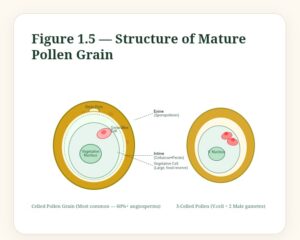
Pollen Grain की दीवार — दो परतें

 Pollen Grain की दीवार — दो परतें
 
परत  नाम  संरचना  विशेषता
 बाहरी कठोर परत  Exine Sporopollenin से बनी  सबसे resistant organic material
भीतरी पतली परत Intine Cellulose + Pectin  पतली और निरंतर परत
 Sporopollenin — NEET का पसंदीदा Topic!
 
Exine Sporopollenin से बनी होती है जो:
– अब तक ज्ञात सबसे  resistant organic material है
– उच्च तापमान सहन कर सकता है
– तेज acid और alkali को झेल सकता है
– Sporopollenin को नष्ट करने वाला कोई भी enzyme अब तक ज्ञात नहीं है
– इसीलिए पराग जीवाश्म के रूप में  करोड़ों वर्षों तक सुरक्षित रहते हैं
 
 Germ Pores: Exine में कुछ स्थानों पर sporopollenin अनुपस्थित होता है — इन्हें Germ Pores कहते हैं। ये पराग नली (pollen tube) निकलने में मदद करते हैं।
 
Pollen Grain की कोशिकाएँ (Cells inside Pollen)
 
जब पराग परिपक्व होता है, तब उसमें दो कोशिकाएँ होती हैं:
 
1. Vegetative Cell (कायिक कोशिका)
– आकार में  बड़ी
– भोजन संग्रह (food reserve) अधिक
– nucleus का आकार बड़ा और अनियमित
– पराग नली (pollen tube) बनाती है
 
2. Generative Cell (जनन कोशिका)
छोटी  कोशिका
– vegetative cell के cytoplasm में  तैरती  है
– आकार — Spindle shaped
– cytoplasm घना, nucleus स्पष्ट
–  दो  male gametes  बनाती है
 
Pollen Grain (mature)
├── Vegetative Cell (बड़ी) → Pollen Tube बनाती है
└── Generative Cell (छोटी) → 2 Male Gametes बनाती है
 
 2-celled vs 3-celled Stage
 
स्थिति  % Angiosperms  विवरण
2-celled stage पर shed 60% से अधिक Vegetative + Generative cell
3-celled stage  पर shed शेष Generative cell पहले ही divide हो जाती है
NOTE- जिन पौधों में pollen 3-celled stage पर shed होता है, वहाँ generative cell **mitosis** द्वारा divide होकर 2 male gametes बना देती है — pollen grain के अंदर ही!
 
 Pollen Allergy — जनरल नॉलेज + NEET
– कई species के pollen grains    allergiesहोती हैं
– Chronic respiratory disorders — Asthma, Bronchitis
Parthenium (carrot grass/गाजर घास) — भारत में imported wheat के साथ आया, अब सर्वत्र फैला है और pollen allergy का बड़ा कारण है
 
 Pollen as Food Supplement
– पराग में  nutrients भरपूर मात्रा में होते हैं
– Western countries में pollen tablets और syrups बिकते हैं
– Athletes और race horses की performance बढ़ाने का दावा
 
 Pollen Viability (पराग की जीवनक्षमता)
Condition Viability
Rice, Wheat 30 minutes में नष्ट
Rosaceae, Leguminosae, Solanaceae महीनों तक viable
Liquid Nitrogen (-196°C) में store करने पर वर्षों तक viable
 Stored pollen = Pollen Banks → Crop breeding programmes में उपयोगी
1.2.2- The Pistil, Megasporangium (Ovule) and Embryo Sac
वर्तिका, बीजांड और भ्रूणकोश
 Gynoecium (जायांग/स्त्रीकेसर समूह)
Gynoecium = फूल का मादा जनन अंग
 
Gynoecium के प्रकार
प्रकार   विवरण  उदाहरण
Monocarpellary एकल pistil
Multicarpellary Syncarpous अनेक pistils, आपस में जुड़े Papaver (poppy)
Multicarpellary Apocarpous अनेक pistils, अलग-अलग Michelia
 
Pistil के तीन भाग
Pistil (वर्तिका)
├── Stigma (वर्तिकाग्र) — पराग के उतरने का platform
├── Style (वर्तिका) — पतला लम्बा भाग
└── Ovary (अंडाशय) — फूला हुआ नीचे का भाग
         └── Ovarian cavity (Locule)
                  └── Placenta
                           └── Ovules (बीजांड)
 
 
NEET Point Stigma = landing platform for pollen grains
 
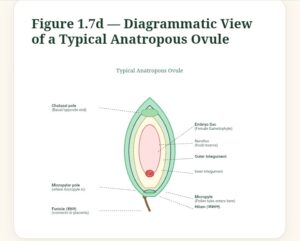
 The Megasporangium (Ovule) — बीजांड की संरचना
Ovule किससे जुड़ा होता है?
Ovule → Funicle (stalk) → Placenta
Ovule और Funicle के जुड़ाव की जगह = Hilum
 
 
Ovule की पूरी संरचना:
Ovule (बीजांड)
├── Funicle — placenta से जोड़ने वाला डंठल
├── Hilum — funicle और ovule का junction
├── Integuments (आवरण) — 1 या 2 सुरक्षात्मक परतें
│       └── Micropyle — integuments का खुला सिरा (tip)
├── Nucellus — कोशिकाओं का समूह, food reserve
│       └── Embryo Sac (भ्रूणकोश) — female gametophyte
├── Micropylar pole — micropyle की तरफ का सिरा
└── Chalazal pole — विपरीत सिरा (basal part)
 
 
Chalaza:  Micropylar end के विपरीत = ovule का  basal भाग
 
 Nucellus की विशेषता:
– इसमें  भरपूर reserve food होता है
– इसके अंदर  Embryo Sac (Female Gametophyte) स्थित होता है
– एक ovule में सामान्यतः  एक embryo sac होता है
 
 
 Megasporogenesis (बृहत्बीजाणुजनन)
 
परिभाषा: Megaspore Mother Cell (MMC) से megaspores बनने की प्रक्रिया। कहाँ होता है?
– Ovule के micropylar region में nucellus के अंदर
एक MMC विभेदित होती है
 MMC की विशेषता:
– बड़ी कोशिका
घना cytoplasm
prominent nucleus
 
प्रक्रिया:
MMC (2n)
    ↓ Meiosis
Megaspore Tetrad (4 haploid megaspores)
    ↓
3 degenerate (नष्ट हो जाते हैं)
    ↓
1 Functional Megaspore (n) ← chalazal end वाला
    ↓
Female Gametophyte (Embryo Sac)
 
NEET KEY: Chalazal end का megaspore → functional → embryo sac बनाता है। बाकी 3 degenerate हो जाते हैं।
 Female Gametophyte (Embryo Sac) — भ्रूणकोश का विकास
Monosporic Development (एकबीजाणुक विकास)
एक functional megaspore से embryo sac बनना = Monosporic development
 
विकास के चरण:
Functional Megaspore (1 nucleus, haploid)
        ↓ 3 Mitotic divisions (कुल 3 बार mitosis)
2-nucleate stage → 4-nucleate stage → 8-nucleate stage
        ↓
Mature Embryo Sac (7 cells, 8 nuclei)
 
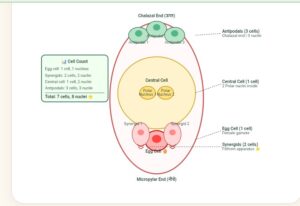
 Mature Embryo Sac — 7 कोशिकाएँ, 8 केंद्रक
 
 
यह NEET का सबसे महत्वपूर्ण topic है! ध्यान से पढ़ें:
स्थान   कोशिकाएँ संख्या   विशेषता
Micropylar end Egg cell 1 Female gamete, fertilisation होती है
Micropylar end Synergids 2 Filiform apparatus, pollen tube guide करती हैं
Chalazal end Antipodals 3 Nutritive function, बाद में degenerate
Centre  Central cell 1  2 Polar nuclei होते हैं
कुल: 1 + 2 + 3 + 1 = 7 cells
केंद्रक: 1 + 2 + 3 + 2 = 8 nuclei (central cell में 2 polar nuclei)
 
Filiform Apparatus क्या है?
– Synergids के micropylar end पर finger-like projections
– Pollen tube को egg cell तक guide करता है
 
 Super Quick Revision — Comparison Table
 Feature Microsporogenesis  Megasporogenesis
मातृ कोशिका | PMC (Pollen Mother Cell) PMC (Pollen Mother Cell) MMC (Megaspore Mother Cell)
विभाजन Meiosis Meiosis
उत्पाद  4 Microspores (सभी functional) 4 Megaspores (1 functional, 3 degenerate)
Ploidy  Haploid (n)  Haploid (n)
स्थान  Anther  Ovule (micropylar region)

 NEET Most Asked Points — Checklist

 
– [ ] Pollen grain — 25-50 micrometres
– [ ] Exine = Sporopollenin (most resistant)
– [ ] Germ pores — sporopollenin absent
– [ ] Intine = Cellulose + Pectin
– [ ] Mature pollen = 2 cells (Vegetative + Generative)
– [ ] 60% angiosperms shed pollen at 2-celled stage
– [ ] Rice/Wheat pollen viable for 30 minutes only
– [ ] Pistil = Stigma + Style + Ovary
– [ ] Ovule attached by Funicle to Placenta
– [ ] Hilum = junction of funicle and ovule
– [ ] MMC undergoes Meiosis → 4 megaspores
– [ ] Only 1 functional megaspore (chalazal)
– [ ] Embryo sac = 7 cells + 8 nuclei
– [ ] Central cell = 2 polar nuclei
– [ ] Synergids have Filiform Apparatus
– [ ] Antipodals = 3 (chalazal end)
– [ ] Monosporic development = from 1 megaspore
 
 
FAQ  Practice Questions
 
Q1. Pollen grain की exine किससे बनी होती है?
Sporopollenin
Q2. Mature pollen grain में कितनी cells होती हैं?
2 (Vegetative + Generative)
 
Q3. Embryo sac में कितने nuclei होते हैं?
8 nuclei
 
Q4. Filiform apparatus किस कोशिका में पाया जाता है?
Synergids में
 
Q5. Megasporogenesis में कितने megaspores बनते हैं और कितने functional होते हैं?
4 बनते हैं, सिर्फ 1 functional (chalazal end वाला)
 
Q6. Ovule को placenta से जोड़ने वाली संरचना का नाम?
Funicle
 
Q7. किस पौधे में pollen 30 minutes में viability खो देता है?
Rice और Wheat
Pollination (परागण), Double Fertilisation (द्विनिषेचन),
 

Sexual reproduction in flowering plants Easy Notes Class 12 TOPIC -3Final Part Notes
Double Fertilisation → Post Fertilisation → Seed → Fruit → Apomixis
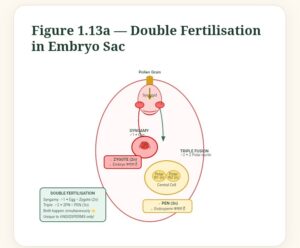
1.3  Double Fertilisation (द्विनिषेचन)
 
Sexual reproduction in flowering plants Easy Notes Class 12
 
 पहले याद करो — Pollen tube क्या करता है?
 
Pollen tube synergid में enters करता है और दो male gametes release करता है। अब यहाँ से असली कहानी शुरू होती है —
 दो fusions एक साथ होती हैं:
Fusion 1 — Syngamy (सिनगैमी):
1st Male gamete (n) + Egg cell (n)
           ↓
        Zygote (2n)
यही असली निषेचन है। Zygote बाद में embryo बनाता है।
 
Fusion 2 — Triple Fusion (त्रि-संलयन):
2nd Male gamete (n) + 2 Polar nuclei (n+n)
           ↓
Primary Endosperm Nucleus — PEN (3n)
तीन nuclei मिलकर PEN बनाते हैं, इसीलिए Triple Fusion कहते हैं।
 
Double Fertilisation क्यों कहते हैं?
क्योंकि एक embryo sac में दो अलग-अलग fusions होती हैं —
– Syngamy (egg के साथ)
– Triple fusion (polar nuclei के साथ)
दोनों साथ-साथ होती हैं। यह angiosperms का unique feature है — बाकी किसी में नहीं होता!
 
NEET Key Points:
 – Syngamy → Zygote (2n) → Embryo बनाता है
 – Triple fusion → PEN (3n) → Endosperm बनाता है
– Central cell after triple fusion → Primary Endosperm Cell (PEC)
 – Double fertilisation = Syngamy + Triple fusion = Angiosperms की पहचान
 
 1.4  Post-Fertilisation: Structures and Events
 निषेचन के बाद क्या होता है?
Double fertilisation के बाद ये सब होता है —
– Endosperm का विकास
– Embryo का विकास
– Ovule → Seed बनता है
– Ovary → Fruit बनती है
इन सब को मिलाकर Post-fertilisation events कहते हैं।
 
 1.4.1  Endosperm (भ्रूणपोष)
सबसे पहले Endosperm क्यों बनता है?
Endosperm embryo से पहले develop होता है। कारण एकदम सीधा है — embryo को develop होने के लिए पोषण चाहिए। Endosperm यही nutrition provide करता है।
सोचो Embryo के विकास से पहले endosperm बनता है। Endosperm embryo के लिए भोजन का काम करता है, इसलिए इसका बनना बहुत महत्वपूर्ण होता है। ऐसे ही पहले endosperm बनता है, फिर embryo develop होता है।
 
 Endosperm कैसे बनता है?
PEN (3n)
    ↓ बार-बार विभाजन (repeated divisions)
Free Nuclear Endosperm
(पहले free nuclei बनते हैं, cell wall नहीं)
    ↓
Cell wall formation
    ↓
Cellular Endosperm (3n)
 
Coconut का example:
– Coconut water = Free nuclear endosperm (हजारों free nuclei वाला)
– White kernel (सफेद गिरी) = Cellular endosperm
 Note: नारियल के अंदर जो liquid भाग होता है, उसे coconut water कहते हैं। यह free nuclear endosperm का उदाहरण है! यह याद करने का सबसे आसान तरीका है।
 
Endosperm का क्या होता है?
Situation  Example
Embryo develop होते-होते पूरा consume हो जाता है Pea, Groundnut, Beans
 Mature seed में बचा रहता है (germination में काम आता है) Castor, Coconut, Wheat, Maize, Barley
 Seeds जिनमें endosperm बचा रहे = Albuminous seeds
Seeds जिनमें endosperm खत्म हो जाए = Non-albuminous / Ex-albuminous seeds
 

1.4.2  Embryo (भ्रूण) का विकास

 
Embryo कहाँ बनता है?
 
Zygote micropylar end पर स्थित होता है। Most zygotes तुरंत divide नहीं करते — पहले कुछ endosperm बनने का इंतजार करते हैं। यह adaptation है ताकि embryo को assured nutrition मिले।
 
Embryo Development के stages:
 
Zygote (2n)
    ↓
Proembryo
    ↓
Globular Embryo (गोलाकार)
    ↓
Heart-shaped Embryo
    ↓
Mature Embryo
 
 Early stages of embryogeny in monocots और dicots में  similar होती हैं।
 
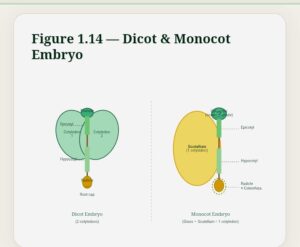
 Dicot Embryo की संरचना (Figure 1.14a)
 
एक typical dicotyledonous embryo में होता है —
 
Embryonal Axis + दो Cotyledons
 
Dicot Embryo
├── Epicotyl (ऊपर) → Plumule (shoot tip) पर end करता है
├── Two Cotyledons (दो बीजपत्र)
└── Hypocotyl (नीचे) → Radicle (root tip) पर end करता है
                              └── Root cap से ढका होता है
 
Part Position  Function
Epicotyl Cotyledon के ऊपर Plumule में end करता है — future shoot
Hypocoty Cotyledon के नीचे Radicle में end करता है — future root
Plumule Epicotyl का tip Shoot apex — पहली पत्तियाँ यहाँ से
Radicle Hypocotyl का tip  Root tip — पहली जड़ यहाँ से
Root cap Radicle के ऊपर जड़ की सुरक्षा
 
 Monocot Embryo की संरचना (Figure 1.14b)
 
Monocot में सिर्फ एक cotyledon होता है।
 
Grass family में cotyledon को Scutellum कहते हैं।
 
Monocot Embryo (Grass)
├── Scutellum (एक cotyledon) — एक तरफ (lateral) होता है
├── Coleoptile — Plumule को ढकने वाला hollow sheath
├── Coleorhiza — Radicle और root cap को ढकने वाला sheath
├── Plumule (Epicotyl में) — shoot apex
└── Radicle (Hypocotyl में) — root apex
Part किसे ढकता है
Coleoptile** | Plumule (shoot) को  Plumule (shoot) को
Coleorhiza  Radicle (root) को
 
 Memory Trick:
Cole-o-PTILE → P = Plumule (shoot)
Cole-o-RHIZA → Rhiza = Root
 
 1.4.3 🌰 Seed (बीज)
 
 Seed क्या है?
 
Seed = fertilised ovule का final product = sexual reproduction का अंतिम उत्पाद।
 
Seed को fertilised ovule” भी कहते हैं।
 
 Seed की सामान्य संरचना:
 
Seed
├── Seed coat (बीज आवरण) ← Integuments से बनता है
│    ├── Testa (outer) — outer integument से
│    └── Tegmen (inner) — inner integument से
├── Cotyledon(s) — food reserve
└── Embryo axis
     ├── Plumule
     └── Radicle
 
Micropyle का क्या होता है?
Seed coat में micropyle एक छोटे छिद्र के रूप में बना रहता है। यह germination के समय oxygen और water को seed के अंदर आने देता है।
 
Albuminous vs Non-albuminous Seeds
Type Endosperm   Examples
Albuminous (with endosperm) Mature seed में बचा रहता है Wheat, Maize, Barley, Castor, Coconut
Non-albuminous / Ex-albuminous Embryo develop होते-होते खत्म Pea, Groundnut, Beans
 
 Perisperm क्या है?
 
कुछ seeds में nucellus के कुछ cells  embryo development के बाद भी बचे  रहते हैं। यह बचा हुआ nucellus =Perisperm
Examples: Black pepper, Beet
 
 Perisperm = Persistent nucellus — यह Pericarp से बिल्कुल अलग है!
 
 Seed Dormancy (बीज प्रसुप्ति)
 
जैसे-जैसे seed mature होता है —
– Water content कम होता है (10-15% moisture रह जाती है)
– Metabolic activity धीमी पड़ जाती है
– Embryo **dormancy** में चला जाता है
 
Dormancy से बाहर कब आता है?
जब मिले — adequate moisture + oxygen + suitable temperature
सबसे पुराना viable seed:
Lupinus arcticus — Arctic Tundra से मिला — 10,000 साल बाद germinate हुआ!
Phoenix dactylifera (Date palm) — 2000 साल पुराना — King Herod’s palace के पास मिला
 Seed = Agriculture की नींव! Dehydration और dormancy की वजह से seeds को store किया जा सकता है और अगले season में crop उगाया जा सकता है।
 1.4.4 Fruit (फल)🍎
 Fruit कैसे बनता है?
Ovules → Seeds बनते हैं और साथ-साथ Ovary → Fruit बनता है।
Ovary wall → Pericarp (फल भित्ति)
 True Fruit vs False Fruit:
Type किससे बनता है  Example
True Fruit  सिर्फ Ovary से  Mango, Tomato, Grapes
False Fruit (Pseudocarp)  Thalamus + Ovary दोनों से  Apple, Strawberry
Apple में:
– Fleshy edible part → Thalamus से बनता है
– Hard core (seeds वाला) → Ovary से बनता है
 
 Parthenocarpic Fruits (अनिषेक फल):
 
कुछ species में  बिना fertilisation के fruit develop हो जाता है।
ऐसे fruits = Parthenocarpic fruits
Example: Banana
 
इन्हें growth hormones apply करके artificially induce किया जा सकता है। Parthenocarpic fruits seedless होते हैं।
 
 1.5 Apomixis and Polyembryony
 
Apomixis (असंगजनन)
 
परिभाषा: बिना fertilisation के seeds का बनना = Apomixis
यह asexual reproduction का एक रूप है जो sexual reproduction की **नकल** करता है।
 
Apomixis कहाँ होता है?
– Asteraceae family में
– Grasses में
– Citrus और Mango में (polyembryony के रूप में)
 
Apomixis के तरीके:
 
तरीका 1: कुछ species में diploid egg cell बिना reduction division के बनता है → बिना fertilisation के embryo बना देती है।
 
तरीका 2(Citrus, Mango में): Nucellus की कोशिकाएँ embryo sac में घुस जाती हैं और embryos बना देती हैं।
 
 Polyembryony (बहुभ्रूणता)
 
परिभाषा: एक seed में  एक से अधिक embryo का होना = Polyembryony
 
Example: Citrus (orange, lemon), Mango
 
संतरे के बीज में कई बार एक से अधिक embryos पाए जाते हैं। इस घटना को polyembryony कहा जाता है। — उसमें कई अलग-अलग sizes के embryos होते हैं!
 
 Apomixis का महत्व (Importance)
 
यह agriculture में बहुत important है। समझो क्यों —
 
Problem with Hybrid crops:
– Hybrid varieties बहुत अच्छी होती हैं — ज्यादा yield, disease resistant
– लेकिन हर साल नए hybrid seeds खरीदने पड़ते हैं
– क्योंकि hybrid के seeds से उगाए पौधे hybrid characters maintain नहीं करते — characters segregate हो जाते हैं
– Hybrid seeds बहुत महंगे होते हैं — farmers के लिए burden
 
Apomixis से Solution:
– अगर hybrid plants में apomixis introduce कर दें
– तो progeny में कोई segregation नहीं होगी
– Farmer उसी crop के seeds अगले साल use कर सकता है
– हर साल महंगे hybrid seeds नहीं खरीदने पड़ेंगे
– Farmers को बहुत **आर्थिक राहत** मिलेगी
 
इसीलिए दुनिया भर की laboratories में apomixis की genetics को समझने और apomictic genes को hybrid varieties में transfer करने पर active research चल रही है।
 

Sexual reproduction in flowering plants Easy Notes Class 12 Complete Chapter Summary Table

Structure Develops from  Ploidy
Zygote  Egg + Male gamete  2n
Embryo   Zygote   2n
Endosperm  PEN (triple fusion)   3n
Seed coat (Testa)   Integuments  2n
Pericarp   Ovary wall   2n
Perisperm   Nucellus remnant  2n
 
 NEET Final Checklist 
 
– [ ] Double fertilisation = Syngamy + Triple fusion — Angiosperms unique
– [ ] Syngamy → Zygote (2n) → Embryo
– [ ] Triple fusion → PEN (3n) → Endosperm
– [ ] Endosperm develops BEFORE embryo
– [ ] Coconut water = Free nuclear endosperm
– [ ] Coconut kernel = Cellular endosperm
– [ ] Albuminous seeds — Wheat, Maize, Castor, Coconut
– [ ] Non-albuminous seeds — Pea, Groundnut, Beans
– [ ] Perisperm = persistent nucellus — Black pepper, Beet
– [ ] Micropyle → facilitates O₂ and water entry during germination
– [ ] Seed moisture at maturity = 10-15%
– [ ] True fruit → from ovary only
– [ ] False fruit → Apple, Strawberry (thalamus contributes)
– [ ] Parthenocarpy → seedless fruit without fertilisation → Banana
– [ ] Coleoptile → covers plumule
– [ ] Coleorhiza → covers radicle
– [ ] Scutellum → cotyledon of monocots (grass)
– [ ] Epicotyl → above cotyledon → ends in plumule
– [ ] Hypocotyl → below cotyledon → ends in radicle
– [ ] Apomixis → seeds without fertilisation → Grasses, Asteraceae
– [ ] Polyembryony → more than one embryo → Citrus, Mango
– [ ] Apomixis importance → preserves hybrid characters, saves cost
 

Sexual reproduction in flowering plants Easy Notes Class 12 Last Important Questions

 
Q1. Coconut water किसका example है?
→ Free nuclear endosperm
 
Q2. Perisperm और Pericarp में क्या अंतर है?
→ Perisperm = seed के अंदर का persistent nucellus | Pericarp = fruit की बाहरी wall (ovary wall से)
 
Q3. Apple को false fruit क्यों कहते हैं?
→ क्योंकि fleshy edible part ovary से नहीं बल्कि thalamus से बनता है
 
Q4. Coleoptile क्या ढकता है?
→ Plumule (young shoot) को
 
Q5. Apomixis का agriculture में क्या importance है?
→ Hybrid characters को बिना segregation के maintain करता है — farmers को हर साल महंगे hybrid seeds नहीं खरीदने पड़ते
 
Q6. Endosperm की ploidy क्या है और क्यों?
→ 3n (Triploid) — क्योंकि 1 male gamete (n) + 2 polar nuclei (n+n) = 3n
 
 My Final Note: Yaar, Chapter 1 complete ho gaya! Double fertilisation, post-fertilisation events, seed aur fruit — ye sab NEET mein directly aate hain. Sabse zyada dhyan rakho — Albuminous vs Non-albuminous seeds ke examples, Perisperm vs Pericarp ka difference, aur Apomixis ka importance. Ye teen points almost har exam mein kisi na kisi form mein zaroor aate hain. All the best! 


Sexual reproduction in flowering plants Easy Notes Class 12 LEVEL 1 — Basic MCQs (Board Level)
 
Q1. The male gametophyte in angiosperms is represented by —
(a) Microsporangium
(b) Pollen grain
(c) Anther
(d) Filament
Answer: (b) Pollen grain
 
Explanation: Pollen grain itself is the male gametophyte. Anther just produces it. Many students confuse anther with male gametophyte — anther is the structure, pollen grain is the gametophyte.
 
Q2. The female gametophyte of a typical angiosperm at maturity is —
(a) 7-celled and 7-nucleate
(b) 8-celled and 8-nucleate
(c) 7-celled and 8-nucleate
(d) 8-celled and 7-nucleate
Answer: (c) 7-celled and 8-nucleate
Explanation: Central cell has 2 polar nuclei — that is why cells are 7 but nuclei are 8. This is the most asked question in NEET!
 
Q3. Which of the following is the correct sequence in microsporogenesis?
 
(a) PMC → Sporogenous tissue → Microspore tetrad → Pollen grain
(b) Sporogenous tissue → PMC → Microspore tetrad → Pollen grain
(c) Sporogenous tissue → Microspore tetrad → PMC → Pollen grain
(d) PMC → Microspore tetrad → Sporogenous tissue → Pollen grain
 Answer: (b) Sporogenous tissue → PMC → Microspore tetrad → Pollen grain
Explanation: Always remember — Sporogenous tissue comes first, then each cell becomes PMC, then meiosis gives a tetrad, then the pollen grain forms.
 
Q4. Tapetum is —
(a) Outermost layer of microsporangium
(b) Innermost layer of microsporangium
(c) Middle layer of microsporangium
(d) Layer just below epidermis
 Answer: (b) Innermost layer of microsporangium
Explanation: Order from outside to inside — Epidermis → Endothecium → Middle layers → Tapetum. Tapetum is the innermost and most important layer.
 
Q5. Pollination in Vallisneria is an example of —
(a) Anemophily
(b) Entomophily
(c) Hydrophily
(d) Ornithophily
 Answer: (c) Hydrophily
Explanation: Vallisneria uses water for pollination. Male flowers/pollen are released on water surface and carried by water currents to female flower.
 
Q6. Which of the following is NOT a wind-pollinated plant?
 
(a) Maize
(b) Grasses
(c) Vallisneria
(d) Wheat
 
 Answer: (c) Vallisneria
 
Explanation: Vallisneria is water-pollinated. Maize, grasses and wheat are all wind-pollinated. Easy elimination question.
 
Q7. Filiform apparatus is present in —
 
(a) Antipodal cells
(b) Synergids
(c) Egg cell
(d) Central cell
Answer: (b) Synergids
 
Explanation: Synergids have special finger-like thickenings at their micropylar tip called filiform apparatus. It guides the pollen tube into the egg cell.
 
Q8. Triple fusion involves fusion of —
 
(a) 2 polar nuclei + egg cell
(b) 1 male gamete + egg cell
(c) 1 male gamete + 2 polar nuclei
(d) 2 male gametes + 1 polar nucleus
 
 Answer: (c) 1 male gamete + 2 polar nuclei
 
Explanation: Three nuclei fuse — 1 male gamete (n) + 2 polar nuclei (n+n) = PEN (3n). That is why called triple fusion.
 
Q9. Primary Endosperm Nucleus (PEN) is —
 
(a) Diploid (2n)
(b) Haploid (n)
(c) Triploid (3n)
(d) Tetraploid (4n)
 
 Answer: (c) Triploid (3n)
Explanation: 1 male gamete (n) + 2 polar nuclei (n+n) = 3n. So, PEN is always triploid.
 
Q10. Cleistogamous flowers are —
 
(a) Flowers that open at night
(b) Flowers that never open
(c) Flowers that open only in water
(d) Flowers that open only in sunlight
 
Answer: (b) Flowers that never open
 
Explanation: Cleisto means closed. These flowers never open, anthers dehisce inside the closed flower, so only autogamy happens.
 

 LEVEL 2 — Medium MCQs (NEET Level)

 
Q11. Geitonogamy is —
 
(a) Functionally, cross-pollination and genetically also cross-pollination
(b) Functionally self-pollination and genetically cross-pollination
(c) Functionally, cross-pollination and genetically self-pollination
(d) Both functionally and genetically self-pollination
 
 Answer: (c) Functionally cross-pollination and genetically self-pollination
Explanation: This is the most tricky point of this chapter! Geitonogamy involves a pollinating agent (so functionally cross) but pollen comes from the same plant (so genetically self). Don’t mix this up!
 
Q12. The ploidy of the microspore is —
 
(a) 2n
(b) n
(c) 3n
(d) 4n
 
 Answer: (b) n (Haploid)
 
Explanation: PMC is 2n. After meiosis → microspores are haploid (n). Simple — meiosis always halves the chromosome number.
 
Q13. In the majority of angiosperms, pollen grains are shed at which stage?
 
(a) 1-celled stage
(b) 2-celled stage
(c) 3-celled stage
(d) 4-celled stage
 
Answer: (b) 2-celled stage
 
Explanation: In more than 60% of angiosperms, pollen is shed when it has a vegetative cell + generative cell = 2-celled stage. In the remaining species, it sheds at the 3-celled stage.
 
Q14. Which part of the pistil recognises the pollen?
 
(a) Ovary
(b) Style
(c) Stigma
(d) Placenta
 
 Answer: (c) Stigma
 
Explanation: Stigma is the landing platform for pollen. Recognition (compatible or incompatible) happens right here through chemical interaction.
 
Q15. Sporopollenin is present in —
 
(a) Intine of pollen grain
(b) Exine of a pollen grain
(c) Tapetum layer
(d) Endothecium layer
 
 Answer: (b) Exine of pollen grain
 
Explanation: Exine is the hard outer wall made of sporopollenin. Intine is an inner soft wall made of cellulose and pectin. Never confuse these two.
 
Q16. Which of the following prevents BOTH autogamy and geitonogamy?
 
(a) Monoecious condition
(b) Dichogamy
(c) Dioecious condition
(d) Self-incompatibility
 Answer: (c) Dioecious condition
 
Explanation: In dioecious plants (like Papaya), male and female flowers are on separate plants. So, same-flower (autogamy) and same-plant (geitonogamy) pollination both become impossible.
 
Q17. The pollen tube enters the ovule through —
 
(a) Chalaza
(b) Hilum
(c) Micropyle
(d) Funicle
 Answer: (c) Micropyle
 
Explanation: Micropyle is the small opening in the integuments. Pollen tube enters through micropyle → goes into synergid → releases male gametes.
 
Q18. Which wall layer of the microsporangium helps in the dehiscence of the anther?
 
(a) Tapetum
(b) Middle layers
(c) Endothecium
(d) Epidermis
 
 Answer: (c) Endothecium
Explanation: Endothecium develops fibrous thickenings and helps in the opening (dehiscence) of anther to release pollen. Tapetum is for nutrition.
 
Q19. In water-pollinated plants like Vallisneria, pollen grains are protected from wetting by —
 
(a) Sporopollenin coating
(b) Mucilaginous covering
(c) Waxy covering
(d) Cellulose covering
 
 Answer: (b) Mucilaginous covering
Explanation: In water-pollinated plants, pollen has a mucilaginous (sticky, slippery) covering that prevents it from getting wet and damaged in water.
 
Q20. Viability of pollen in rice and wheat is only —
 
(a) 30 hours
(b) 30 days
(c) 30 minutes
(d) 3 days
 Answer: (c) 30 minutes
Explanation: Rice and wheat pollen lose viability very quickly — within just 30 minutes of release. That is why these crops need very efficient and fast pollination.
 

 LEVEL 3 — NEET Tough MCQs For Exam

 
Q21. Number of mitotic divisions required to form an 8-nucleate embryo sac from a functional megaspore is —**
 
(a) 2
(b) 3
(c) 4
(d) 8
 Answer: (b) 3
Explanation: 1 nucleus → 2 (1st mitosis) → 4 (2nd mitosis) → 8 (3rd mitosis). So exactly 3 mitotic divisions.
 
Q22. Which of the following is NOT a feature of wind-pollinated flowers?
 
(a) Light non-sticky pollen
(b) Large feathery stigma
(c) Brightly coloured petals
(d) Well-exposed stamens
Answer: (c) Brightly coloured petals
Explanation: Wind-pollinated flowers don’t need to attract any animal, so they have no need for colourful petals. Bright colours are a feature of insect-pollinated flowers.
 
Q23. Parthenium (carrot grass) came to India as a contaminant in —
 
(a) Imported rice
(b) Imported wheat
(c) Imported maize
(d) Imported barley
 Answer: (b) Imported wheat
 
Explanation: Parthenium hysterophorus (gajar ghaas) came to India as a contaminant with imported wheat. It causes serious pollen allergy in humans.
 
Q24. In angiosperms, the mature male gametophyte has —
 
(a) 1 vegetative cell and 1 generative cell
(b) 1 vegetative cell and 2 male gametes
(c) Both (a) and (b) are correct
(d) Only 1 cell
 
 Answer: (c) Both (a) and (b) are correct
 
Explanation: When pollen is 2-celled, it has a vegetative cell + a generative cell. When it is 3-celled — generative cell is already divided into 2 male gametes. Both are mature forms depending on the species.
 
Q25. Which of the following plants shows polyembryony?
 
(a) Rice
(b) Wheat
(c) Citrus
(d) Pea
 
Answer: (c) Citrus
 
Explanation: Citrus (orange, lemon) and Mango show polyembryony — more than one embryo in a single seed. This is a classic example always asked in exams.
 
Q26. Emasculation is carried out —
 
(a) After anthers dehisce
(b) Before anthers dehisce
(c) After pollination
(d) After fertilisation
 
 Answer: (b) Before anthers dehisce
 
Explanation: The whole purpose of emasculation is to prevent self-pollination. So it MUST be done before anthers open and release pollen. If done after dehiscence — self-pollination already happened — no use.
 
Q27. The ‘tassels’ seen in maize cob are actually —
 
(a) Male flowers
(b) Stigma and style
(c) Anthers
(d) Sepals
 
Answer: (b) Stigma and style
 
Explanation: In maize, the silky threads/tassels you see are the stigma and style that wave in wind to trap pollen grains. Beautiful example of wind pollination adaptation.
 
Q28. Which type of pollination brings genetically different pollen to the stigma?
 
(a) Autogamy
(b) Geitonogamy
(c) Xenogamy
(d) Both (a) and (b)
 
 Answer: (c) Xenogamy
 
Explanation: Only xenogamy (cross-pollination from different plant) brings genetically different pollen. Autogamy and geitonogamy both use same plant’s pollen — so genetically same.
 
Q29. An anther has 4 microsporangia. If each microsporangium has 50 PMCs, how many pollen grains will be produced?
 
(a) 200
(b) 400
(c) 800
(d) 1600
 Answer: (c) 800
 
Explanation: 1 PMC → meiosis → 4 microspores/pollen grains. So 50 PMCs → 200 pollen grains per microsporangium. 4 microsporangia × 200 = 800 pollen grains. Simple multiplication!
 
Q30. Apomixis is most commonly found in —
 
(a) Legumes
(b) Grasses
(c) Aquatic plants
(d) Trees
 
Answer: (b) Grasses
 
Explanation: Apomixis — seed formation without fertilisation — is particularly found in grasses. This is directly mentioned in NCERT so it comes directly in exams.*
 

 Quick Summary — Most Repeated NEET Points in Exams


Nimber Topic   Most Tricky Point 
1 Embryo sac   7-celled BUT 8-nucleate 
2 Geitonogamy   Functionally cross — Genetically self
3 Tapetum   Innermost layer — provides nutrition + sporopollenin
4 Triple fusion   1 male gamete + 2 polar nuclei = 3n PEN
5 Pollen viability   Rice/wheat = 30 minutes only
6 Sporopollenin   Most resistant organic material — in exine
7 Cleistogamous  Never opens — always autogamy
8 Dioecy   Prevents BOTH autogamy + geitonogamy
9 Apomixis   Seeds without fertilisation — mainly grasses
10 Apomixis  Seeds without fertilisation — mainly grasses
 My Suggestion: Yaar, ek baat yaad rakho — NEET mein Chapter 1 se minimum 3-4 questions aate hain guaranteed. Embryo sac wala question, triple fusion, geitonogamy ka tricky point aur tapetum — ye sab baar baar aate hain. Inhe ek baar achhe se samajh lo, ratta mat maaro — samajhoge toh kabhi bhoologe nahi!
 Chapter 1: Sexual Reproduction in Flowering Plants
 

Sexual reproduction in flowering plants Easy Notes Class 12

 
 Q1. Name the parts of an angiosperm flower in which the development of the male and female gametophytes takes place.
 
Answer: See, this question is very simple but students often get confused between the two. So let me explain it clearly —
Male gametophyte develops inside the Anther (specifically inside the microsporangia/pollen sacs of the anther). The pollen grain itself IS the male gametophyte.
The female gametophyte develops inside the  Ovule  (specifically inside the nucellus of the ovule). The embryo sac IS the female gametophyte.
 
So simply put —
– Anther → Male gametophyte (Pollen grain)
– Ovule → Female gametophyte (Embryo sac)
Question and Answer Download kare KLICK 
Mobile par Downlod kar ne keliye yaha CLICK 

Sexual reproduction in flowering plants Easy Notes Class 12, Important Images
Sexual reproduction in flowering plants Easy Notes Class 12Sexual reproduction in flowering plants Easy Notes Class 12Sexual reproduction in flowering plants Easy Notes Class 12Sexual reproduction in flowering plants Easy Notes Class 12

Sexual reproduction in flowering plants Easy Notes Class 12

Leave a Reply

Your email address will not be published. Required fields are marked *

Scroll to Top