

Class 8 geography chapter 3 agriculture notes
Teacher: Mr Om Sikrwar | Characters: Arjun, Priya, Rohan, Sonu
Agriculture class 8 geography summary
Agriculture is the backbone of human civilisation. In Class 8 Geography Chapter 3, students learn about types of farming, major crops of the world, and agricultural development. In this lesson, Mr Om Sikrwar explains the entire chapter through a simple classroom story with four students — Arjun, Priya, Rohan and Sonu.
Scene 1 — A Golden Morning in the Fields
One bright morning, four friends — Arjun, Priya, Rohan and Sonu — were walking past the fields near their village. A farmer was busily tilling his land.
Rohan (excitedly): “Uncle, what are you doing? This land was bare just last week!”
Farmer: “Son, I am preparing to sow wheat. I have already added manure, and now I am ploughing the soil.”
Priya: “So the bread we eat every day — it all starts right here!”
Mr Sikrwar Explains — What is Agriculture?
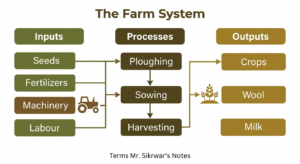
Agriculture Class 8 Geography Chapter 3 | MP3 Audio Notes + PDF Notes for Students
Mr Sikrwar (stepping forward): “Exactly, Priya! This is agriculture. The word comes from two Latin words — Ager, meaning soil and Culture, meaning cultivation. Agriculture is a primary activity.”
Mr Sikrwar drew three circles on the ground with a stick and explained:
|
Activity |
Meaning |
Examples |
|
Primary |
Direct extraction from nature |
Farming, fishing, gathering |
|
Secondary |
Processing raw materials into finished goods |
Baking bread, weaving cloth, and steelmaking |
|
Tertiary |
Providing services |
Banking, transport, trade, insurance |
Sonu: “So growing wheat is primary, baking biscuits is secondary, and selling at the market is tertiary!”
Mr Sikrwar: “Absolutely right! Well done, Sonu!”
Scene 2 — Types of Farming
Everyone sat beneath a mango tree at the edge of the field and drank water. Arjun: “Sir, is farming done the same way everywhere in the world?”
Mr Sikrwar: “Not at all! Farming takes many forms. Let us go through them one by one.”
-
A) Subsistence Farming
When a farmer grows crops only to feed his own family — not for sale — it is called subsistence farming. It has two forms:
|
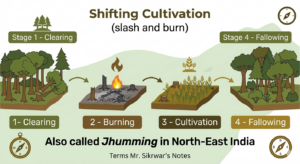
1. Intensive Subsistence Farming — Small plots, high labour, two to three crops per year on the same land. Practised in densely populated monsoon regions of South, South-East and East Asia. Principal crop — rice. 2. Primitive Subsistence Farming — Two methods: * Shifting Cultivation (Slash and Burn): Trees are felled and burnt; ash enriches the soil. Crops such as maize, yam and cassava are grown. Once fertility is exhausted, the plot is abandoned and a new one cleared. Known as Jhumming (North-East India), Milpa (Mexico), Roca (Brazil), Ladang (Malaysia). * Nomadic Herding: Herders move across semi-arid regions — Sahara, Central Asia, parts of India — with sheep, camels, yak and goats, following defined routes in search of fodder and water. |
-
B) Commercial Farming
When crops and livestock are raised for sale in the market, using large tracts of land, heavy machinery and substantial capital, it is commercial farming.
|
Type |
Key Features |
Major Regions |
|
Commercial Grain Farming |
Wheat and maize; vast farms; sparse population; severe winters limit crops to one per year |
Temperate grasslands of North America, Europe and Asia |
|
Mixed Farming |
Crops and livestock reared together |
Europe, eastern USA, Argentina, south-east Australia, New Zealand, South Africa |
|
Plantation Agriculture |
Single crop over vast area; heavy labour and capital; transport network essential |
Tea (India/Sri Lanka), Coffee (Brazil), Rubber (Malaysia), Sugar cane, Cashew |
Scene 3 — Identifying Major Crops
A market stall nearby displayed a variety of crops. Mr Sikrwar handed each friend a different sample and explained:
|
Crop |
Climate & Soil |
Major Producers |
|
Rice |
High temperature, high humidity, heavy rainfall; alluvial clayey soil that retains water. Kharip Crop |
China (the largest producer), India, Japan, Sri Lanka, Egypt |
|
Wheat |
Moderate temperature during growing season; bright sunshine at harvest; well-drained loamy soil. |
USA, Canada, Russia, Ukraine, Australia, India (winter crop) |
|
Millets |
Coarse grains grow on less fertile, sandy soils; low rainfall; hardy crop. Varieties: jowar, bajra, ragi. |
India, Nigeria, China, Niger |
|
Maize |
Moderate temperature, ample rainfall, lots of sunshine; well-drained, fertile soils. |
North America, Brazil, China, Russia, Canada, India, Mexico |
|
Cotton |
High temperature; light rainfall; 210 frost-free days; bright sunshine; black and alluvial soils. |
China, USA, India, Pakistan, Brazil, Egypt |
|
Jute — the Golden Fibre |
High temperature; heavy rainfall; humid climate; alluvial soil. |
India and Bangladesh (leading producers) |
|
Coffee |
Warm, wet climate; well-drained loamy soil; hill slopes preferred. |
Brazil (leading producer), Colombia, India |
|
Tea |
Cool climate; gentle slopes; well-drained loamy soil; high, well-distributed rainfall. |
Kenya, India, China, Sri Lanka (finest quality) |
Scene 4 — India and the USA: A Tale of Two Farms
Sonu: “Sir, both India and the USA practise agriculture — so what makes them different?”
Mr Sikrwar: “Excellent question! Let me tell you about two farmers — Munna Lal from India and Joe Horan from the USA.”
|
India — Munna Lal (Ghazipur, Uttar Pradesh) Farm size: 1.5 hectares Crops: wheat and rice Tools: bullocks for ploughing; rented tractor; tubewell for irrigation Sells produce at the local mandi Keeps two buffaloes and hens Family members assist with all tasks. Member of a co-operative society Occasionally borrows from a bank or the co-operative for seeds and implements |
USA — Joe Horan (Iowa State) Farm size: approximately 300 hectares Crop: maize Technology: satellite-linked computer; soil-testing laboratory Scientific fertiliser programme Modern heavy machinery throughout manages the farm largely on his own. Monitors soil and water resources precisely. Takes careful measures to control pests |
Priya: “So India is a developing country with small farms and intensive labour, while the USA is a developed country with vast farms and advanced technology!”
Mr Sikrwar: “Precisely, Priya. Both grow food, but the scale and the methods are worlds apart.”
Scene 5 — Agricultural Development and the Final Lesson
Arjun: “Sir, can Indian agriculture be improved further?”
Mr Sikrwar: “Absolutely! That is what Agricultural Development means — efforts to increase farm production so as to meet the growing demand of an ever-increasing population.”
|
Aspects of Agricultural Development: Increasing the area of cultivated land Using High-Yielding Variety (HYV) seeds Improving irrigation facilities Using fertilisers and pesticides correctly Mechanisation — tractors, harvesters Training farmers in modern agricultural practices Improving storage and market linkages Ultimate aim: Food Security |
Rohan: “So food security means every person has access to enough safe and nutritious food at all times?”
Mr Sikrwar: “Word perfect, Rohan. Food security exists when all people, at all times, have access to sufficient, safe and nutritious food to meet their dietary needs and food preferences for an active and healthy life.”
Chapter Summary — From Mr Sikrwar’s Notes
- Agriculture is a primary activity — it involves growing crops, fruits, vegetables and rearing livestock.
- Two main types of farming: Subsistence Farming and Commercial Farming. 3. Shifting cultivation (slash and burn) is also called Jhumming in North-East India.
- Plantation agriculture involves a single crop grown on a large scale; transport networks are essential.
- Rice — China is the leading producer; Wheat — USA, Canada, Russia, India; Cotton — China, USA, India.
- Jute is known as the ‘Golden Fibre’; India and Bangladesh are the leading producers.
- Tea — Kenya, India, China, Sri Lanka; Coffee — Brazil is the largest producer. 8. India: small farms, intensive labour | USA: vast farms, advanced technology. 9. Agricultural Development aims ultimately at achieving Food Security for all.
Word Origin of ‘Agriculture’: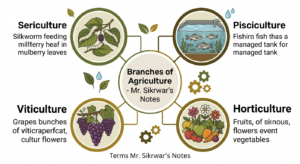 From Latin Ager (soil/field) + Cultura (cultivation/tilling). The word literally means ‘cultivating the soil’. Related Terms: Sericulture — commercial rearing of silkworms Pisciculture — breeding of fish in specially constructed tanks and ponds Viticulture — cultivation of grapes Horticulture — growing vegetables, flowers and fruits for commercial use |
|
Subject: |
Agriculture Class 8 Geography Chapter 3 |
|
Class: |
8 CBSE and Other States |
|
Teacher: |
Mr Om Sikrwar |
|
Language: |
British English |
|
Sections: |
MCQ | Fill in the Blanks | Short Answer | Long Answer . You can freely download Notes |
Class 8 geography chapter 3 agriculture notes MCQ
Q1. Agriculture is classified as which type of economic activity?
- A) Secondary
- B) Tertiary
- C) Primary ✓
- D) Quaternary
Answer: (C)
Explanation: Agriculture involves the direct extraction and production of natural resources — crops, fruits, vegetables and livestock — so it is a Primary activity.
Q2. Which of the following is NOT an example of a primary activity?
- A) Fishing
- B) Gathering
- C) Weaving cloth ✓
- D) Farming
Answer: (C)
Explanation: Weaving cloth is a Secondary activity because it processes raw material (cotton) into a finished product. Fishing, gathering and farming all involve direct extraction from nature.
Q3. The word ‘agriculture’ comes from which language?
- A) Greek
- B) French
- C) Sanskrit
- D) Latin ✓
Answer: (D)
Explanation: The word comes from Latin — Ager meaning soil or field, and Cultura meaning cultivation or tilling.
Q4. Which type of farming is practised to meet the needs of the farmer’s own family?
- A) Commercial farming
- B) Subsistence farming ✓
- C) Plantation agriculture
- D) Mixed farming
Answer: (B)
Explanation: Subsistence farming is carried out using low levels of technology and household labour to produce a small output — just enough for the family’s needs.
Q5. Shifting cultivation is also known as ‘slash and burn’ agriculture. What is it called in North-East India?
- A) Milpa
- B) Ladang
- C) Roca
- D) Jhumming ✓
Answer: (D)
Explanation: In North-East India it is called Jhumming. Other regional names include Milpa (Mexico), Roca (Brazil) and Ladang (Malaysia).
Q6. In which regions is nomadic herding mainly practised?
- A) Tropical rainforests
- B) Semi-arid and arid regions ✓
- C) Coastal plains
- D) River deltas
Answer: (B)
Explanation: Nomadic herding is practised in the semi-arid and arid regions of the Sahara, Central Asia, and parts of India such as Rajasthan and Jammu & Kashmir.
Q7. Which crop is the staple food of tropical and sub-tropical regions?
- A) Wheat
- B) Maize
- C) Rice ✓
- D) Millets
Answer: (C)
Explanation: Rice is the major food crop of the world and the staple diet of tropical and sub-tropical regions. It needs high temperature, high humidity and heavy rainfall.
Q8. Wheat grows best in which type of soil?
- A) Black cotton soil
- B) Clayey soil
- C) Well-drained loamy soil ✓
- D) Sandy soil
Answer: (C)
Explanation: Wheat thrives in well-drained loamy soil. It requires moderate temperature during the growing season and bright sunshine at the time of harvest.
Q9. Jute is commonly known as the ‘Golden Fibre’. Which two countries are its leading producers?
- A) China and Japan
- B) India and Bangladesh ✓
- C) Brazil and Argentina
- D) USA and Canada
Answer: (B)
Explanation: Jute grows well on alluvial soil and requires high temperature, heavy rainfall and a humid climate. India and Bangladesh are the leading producers in the world.
Q10. Which country is the leading producer of coffee in the world?
- A) India
- B) Colombia
- C) Brazil ✓
- D) Kenya
Answer: (C)
Explanation: Brazil is the world’s leading producer of coffee, followed by Colombia and India. Coffee requires a warm and wet climate with well-drained loamy soil.
Q11. What is plantation agriculture?
- A) Growing several crops on a small plot
- B) Growing a single crop on a large area with heavy capital ✓
- C) Farming for only the family’s needs
- D) Rearing animals in the desert
Answer: (B)
Explanation: Plantation agriculture involves growing a single crop such as tea, coffee, rubber or sugarcane over a large area. It requires a large amount of labour and capital, and a well-developed transport network.
Q12. Which of the following is a fibre crop?
- A) Rice
- B) Maize
- C) Cotton ✓
- D) Coffee
Answer: (C)
Explanation: Cotton is a fibre crop. It is one of the most important raw materials for the textile industry. Jute is the other major fibre crop covered in this chapter.
Q13. China leads in the production of which crop?
- A) Jute
- B) Rice ✓
- C) Coffee
- D) Tea
Answer: (B)
Explanation: China is the world’s leading producer of rice, followed by India, Japan, Sri Lanka and Egypt.
Q14. Cotton requires how many frost-free days for its growth?
- A) 100
- B) 150
- C) 180
- D) 210 ✓
Answer: (D)
Explanation: Cotton requires high temperature, light rainfall, two hundred and ten frost-free days and bright sunshine for its growth. It grows best on black and alluvial soils.
Q15. Which type of farming uses land for both growing crops and rearing livestock together?
- A) Commercial grain farming
- B) Plantation agriculture
- C) Mixed farming ✓
- D) Intensive subsistence farming
Answer: (C)
Explanation: In mixed farming, the land is used for growing food and fodder crops as well as rearing livestock. It is widely practised in Europe, eastern USA, Argentina, south-east Australia, New Zealand and South Africa.
Q16. The ultimate aim of agricultural development is to ensure what?
- A) Higher crop prices
- B) Food security ✓
- C) More land for farming
- D) Bigger machinery
Answer: (B)
Explanation: The ultimate aim of agricultural development is to increase food security — ensuring that all people, at all times, have access to sufficient, safe and nutritious food.
Q17. Horticulture refers to which of the following activities?
- A) Commercial rearing of silkworms
- B) Breeding fish in tanks
- C) Cultivation of grapes
- D) Growing vegetables, flowers and fruits commercially ✓
Answer: (D)
Explanation: Horticulture is the growing of vegetables, flowers and fruits for commercial use. Sericulture = silkworms; Pisciculture = fish breeding; Viticulture = grapes.
Q18. Which of the following countries is noted for its tea production?
- A) Brazil
- B) USA
- C) Kenya ✓
- D) Mexico
Answer: (C)
Explanation: Kenya, along with India, China and Sri Lanka, is known for producing the finest quality tea in the world. Tea requires a cool climate, gentle slopes and heavy, well-distributed rainfall.
Q19. Intensive subsistence agriculture is most common in which region?
- A) Temperate grasslands of North America
- B) Densely populated monsoon regions of South and East Asia ✓ C) Arid regions of Africa
- D) Polar regions
Answer: (B)
Explanation: Intensive subsistence agriculture is prevalent in the thickly populated monsoon regions of South, South-East and East Asia. Rice is the main crop, and more than one crop is grown annually on the same plot.
Q20. Which of the following is a correct description of ‘arable land’?
- A) Land covered by forests
- B) Land used for grazing animals
- C) Land on which crops are grown ✓
- D) Land that is permanently flooded
Answer: (C)
Explanation: Arable land is the land on which crops are grown. Favourable topography of soil and climate are vital for agricultural activity on arable land.
Class 8 Geography Chapter 3 Agriculture Notes: Fill in the Blanks
Section B — Fill in the Blanks (15 Questions)
Fill in each blank with the correct word or phrase. The answers are given below each question.
Q1. Agriculture is a ___________ activity.
Answer: primary
Q2. The word ‘agriculture’ comes from the Latin words ___________ meaning soil and ___________ meaning cultivation.
Answer: Ager / cultura
Q3. Shifting cultivation is also known as ‘___________’ agriculture. Answer: slash and burn
Q4. In North-East India, shifting cultivation is called ___________. Answer: Jhumming
Q5. ___________ farming is practised to meet the needs of the farmer’s family only.
Answer: Subsistence
Q6. Rice grows best in ___________ soil that can retain water. Answer: alluvial clayey
Q7. Jute is known as the ‘___________ Fibre’.
Answer: Golden
Q8. ___________ is the leading producer of coffee in the world. Answer: Brazil
Q9. Cotton requires ___________ frost-free days for its growth. Answer: 210
Q10. The ultimate aim of agricultural development is to increase ___________. Answer: food security
Q11. Growing a single crop over a very large area is called ___________ agriculture.
Answer: plantation
Q12. In ___________ farming, crops are grown alongside the rearing of livestock.
Answer: mixed
Q13. ___________, India, China and Sri Lanka are well known for producing the finest quality tea.
Answer: Kenya
Q14. Millets are also called ___________ grains.
Answer: coarse
Q15. Nomadic herding is practised in the ___________ and arid regions of the Sahara and Central Asia.
Answer: semi-arid THE END This is the third chapter Agriculture Class 8 Geography Chapter 3 | MP3 Audio Notes + PDF Notes for Students
“Agriculture feeds civilisation.” — Chapter 3 | Teacher: Mr Om Sikrwar | Class 8 Geography
Land, soil, water, natural vegetation and wildlife resources notes class 8
Class 8 Geography Agriculture PDF FREE DOWNLOAD CLICK