

Exploring the Investigative World of Science Class 8 Easy Notes
Introduction — Exploring the Investigative World of Science Class 8 Easy Notes
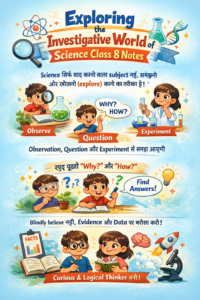
Exploring the Investigative World of Science Class 8 easy Notes हमें यह सिखाता है कि science सिर्फ याद करने वाला subject नहीं है, बल्कि समझने और खोजने (explore करने) का तरीका है। इस chapter में हम सीखते हैं कि कैसे observation, question और experiment के जरिए हम किसी भी चीज़ को अच्छे से समझ सकते हैं।
यह notes हमें encourage करता है कि हम हर चीज़ पर “why” और “how” जैसे सवाल पूछें और उनके answers खुद ढूँढने की कोशिश करें। यही investigative approach हमें real life में भी मदद करती है।
Science में हम blindly believe नहीं करते, बल्कि evidence और data पर भरोसा करते हैं।
इस तरह, Exploring the Investigative World of Science Class 8 Notes हमें एक curious और logical thinker बनाता है
Topic 1 — What is Science?
छात्रों, ध्यान से समझो।
प्रकृति और भौतिक दुनिया का व्यवस्थित अध्ययन, प्रेक्षण (observation) और प्रयोगों के माध्यम से जो सुसंगठित और विशेष ज्ञान प्राप्त होता है, उसे विज्ञान (Science) कहते हैं।
We are studying Exploring the Investigative World of Science Class 8. Science is the systematic study of nature and the physical world, gained through observation and experimentation.
विज्ञान तथ्यों (facts) पर आधारित होता है और यह “क्यों” (why) और “कैसे” (how) जैसे प्रश्नों के उत्तर खोजता है।
Science is based on facts and tries to find answers to questions like “why” and “how”.
‘Science’ शब्द लैटिन भाषा के शब्द ‘scientia’ से बना है, जिसका अर्थ है — ‘जानना’ (to know)।
The word ‘Science’ comes from the Latin word ‘scientia’, which means “to know”.
इस प्रकार, विज्ञान हमें चीज़ों को समझने, सोचने और सही निष्कर्ष तक पहुँचने में मदद करता है।
|
Om Sir का सूत्र : Science = देखो (Observe) + सवाल पूछो + जाँचो (Experiment) + समझाओ (Explain)! Om Sir’s Formula: Science = Observe + Question + Experiment + Explain. This chain never breaks! |
Nature of Science
बच्चों, एक ज़रूरी बात समझो।
विज्ञान (Science) हमेशा बदलता रहता है। जब भी कोई नया प्रेक्षण (observation) होता है, तो नई जानकारी और नए विचार सामने आते हैं।
Science is always changing. New observations lead to new ideas and better understanding.
विज्ञान में किसी भी बात को बिना सोचे-समझे स्वीकार नहीं किया जाता।
हर बात के लिए सबूत (evidence) होना बहुत ज़रूरी है।
In science, nothing is accepted blindly. Every idea must be supported by proper evidence.
हमारी कक्षा 8 में हम Investigative Science सीखेंगे,
यानि हम खुद जाँच-पड़ताल करेंगे, प्रश्न पूछेंगे और उनके उत्तर खोजेंगे।
In Class 8, we will learn Investigative Science — that means we will ask questions, explore, and find answers on our own.
Topic 2 — Steps of Scientific Investigation
विषय 3 — चर (Variables): क्या बदलता है, क्या नया है? | Variables: What Changes, What Stays?
Om Sir बोले — ‘जब हम experiment करत हैं, तो कुछ चीज़ें हम बदलत हैं और कुछ वैसी रखत हैं — इन्हें Variables (चर) कहत हैं!’
Om Sir explained — ‘When we conduct an experiment, certain things are changed whilst others remain the same. These are called Variables!’
|
Variable Type / प्रकार |
Gwalior बोली में अर्थ |
British English Meaning |
|
Independent Variable स्वतंत्र चर |
जो हम खुद बदलत हैं — जैसे आटे की मोटाई, तेल की गर्मी |
That which we deliberately alter — e.g. dough thickness, oil temperature |
|
Dependent Variable आश्रित चर |
जो खुद-ब-खुद बदलत है — जैसे पूड़ी कितनी फूली, कितने seconds में |
That which changes as a result — e.g. how much the puri puffed up, and in how many seconds |
|
Controlled Variable नियंत्रित चर |
जो हम वैसो रखत हैं — जैसे आटे का प्रकार, तेल की मात्रा |
That which remains constant throughout — e.g. type of dough, quantity of oil |
Golden Rule सुनहरा नियम
बच्चों, एक बहुत ज़रूरी नियम याद रखो —
“एक बार में सिर्फ एक ही चीज़ बदलो, नहीं तो सही कारण समझ नहीं आएगा।”
अगर तुम एक साथ कई चीज़ें बदल दोगे, तो यह पता लगाना मुश्किल हो जाएगा कि असली बदलाव किस वजह से हुआ।
The Golden Rule:
“Alter only one variable at a time — otherwise, you cannot determine which change caused the result.”
This rule is the foundation of systematic investigation in science.
Topic 4 — Matter & Particles
कक्षा में एक दिन अर्जुन ने सवाल पूछा —
“Sir, पानी, बर्फ और भाप — तीनों एक ही चीज़ लगती हैं, फिर भी इतनी अलग क्यों हैं?”
Arjun asked,
“Sir, water, ice, and steam all seem to be the same substance — yet why are they so different?”
ओम सर मुस्कुराए और समझाने लगे —
“ऐसा इसलिए है क्योंकि हर चीज़ बहुत छोटे-छोटे कणों (particles) से बनी होती है।”
Om Sir smiled and explained,
“This is because everything is made up of very tiny particles.”
उन्होंने आगे कहा —
ये कण इतने छोटे होते हैं कि हम उन्हें अपनी नंगी आँखों से देख नहीं सकते,
लेकिन इन्हीं कणों के कारण पदार्थ (matter) के रूप बदलते हैं — जैसे ठोस (solid), द्रव (liquid) और गैस (gas)।
He further added,
These particles are so small that we cannot see them with our naked eyes,
Yet they are responsible for different forms of matter — solid, liquid, and gas.
👉 यानी, भले ही पानी, बर्फ और भाप एक ही पदार्थ हों,
लेकिन उनके कणों की व्यवस्था (arrangement) और गति (movement) अलग-अलग होती है —
इसी वजह से वे अलग दिखाई देते हैं।
- ठोस (Solid): कण बहुत पास-पास, ज़्यादा हिलत-डुलत नहीं — जैसे बर्फ। — Particles are densely packed and barely move — e.g. ice.
- द्रव (Liquid): कणों में थोड़ी space, थोड़ी movement — जैसे पानी। — Particles have some space and moderate movement — e.g. water.
- गैस (Gas): कण बहुत दूर-दूर, बड़ी आज़ादी से घूमत हैं — जैसे भाप। — Particles are far apart and move about quite freely — e.g. steam.
सोनू का मज़ेदार उदाहरण (Easy to Remember)
बच्चों, सोनू ने बहुत ही मज़ेदार तरीके से समझाया —
Solid (ठोस) = Gwalior Trade Fair की भीड़ —
सब लोग एक-दूसरे से सटे हुए!
Liquid (द्रव) = सामान्य सड़क —
गाड़ियाँ पास-पास हैं, पर चल सकती हैं।
Gas (गैस) = हाईवे पर अकेली गाड़ी —
पूरा खुला स्थान, कोई रोक-टोक नहीं!
Sonu’s delightful analogy:
- Solid = A packed fair — everyone tightly packed together!
- Liquid = A normal road — vehicles are close, but can move around.
- Gas = A wide highway — a single car moving freely with lots of space!
Topic 5 — तत्व, यौगिक और मिश्रण | Elements, Compounds & Mixtures
प्रिया ने पूछा — ‘Sir, पानी और चाय दोनों liquid हैं — तो क्या दोनों एक जैसे हैं?’
Priya enquired — ‘Sir, both water and tea are liquids — are they, then, essentially the same?’
- तत्व — Element: सिर्फ एक ही प्रकार के atom होत हैं — जैसे सोना (Gold), ऑक्सीजन (O₂), लोहा (Iron)। — Contains only one type of atom — e.g. Gold (Au), Oxygen (O₂), Iron (Fe).
- यौगिक — Compound: दो या ज़्यादा elements chemically जुड़े होते हैं — जैसे पानी (H₂O), नमक (NaCl)। — Two or more elements chemically bonded — e.g. Water (H₂O), Common Salt (NaCl).
- मिश्रण — Mixture: दो या ज़्यादा substances physically मिले होते हैं — जैसे चाय, समुद्री पानी, मिट्टी। — Two or more substances physically mixed — e.g. tea, sea water, soil.
|
💡 मुख्य फर्क (Gwalior बोली में): Compound को physically अलग नहीं कर सकते — chemical reaction चाहिए। Mixture को अलग कर सकते हैं — जैसे छानना (Filter), उड़ाना (Evaporation), चुम्बक (Magnet)! Key Distinction: A Compound cannot be separated by physical means — a chemical reaction is required. A Mixture, however, may be separated physically — by filtration, evaporation, or a magnet! |
Topic 6 — प्रकाश की दुनिया (Light & Optics) | The World of Light & Optics
रोहन ने खिड़की की तरफ देखते हुए पूछा — ‘Sir, आईने में हम अपने आप को देखते हैं — ऐसे कैसे होते हैं?’
Rohan gazed towards the window and asked — ‘Sir, we see ourselves in a mirror — how exactly does this come about?’
- प्रकाश सीधी रेखा में चलता है — इसे Rectilinear Propagation कहते हैं। — Light travels in a straight line — this is known as Rectilinear Propagation.
- समतल दर्पण (Flat Mirror): प्रकाश को वापस उछालता है (Reflect) — image उतनी ही बड़ी और उतनी ही दूरी पर। — Reflects light back — the image is the same size and at the same distance.
- वक्र दर्पण (Curved Mirror): Image बड़ी या छोटी होत है — जैसे गाड़ी के side mirrors, makeup mirrors। — The image is magnified or diminished — e.g. car side mirrors, cosmetic mirrors.
- लेंस (Lens): प्रकाश को मोड़ता है (Refraction) — जैसे चश्मे के लेंस, magnifying glass। — Bends light (Refraction) — e.g. spectacle lenses, magnifying glasses.
- खुरदरी सतह भी प्रकाश reflect करती है — इसीलिए हम non-shiny चीज़ें भी देख पाते हैं! — Even rough surfaces reflect light — this is precisely why we can see non-shiny objects!
Topic 7 — चंद्रमा की कलाएं और Calendar | Moon Phases & the Calendar
सोनू ने torch की रोशनी ball पर डाली और बोली — ‘Oh! Moon खुद रोशनी नई देत — यो सूरज की रोशनी reflect करत है!’
Sonu shone a torch upon a ball and exclaimed — ‘Oh! The Moon does not emit its own light — it merely reflects sunlight!’
Om Sir बोले — ‘Earth, Moon और Sun की positions बदलत रहत हैं — इसीलिए Moon के अलग-अलग हिस्से रोशन दिखत हैं। इन्हें Moon Phases (चंद्रमा की कलाएं) कहते हैं।’
Om Sir said — ‘The relative positions of the Earth, Moon, and Sun constantly change — hence we observe different portions of the Moon illuminated. These are called Moon Phases!’
- पूर्णिमा (Purnima / Full Moon): Earth, Moon और Sun एक लाइन में — Moon, Earth के विपरीत दिशा में। — Earth, Moon, and Sun are aligned — Moon is on the opposite side of the Earth from the Sun.
- अमावस्या (Amavasya / New Moon): Moon, Earth और Sun के बीच में — हमें Moon का अँधेरा हिस्सा दिखता है। — The Moon is between Earth and the Sun — we see the Moon’s unilluminated face.
- इन lunar cycles को observe करके मनुष्यों ने पहला calendar बनाया! — By observing these very lunar cycles, our ancestors fashioned the very first calendars!
|
💡 अरजुन की insight (Gwalior बोली में): ‘मतलब हमारो calendar — चैत्र, वैशाख — सब Moon की चाल से बनो है! Science कितनी पुरानी है यार!’ Arjun’s insight: ‘So our calendar — Chaitra, Vaishakh — all of it was derived from the Moon’s movements! How ancient and magnificent Science truly is!’ |
Topic 8 — पारितंत्र और जलवायु परिवर्तन | Ecology & Climate Change
प्रिया बोली — ‘Sir, Earth कितनी अच्छी है — न ज़्यादा गर्म, न ज़्यादा ठंडी!’
Priya remarked — ‘Sir, Earth is so perfectly suited — neither too warm nor too cold!’
- Earth सूरज से बिल्कुल सही दूरी पर है — इसीलिए पानी liquid form में रहता है। — Earth is at precisely the right distance from the Sun — hence water remains in liquid form.
- वातावरण (Atmosphere): Oxygen देत है + Ozone layer, UV rays से बचाती है। — Provides us with Oxygen, and the Ozone layer protects us from harmful UV radiation.
- हर जीव अपने environment से connected है — plants, animals, soil, water — सब एक chain में। — Every living organism is connected to its environment — plants, animals, soil, water — all in one great chain.
रोहन का चेहरो serious हो गओ — ‘Sir, लेकिन हम ही तो Earth को नुकसान पहुँचात हैं?’
Rohan’s expression grew quite serious — ‘Sir, but are we not the very ones causing harm to the Earth?’
Om Sir बोले — ‘हाँ, Rohan। मानवीय गतिविधियों (Human Activities) से Earth का तापमान बढ़ता जा रहा है। Drought, floods, cyclones — सब बढ़ रहे हैं।’
Om Sir replied gravely — ‘Indeed, Rohan. Human activities are causing the Earth’s temperature to rise steadily. Droughts, floods, and cyclones are all on the increase.’
|
💡 सोनू का powerful बात (Gwalior-Morena भाव में): ‘Problem भी हम हैं, Solution भी हम हैं! Science सीख के हम बदलाव ला सकत हैं!’ Sonu’s powerful declaration: ‘The problem is us, and the solution is us! By learning and applying Science, we can bring about meaningful change!’ |
त्वरित पुनरावृत्ति — Quick Revision of Exploring the Investigative World of Science Class 8
Chapter 1 — Key Points at a Glance
बच्चों, चलो जल्दी से पूरे chapter को आसान भाषा में दोहरा लेते हैं 👇
- Science क्या है?
Science मतलब — देखो, सवाल पूछो, प्रयोग करो और समझाओ। - Investigation का Golden Rule:
एक समय में सिर्फ एक ही variable बदलो, तभी सही कारण समझ आएगा। - Variables के प्रकार:
- Independent → जिसे हम बदलते हैं
- Dependent → जो उसके कारण बदलता है
- Controlled → जिसे हम same रखते हैं
- Observation बहुत ज़रूरी है:
हर छोटी-बड़ी बात को note करो — यही नए सवालों की शुरुआत होती है। - Matter & Particles:
हर पदार्थ छोटे-छोटे कणों से बना होता है।
Solid, Liquid, Gas में कणों की movement अलग होती है। - Types of Substances:
- Element → शुद्ध पदार्थ
- Compound → रासायनिक रूप से जुड़ा
- Mixture → भौतिक रूप से मिला हुआ
- Light (प्रकाश):
प्रकाश reflect (परावर्तन) और refract (अपवर्तन) होता है —
इसी principle पर mirrors और lenses काम करते हैं। - Moon Phases (चंद्रमा के कलाएँ):
ये Earth, Moon और Sun की positions पर depend करती हैं।
इसी से calendar बनाया गया। - Earth & Life:
पृथ्वी सही दूरी पर है, और
atmosphere + ozone layer हमें सुरक्षित रखते हैं। - Climate Change:
इंसानी activities से temperature बढ़ रहा है —
हम ही समस्या हैं और हम ही उसका समाधान भी।
📖 शब्द-सूची — Key Terms Glossary | Important Terminology
|
Term / शब्द |
Gwalior बोली में अर्थ |
British English / Example |
|
Variable / चर |
परिवर्तनशील कारक — जो बदलत है experiment में |
A factor that changes in an experiment |
|
Hypothesis / परिकल्पना |
शिक्षित अनुमान — ‘मेरो लगत है कि…’ |
An educated guess — ‘I hypothesise that…’ |
|
Observation / प्रेक्षण |
जो हमने देखो — आँखों से या instruments से |
What we have observed — by eye or instrument |
|
Systematic Investigation |
क्रमबद्ध जाँच — एक-एक करके |
A step-by-step, methodical enquiry |
|
Element / तत्व |
शुद्ध पदार्थ — एक ही प्रकार का atom |
Pure substance — one type of atom only |
|
Compound / यौगिक |
रासायनिक रूप से जुड़े atoms |
Chemically bonded atoms — e.g. H₂O, NaCl |
|
Mixture / मिश्रण |
भौतिक रूप से मिले पदार्थ |
Physically mixed substances — e.g. tea, soil |
|
Reflection / परावर्तन |
प्रकाश वापस उछलत है — जैसे आईने में |
Light bounces back — as in a mirror |
|
Refraction / अपवर्तन |
प्रकाश मुड़त है — जैसे lens में |
Light bends — as in a lens or spectacles |
|
Moon Phase / चंद्र कला |
Moon का वो हिस्सो जो रोशन दिखत है |
The illuminated portion of the Moon visible to us |
|
Climate Change / जलवायु परिवर्तन |
मानवीय गतिविधियों से बढ़त तापमान |
Rising temperatures caused by human activities |
|
Ecosystem / पारितंत्र |
जीवित + अजीवित सब मिलकर एक तंत्र |
All living and non-living things forming one system |
Om Sir का आखिरी सन्देश | Om Sir’s Farewell Message
‘याद रखो — Science सिर्फ किताब में नई है। जब पूड़ी फूलती है, जब Moon बदलता है, जब बिजली चलती है — वहाँ Science है।’
‘Remember — Science does not reside solely within the pages of a book. When a puri puffs up, when the Moon changes, when electricity flows — Science is there.’
Exploring the Investigative World of Science Class 8 Easy Notes Free Download
— Om Sikarwar | CLASS ORB.COM | Class 8 | CBSE & All State Boards