

Physics class 11 Units and Measurements | Important MCQs, Q&A & Revision Guide
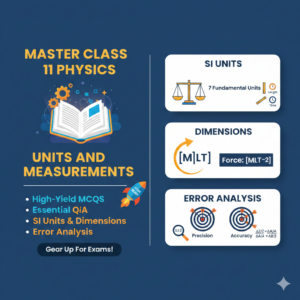
Class 11 Physics Chapter 1 – Units and Measurements Notes (मात्रक एवं मापन)
नमस्ते छात्रों! आज हम शुरू कर रहे हैं Physics Class 11 Chapter 1: Units and Measurements (मात्रक एवं मापन)।
यह chapter पूरी Class 11 Physics का foundation है। अगर आप Units and Measurements Notes, SI Units, Dimensional Formula, और Significant Figures Rules अच्छे से समझ लेते हैं, तो आगे की Physics बहुत आसान हो जाएगी।
यह पोस्ट एक complete Units and Measurements Revision Guide है जिसमें आपको मिलेंगे:
-
Important MCQs
-
Short Answer Questions
-
Dimensional Formula List
-
SI Units List
-
Significant Figures Rules
-
Previous Year Questions (2019–2024)
1. Introduction – Physics Class 11 Units and Measurements
1.1 भूमिका (Introduction)
Physics असल में हमारे आस-पास की दुनिया सभी भौतिक चीजों को समझने का एक तरीका है। लेकिन इसे समझने (understand) के लिए हमें चीज़ों को ‘नापना’ (measure) पड़ता है।
1. मापन की आवश्यकता (Need for Measurement)
Imagine करो कि आप एक दुकान पर जाकर कहें, “मुझे थोड़ा दूध दे दो।” दुकानदार उलझन में पड़ जाएगा। आपको उसे एक Definite Quantity बतानी होगी, जैसे “2 लीटर”। यही Measurement का महत्व है। Physics एक Exact Science है, जहाँ सिर्फ अंदाज guesswork लगाने से काम नहीं चलता।
2. भौतिक राशियाँ (Physical Quantities)
वो सभी चीज़ें जिन्हें हम माप (measure) सकते हैं। उन्हें Physical Quantities कहते हैं।
* Examples: Length (लंबाई), Mass (द्रव्यमान), Time (समय), Temperature (तापमान)
* जबकि प्यार, गुस्सा, या दुख। इन्हें हम numbers में नहीं नाप सकते, इसलिए ये Physics का हिस्सा नहीं हैं।
3. मापन क्या है? (What is Measurement?)
Measurement असल में एक Comparison (तुलना) है।
जिसमें किसी अज्ञात राशि (unknown quantity) की तुलना एक निश्चित मानक (fixed standard) से करना ही मापन कहलाता है।
For Example:-
मान लीजिए आपको एक मेज़ की लंबाई नापनी है। आप एक scale (standard) लेते हैं और देखते हैं कि वह scale मेज़ पर कितनी बार फिट आता है।
4. मापन के दो मुख्य भाग (Two Parts of Measurement)
जब भी हम कुछ measure करते हैं, हमें दो चीज़ें लिखनी पड़ती हैं:
* Numerical Value (n): यह बताता है कि वह राशि कितनी बार शामिल है।
* Unit (u): वह standard जिसमें हम नाप रहे हैं।
Formula: Q = n \times u
* Example: अगर किसी छड़ (rod) की लंबाई 5 meter है, तो:
* 5 = Numerical value (संख्यात्मक मान)
* meter = Unit (मात्रक)
नोट
याद रखिए, Physics में बिना Unit के कोई भी value अधूरी है। अगर आप Exam में सिर्फ “5” लिखकर आएंगे, तो नंबर कट सकते हैं क्योंकि “5” कुछ भी हो सकता है—5 cm, 5 kg या 5 seconds!
1.2 मात्रकों की अंतर्राष्ट्रीय प्रणाली (The International System of Units)
छात्रों अब हम बात करेंगे एक ऐसी समस्या की जिसने पुराने समय के वैज्ञानिकों को बहुत परेशान किया था, और उसका समाधान उन्होंने कैसे निकला। उस ज़माने में, अलग-अलग देशों में मापने के तरीके भी अलग-अलग थे। कहीं लंबाई को ‘फुट’ (foot) में नापा जाता था, तो कहीं ‘गज़’ (yard) में। इससे International Trade और Science में बड़ी confusion होती थी। इसी को ठीक करने के लिए SI Units का जन्म हुआ।
1. मात्रकों की प्रणालियाँ (Systems of Units)
SI unit से पहले दुनिया में तीन मुख्य प्रणालियाँ मशहूर थीं:
CGS System: centimetre, gram, second (छोटी measurements के लिए)
FPS System: Foot, Pound, Second (इसे British System भी कहते हैं)
MKS System: Metre, Kilogram, Second (बड़ी measurements के लिए)।
2. SI Units क्या है? (What are SI Units?)
सन् 1971 में General Conference on Weights and Measures ने एक ऐसी प्रणाली को मंज़ूरी दी जो पूरी दुनिया में एक समान मान्यता प्राप्त (Universal) हो। इसे Le Système International d’ Unités या संक्षेप में SI कहा गया।
इसे दो भागों में बांटा गया है:
* Base Units (मूल मात्रक)
* Derived Units (व्युत्पन्न मात्रक)
3. सात मूल मात्रक (The 7 Base Units)
Physics की दुनिया इन्हीं 7 ‘ईंटों’ से बनी है। आप दुनिया की किसी भी physical quantity को इन सात के मेल से लिख सकते हैं:
| भौतिक राशि (Physical Quantity) | मात्रक (SI Unit) | संकेत (Symbol) |
| 1 | लंबाई | Length | Metre | m |
| 2 | द्रव्यमान | Mass | Kilogram | kg |
| 3 | समय | (Time) | Second | s |
| 4 | विद्युत धारा | Electric Current | Ampere | A |
| 5 | ऊष्मागतिक ताप | (Temperature) | Kelvin | K |
| 6 | पदार्थ की मात्रा | (Amount of Substance) | Mole | mol |
| 7 | ज्योति तीव्रता | Luminous Intensity | Candela | cd |
1.3.1 सार्थक अंकों के गणितीय संक्रिया के नियम
सार्थक अंक (Significant Figures) का विषय शुरू में थोड़ा कठिन लग सकता है, लेकिन विज्ञान में यह अत्यंत आवश्यक है। भौतिकी और रसायन विज्ञान में गणना करते समय हमें यह ध्यान रखना होता है कि हमारा उत्तर माप की शुद्धता के अनुसार ही हो।
जब हम संख्याओं को जोड़ते, घटाते, गुणा या भाग करते हैं, तो अंतिम उत्तर की लंबाई मनमाने ढंग से नहीं लिखी जाती। इसके लिए निश्चित नियम बनाए गए हैं।
1. जोड़ और घटाव का नियम (Addition & Subtraction Rule)
जोड़ और घटाव में दशमलव के बाद के अंकों पर ध्यान दिया जाता है।
नियम: परिणाम में दशमलव के बाद उतने ही अंक होने चाहिए, जितने सबसे कम दशमलव वाले पद में हैं।
उदाहरण: 12.11 + 18.0 + 1.012 = 31.122
यहाँ 18.0 में दशमलव के बाद केवल 1 अंक है।
इसलिए सही उत्तर होगा: 31.1
2. गुणा और भाग का नियम (Multiplication & Division Rule)
गुणा और भाग में दशमलव के अंकों की नहीं, बल्कि कुल सार्थक अंकों की संख्या देखी जाती है।
नियम: परिणाम में उतने ही सार्थक अंक होने चाहिए, जितने सबसे कम सार्थक अंक वाली संख्या में हैं।
उदाहरण: 2.5 × 1.25 = 3.125
2.5 में 2 सार्थक अंक हैं।
1.25 में 3 सार्थक अंक हैं।
सबसे कम 2 हैं, इसलिए अंतिम उत्तर होगा: 3.1
परीक्षा के लिए महत्वपूर्ण प्रश्न-उत्तर
प्रश्न 1: सार्थक अंक क्यों आवश्यक हैं? क्या हम कैलकुलेटर का पूरा उत्तर नहीं लिख सकते? (: Why are significant figures necessary? Can’t we write the full answer from a calculator?)
उत्तर: विज्ञान में माप की एक सीमा होती है। यदि कोई स्केल केवल मिलीमीटर तक माप सकती है, तो हम उससे अधिक सूक्ष्म माप का दावा नहीं कर सकते। सार्थक अंक यह बताते हैं कि हमारी माप कितनी विश्वसनीय है। इसलिए हमें उतना ही लिखना चाहिए जितना माप से स्पष्ट होता है।
(Measurements in science have a limit. If a scale can only measure up to millimetres, we can’t claim to measure more precisely than that. Significant figures indicate how reliable our measurements are. Therefore, we should write only what the measurement indicates.)
प्रश्न 2: यदि उत्तर 5.0 आए तो क्या उसे 5 लिख सकते हैं? (If the answer is 5.0, can we write it as 5?)
उत्तर: नहीं। 5.0 का अर्थ है कि माप दशमलव के पहले स्थान तक निश्चित है।
5.0 में 2 सार्थक अंक हैं, जबकि 5 में केवल 1। दोनों का अर्थ अलग है, इसलिए 5.0 को 5 नहीं लिखा जाना चाहिए।
(No. 5.0 means the measurement is exact up to the first decimal place. 5.0 has two significant figures, while 5 has only one. Both have different meanings, so 5.0 should not be written as 5.)
याद रखने योग्य बातें (Points to Remember)
1 .यदि शून्य दो गैर-शून्य अंकों के बीच में है, तो वह सार्थक होता है।
(If a zero is between two non-zero digits, it is significant.)
२.यदि शून्य किसी संख्या के प्रारंभ में है, तो वह केवल स्थान बताने के लिए होता है, उसे सार्थक नहीं माना जाता।
(If a zero is at the beginning of a number, it is only for position marking; it is not considered significant.)
3 . राउंड ऑफ करते समय यदि हटाया जाने वाला अंक 5 से बड़ा है, तो पिछले अंक में 1 जोड़ देते हैं। यदि 5 से छोटा है, तो उसे छोड़ देते हैं।
(. When rounding, if the digit to be removed is greater than 5, add 1 to the previous digit. If it is less than 5, it is discarded)
नोट, शुद्ध संख्याएँ (जैसे 2 गेंद, 4 कॉपी) पूर्णतः निश्चित होती हैं, इसलिए उनमें सार्थक अंकों की कोई सीमा नहीं मानी जाती
4. पूरक मात्रक (Supplementary Units)
इन 7 के अलावा, दो और मात्रक हैं जिन्हें हम Angles नापने के लिए इस्तेमाल करते हैं:
* Plane Angle (समतल कोण): इसका मात्रक Radian (rad) है।
* Solid Angle (घन कोण): इसका मात्रक steradian (sr) है।
Teacher’s Note
बेटा, ध्यान रखना कि Physics में numerical solve करते समय हमेशा values को SI Units में बदलना ज़रूरी है। अगर सवाल में लंबाई cm में दी है, तो उसे पहले metre (m) में बदलें, तभी calculation सही आएगा।
1.4 विमाएँ और विमीय सूत्र
(Dimensions and Dimensional Formulae)
बच्चों, अब हम Physics के एक बहुत ही महत्वपूर्ण भाग की चर्चा करेंगे।
अगर मात्रक (Units) भाषा है, तो विमाएँ (Dimensions) उस भाषा का व्याकरण (Grammar) हैं।
विमा (Dimension) क्या है?
जब किसी व्युत्पन्न राशि (Derived Quantity) को मूल राशियों (Base Quantities) के पदों (terms) में व्यक्त किया जाता है, और उन पर जो घात (powers) लगाई जाती है, उन्हें विमा (Dimensions) कहते हैं।
द्रव्यमान (Mass) को हम [M] लिखते हैं।
Length (लंबाई/दूरी) को हम [L] लिखते हैं।
Time (समय) को हम [T] लिखते हैं।
विमीय सूत्र निकालना (How to find Dimensional Formula)
चलिए, मैं आपको step-by-step सिखाता हूँ कि फॉर्मूला कैसे बनाया जाता है:
1. क्षेत्रफल (Area)
Formula: Length \times Breadth (लंबाई \times चौड़ाई)
दोनों ही ‘लंबाई’ के रूप हैं, इसलिए: [L] \times [L] = [L^2]
Final Dimensional Formula: [M^0 L^2 T^0]
2. वेग (Velocity)
Formula: Displacement / Time (विस्थापन / समय)
विस्थापन [L] है और समय [T] है।
जब T ऊपर जाएगा, तो उसकी power minus हो जाएगी: [L] / [T] = [L T^{-1}]
Final Dimensional Formula: [M^0 L-1 T{-1}]
3. बल (Force) – सबसे Important!
Formula: Mass \times Acceleration (द्रव्यमान \times त्वरण)
Mass [M] है और त्वरण (Acceleration) [L T^{-2}] होता है।
Final Dimensional Formula: [M^1 L^1 T^{-2}
D. त्वरण (Acceleration)
-
सूत्र: वेग में परिवर्तन / समय (Change in Velocity / Time)
-
विमा: $[LT^{-1}] / [T] = [LT^{-2}]$
E. बल (Force) — यह सबसे महत्वपूर्ण है!
-
सूत्र: द्रव्यमान $\times$ त्वरण (Mass $\times$ Acceleration)
-
विमा: $[M] \times [LT^{-2}] = [MLT^{-2}]$
1. मूलभूत आधार (The Basics)
किसी भी भौतिक राशि की विमा निकालने के लिए हम इन सात मूल प्रतीकों का उपयोग करते हैं, जिनमें से मुख्य ये तीन हैं:
| भौतिक राशि (Physical Quantity) | प्रतीक (Symbol) |
| द्रव्यमान (Mass) | [M] |
| लंबाई (Length) | [L] |
| समय (Time) | [T] |
विमीय विश्लेषण के उपयोग (Uses of Dimensional Analysis)
विमाओं का इस्तेमाल हम तीन मुख्य कामों के लिए करते हैं:
1. Checking Correctness: यह जाँचने के लिए कि कोई Formula सही है या गलत। (Principal of Homogeneity)
2. Conversion of Units: एक unit system (जैसे MKS) से दूसरे (CGS) में बदलने के लिए।
3 Deriving Formulas: अलग-अलग physical quantities के बीच संबंध स्थापित करने के लिए।
Teacher’s Note
बेटा, एग्जाम में अक्सर पूछा जाता है—”क्या ऐसी कोई राशि है जिसकी Unit तो है पर Dimension नहीं?”
इसका जवाब है: Plane Angle (समतल कोण)। इसकी Unit ‘Radian’ होती है, लेकिन यह Dimensionless ([M^0 L^0 T^0]) है। यह point competitive exams के लिए बहुत ज़रूरी है!
Q1 – B: According to Newton’s Second Law, force depends on mass and acceleration.
F=maF = m a
बल द्रव्यमान और त्वरण पर निर्भर करता है।
Q2 – C Strain is a ratio. It is the change in dimension divided by the original dimension, so it has no unit because both quantities are in the same units.
व्याख्या (Hindi): विकृति (Strain) समान मात्रकों का अनुपात है, इसलिए इसका कोई मात्रक नहीं होता।
Q3 – C
Explanation (English): Work is done when a force moves an object through a distance.
W=FdW = F d
व्याख्या (Hindi): जब कोई बल किसी वस्तु को दूरी तक ले जाता है, तब कार्य होता है।
Q4 – A
Explanation (English): This formula is derived from Newton’s Law of Gravitation. It shows the gravitational force between two masses.
F=Gm1m2/r2F = G m_1 m_2 / r^2
व्याख्या (Hindi): यह सूत्र न्यूटन के गुरुत्वाकर्षण नियम से निकाला गया है, जो दो द्रव्यमानों के बीच बल को दर्शाता है।
Objective Questions
Multiple Choice Questions
- Which pair has same dimensions ?
(i) frequency and angle,
(ii) angular velocity and linear velocity,
(iii) specific heat and thermal capacity,
(iv) angular momentum and Planck constant. - Which one is not S.I. unit ?
(i) ampere,
(ii) candela,
(iii) newton,
(iv) kelvin. - Which one is derived unit ? (2019)
(i) kilogram,
(ii) newton,
(iii) metre,
(iv) candela. - The dimensional formula of surface tension is :
(i) [ML⁻¹T⁻²],
(ii) [MLT⁻²],
(iii) [ML⁻¹T⁻¹],
(iv) [MT⁻²]. - The dimensional formula of calorie is :
(i) [ML⁻¹T⁻²],
(ii) [M²LT⁻²],
(iii) [M²L⁻²T],
(iv) [ML²T⁻²]. - The dimensional formula of stress or pressure is : (2019)
(i) [M⁻¹L²T⁻²],
(ii) [ML⁻¹T⁻²],
(iii) [MLT⁻²],
(iv) [ML⁻¹T⁻³]. - Which quantity have same dimensional formula as Planck’s constant ? (2020)
(i) Torque,
(ii) Energy,
(iii) Momentum,
(iv) Angular momentum. - 1 Å (angstrom) is equal to : (2023)
(i) 10⁻¹⁰ cm,
(ii) 10⁻⁸ cm,
(iii) 10⁻¹² cm,
(iv) 10⁻⁶ cm. - Which of the following is a fundamental unit of S.I. system ? (2024)
(i) metre,
(ii) coulomb,
(iii) volt,
(iv) joule.
Ans. 1. (iv), 2. (iii), 3. (ii), 4. (iv), 5. (iv), 6. (ii), 7. (iv), 8. (ii), 9. (i).
Fill in the Blanks
- The dimensions of Planck constant is __________.
- If the significant figures are __________ then quantity is more significant.
- The number of significant figure in 4·0030 is __________. (2019, 2020)
- The dimensional formula of Torque is __________.
- The volume of cube of side 1 cm is equal to __________ m³. (2022)
Ans. 1. [ML²T⁻¹], 2. more, 3. 5, 4. [ML²T⁻²], 5. 10⁻⁶.
True/False
- The dimensions of all the terms on both sides of a physical equation must be same.
- The dimensional formula of surface tension is [MLT⁻²].
- The unit of work is erg in C.G.S. system.
- The number of significant figures is 5 in 4·0030. (2024)
Ans. 1. True, 2. False, 3. True, 4. True.
Match the Columns
‘A’
- 1 joule
- Dimension of modulus of rigidity
- Kelvin
- (P + a/v²) (V – b) = RT
‘B’
(i) [ML⁻¹T⁻²]
(ii) vander Waal’s gas equation
(iii) 1 × 10⁷ erg
(iv) Fundamental unit
Ans. 1 → (iii), 2 → (i), 3 → (iv), 4 → (ii).
Answer in One Word/Sentence
- The unit metre/second belongs to?
- Which one is the fundamental unit among tesla, ohm, ampere, joule and newton?
- What is the relation between a micron and an angstrom?
- Express 6893·26 kg in two significant figures.
- Write the names of two dimensionless quantities.
- Write the relation between M.K.S. unit and C.G.S. unit of force. (2023)
Ans. 1. Derived unit, 2. ampere, 3. 1 micron = 10⁴ angstrom, 4. 6·9 × 10³ kg, 5. Strain and Poisson’s ratio, 6. 1 N = 10⁵ dyne.
Very Short Answer Type Questions
Q. 1. What is a unit?
Ans. Measurement of any physical quantity involves comparison with a certain basic accepted reference standard called a unit.
Q. 2. What do you mean by derived unit ?
Ans. The unit of all other physical quantities express as the terms of basic unit is called derived unit. For example, the unit of velocity is metre/second.
Q. 3. What do you mean by dimensional balance of any equation ?
Ans. It means the dimensions of all the term of both side of equation must be same.
Q. 4. Name three physical quantities which have the dimensional formula [ML⁻¹T⁻²].
Ans. Pressure, stress, modulus of elasticity.
Q. 5. Write the limitations of dimensional analysis. (2022, 23)
Ans. See Short Answer Type Q. no. 1.
Q. 6. (i) [ML⁻¹T⁻²], (ii) [ML²T⁻¹], write the two physical quantities which have same dimension with (i) and (ii) part.
Ans. (i) Pressure and stress,
(ii) Planck constant and angular momentum.
Q. 7. Differentiate mN, Nm and nm.
Ans. Meaning of mN—milinewton, 1 mN = 10⁻³ N
Meaning of Nm—newton metre
Meaning of nm—nano metre.
Q. 8. How many astronomical unit are there in one parsec ? (2023)
Ans. 1 parsec = 2·06 × 10⁵ atomic unit (au).
Short Answer Type Questions
Q. 1. What is the dimensional equation? Write its four uses and four limitations.
Ans. The equation express the relation between fundamental units and derived units is called a dimensional equation.
Uses of dimensional equation :
(1) To determine the unit of any physical quantity.
(2) To convert units of one system into the units of other system.
(3) To check the dimensional balance of a physical equation.
(4) To establish the relation among various physical quantities.
Limitations of dimensional equation :
(1) By this method, the value of any dimensionless constant involved in the formula cannot be calculated.
(2) If a physical quantity depends upon more than three factors, then the relation among them cannot be established.
(3) Such a relation cannot be established in which the addition and subtraction of more than one quantity involved.
(4) By this method, the equation containing trigonometrical, exponential and terms like log cannot be analysed.
Q. 2. Write the fundamental and supplementary quantities in the S.I. system. Write the unit and symbol of theirs.
Ans. There are seven fundamental quantities and two supplementary quantities :
Units and Measurement (Page 25)
(iv) Latent heat :
Latent heat = Thermal energy / Mass
Dimensions of latent heat = [ML²T⁻²] / [M] = [L²T⁻²]
Q. 5.
Write the dimensional formula of the following physical quantities: (2020)
(i) Planck constant
(ii) Universal gravitational constant
(iii) Modulus of elasticity
(iv) Force constant of spring
Ans.
(i)
E = hν
Planck constant h = E / ν
Dimensional formula of Planck constant
= [ML²T⁻²] / [T⁻¹]
= [ML²T⁻¹]
(ii) Gravitation constant: See Short Answer Type Q. no. 4.
(iii) Modulus of elasticity: See Short Answer Type Q. no. 4.
(iv)
F = kx
Force constant k = F/x
Dimensional formula of force constant
= [MLT⁻²] / [L]
= [MT⁻²]
Q. 6.
Determine the dimensional formula for : (2023)
(i) Coefficient of thermal conductivity
(ii) Angular momentum
(iii) Young Elastic Modulus
Ans.
(i) Coefficient of thermal conductivity (K) :
Heat Q = K A Δθ t / l
K = Ql / (A Δθ t)
Dimensions of K =
[ML²T⁻²][L] / [L²][θ][T]
= [MLT⁻³θ⁻¹]
(ii) Angular momentum :
Angular momentum L = Iω
Dimensions of angular momentum
= [ML²][T⁻¹]
= [ML²T⁻¹]
(iii) Young Elastic Modulus : See Short Answer Type Q. no. 4.
Q. 7.
Check the correctness of the equation (second equation of motion)
S = ut + 1/2 at² by dimensional method.
Ans.
Taking dimension of L.H.S. = [L]
Taking dimension of R.H.S.
= [LT⁻¹][T] + 1/2 [LT⁻²][T²]
= [L] + [L]
= [L]
Dimensions of L.H.S. = Dimensions of R.H.S.
Hence, given equation S = ut + 1/2 at² is correct.