"Direct & Bold" approach Headline: Level Up Your Learning — For Free.Body: Master every subject from Class 6th to 12th with expert-led resources. No subscriptions, no barriers. Just pure knowledge.
Complete Study Notes | MCQ | Short & Long Answer Questions
CBSE & State Board Students के लिए
My advice to students:-
संसाधन ऐसी चीजें हैं जो मनुष्यों को उनकी ज़रूरतों को पूरा करने और उनके जीवन को बेहतर बनाने में मदद करती हैं। संसाधन प्राकृतिक, मानव निर्मित और मानव संसाधन हो सकते हैं। प्राकृतिक संसाधन प्रकृति से आते हैं, जैसे पानी, मिट्टी, जंगल और खनिज। मानव निर्मित संसाधन लोगों द्वारा बनाए जाते हैं, जैसे सड़कें, इमारतें और मशीनें। मानव संसाधन का अर्थ है लोग और उनके कौशल, ज्ञान और काम करने की क्षमता।
संसाधनों का विकास के लिए महत्वपूर्ण है, लेकिन उनका उपयोग सावधानीपूर्वक और स्थायी रूप से किया जाना चाहिए ताकि वे समाप्त न हो जाएं। संसाधनों का संरक्षण भविष्य की पीढ़ियों के लिए उनकी रक्षा करने में मदद करता है। Resources Class 8 Geography Essential Chapter Notes के
इस अध्याय में MCQ., Short Answer और Long Answer ,MP3 Audio Notes शिक्षण सहायता, प्रमुख शब्दों की शब्दावली और छात्रों को अवधारणाओं को आसानी से समझने और परीक्षाओं के लिए अच्छी तरह से तैयार करने में मदद करने के लिए एक त्वरित समीक्षा तालिका शामिल है।
(ए) याद रखने योग्य बातें
संसाधन: संसाधन वह चीज़ है जिसका उपयोग मनुष्य अपनी इच्छाओं या लालसाओं को पूरा करने के लिए करता है।
हमारे पर्यावरण में उपलब्ध हर चीज़ को संसाधन कहा जाता है। जिनका उपयोग हम हम अपनी आवश्यकताओ को पूरा करने के लिए कर ते है
TOPIC 1 — RESOURCE KYA HOTA HAI? (What is a Resource?)
Mona और Raju अपनी Amma के साथ घर साफ कर रहे थे। Amma ने कहा — “देखो इन सब चीज़ों को — कपड़े, बर्तन, अनाज, कंघी, शहद की बोतल, किताबें। इन सबका एक उपयोग है।”
Raju ने पूछा — “Resource क्या होता है?”
Amma ने जवाब दिया — “Anything that can be used to satisfy a need is a Resource.“
यानी — “जो भी किसी ज़रूरत को पूरा करने के काम आए, वह Resource है।“
Examples देखो:
– पानी जो तुम प्यास लगने पर पीते हो Resource
– घर में use होने वाली electricity Resource
– School से घर आने वाला rickshaw Resource
– पढ़ने की textbook Resource
– खाने में use होने वाली सब्ज़ियाँ Resource
इन सबमें क्या Common है?
इन सबको तुमने USE किया — इसलिए इनमें UTILITY है।
Utility यानी उपयोगिता — यही किसी चीज़ को Resource बनाती है।
Value (मूल्य) क्या होता है?
कोई भी चीज़ Resource तभी बनती है जब उसमें Value हो।
Value = Worth = किसी चीज़ की कीमत या महत्व
– कुछ Resources की Economic Value होती है — जैसे metals, minerals
– कुछ की Economic Value नहीं होती — जैसे एक सुंदर landscape
– लेकिन दोनों important हैं क्योंकि दोनों human needs पूरी करते हैं
एक interesting example:
तुम्हारी दादी के घरेलू नुस्खों की आज कोई commercial value नहीं है।
लेकिन अगर कोई medical company उन्हें patent करके बेचता है — तो वही नुस्खे बहुत valuable हो जाएंगे!
Glossary (शब्दकोश):
– Utility = उपयोगिता — किसी चीज़ की उपयोगी होने की quality
– Value = मूल्य — किसी resource की कीमत या महत्व
– Patent= एकस्वाधिकार — किसी idea या invention पर exclusive right
TOPIC 2 — SUBSTANCE RESOURCE KAISE BANTA HAI?
दो चीज़ें किसी भी substance को resource में बदल सकती हैं:
1. TIME (समय)
2. TECHNOLOGY (तकनीक)
Technology = latest knowledge और skill का उपयोग करके चीज़ें बनाना
सबसे Important Resource कौन है?
PEOPLE खुद सबसे important resource हैं!
क्योंकि लोगों के पास —
– Ideas होते हैं
– Knowledge होती है
– Inventions और Discoveries होती हैं
— यही सब नए resources बनाते हैं।
Examples देखो:
– आग की खोज → खाना बनाना और दूसरी processes शुरू हुईं
– पहिए का आविष्कार → transport के नए तरीके बने
– Hydroelectricity की technology → तेज़ बहते पानी की energy को बिजली में बदला
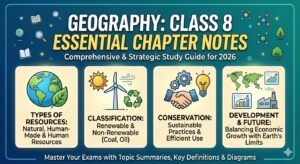
TOPIC 3 — TYPES OF RESOURCES (संसाधनों के प्रकार)
Resources को तीन भागों में बाँटा गया है:
(A) NATURAL RESOURCES (प्राकृतिक संसाधन)
Definition:
वे Resources जो प्रकृति से मिलते हैं और बिना ज़्यादा बदलाव के use किए जाते हैं, Natural Resources कहलाते हैं।
Examples:
– जो हवा हम साँस लेते हैं
– नदियों और झीलों का पानी
– मिट्टी (Soil)
– खनिज (Minerals)
– जंगल (Forests)
इनमें से कई resources प्रकृति के free gifts हैं जिन्हें directly use किया जा सकता है।
Natural Resources दो प्रकार के होते हैं:
( i) RENEWABLE RESOURCES (नवीकरणीय संसाधन)
Definition:
वे resources जो जल्दी से renew हो जाते हैं या replenish हो जाते हैं, RenewableResources कहलाते हैं।
Examples:– Solar Energy (सौर ऊर्जा) – Wind Energy (पवन ऊर्जा) – Water (पानी) – Forests (जंगल)
याद रखो:
– Solar और Wind energy unlimited हैं — human activities से affect नहीं होतीं।
– लेकिन Water, Soil और Forests को careless तरीके से use करने पर इनका stock कम हो सकता है।
– पानी unlimited लगता है, लेकिन आज दुनिया के कई हिस्सों में पानी की कमी बड़ी समस्या है।
( ii) NON-RENEWABLE RESOURCES (अनवीकरणीय संसाधन)
Definition:
वे resources जिनका limited stock है और एक बार खत्म होने पर हज़ारों साल लगते हैं दोबारा बनने में, Non-Renewable Resources कहलाते हैं।
Q6. Coal, Petroleum और Natural Gas किस प्रकार के resources हैं?
(A) Renewable (B) Human Made (C) Human Resources (D) Non-Renewable
Answer: (D) Non-Renewable
Q7. Buildings, Bridges, Roads, Machinery और Vehicles किस प्रकार के resources हैं?
(A) Natural Resources (B) Human Resources (C) Human Made Resources (D) Renewable Resources
Answer: (C) Human Made Resources
Q8. निम्न में से कौन सा Human Made Resource है?
(A) Cancer की दवाइयाँ (B) Spring water (C) Tropical forests (D) Mineral deposits
Answer: (A) Cancer की दवाइयाँ
Q9. लोगों को किस प्रकार का resource माना जाता है?
(A) Natural (B) Human Made (C) Non-Renewable (D) Human
Answer: (D) Human
Q10. लोगों की skills को बेहतर बनाकर ज़्यादा resources create करना क्या कहलाता है?
(A) Resource Conservation (B) Sustainable Development (C) Human Resource Development (D) Technology Development
Answer: (C) Human Resource Development
Q11. Resources को सावधानी से use करना और उन्हें renew होने का समय देना क्या कहलाता है?
(A) Sustainable Development (B) Resource Conservation (C) Human Resource Development (D) Resource Utilisation
Answer: (B) Resource Conservation
Q12. Present की ज़रूरतें पूरी करते हुए Future के लिए resources बचाना क्या कहलाता है?
(A) Resource Conservation (B) Non-Renewable Development (C) Sustainable Development (D) Technology
Answer: (C) Sustainable Development
Q13. Natural Resources का distribution किन factors पर depend करता है?
(A) Human Population (B) Terrain, Climate और Altitude (C) Available Technology (D) Economic Value
Answer: (B) Terrain, Climate और Altitude
Q14. निम्न में से कौन सा Non-Renewable Resource का example है?
(A) Solar Energy (B) Wind Energy (C) Petroleum (D) Water
Answer: (C) Petroleum
Q15. कौन सी दो चीज़ें किसी substance को resource में बदल सकती हैं?
(A) Water और Soil (B) Time और Technology (C) Money और Labour (D) Climate और Terrain
Answer: (B) Time और Technology
Resources class 8 Long questions and answers
(लगभग 35 शब्द)
Q1. Resource क्या होता है? दो examples दो।
कोई भी चीज़ जो किसी ज़रूरत को पूरा कर सके, Resource कहलाती है। Resource में Utility और Value दोनों होना चाहिए। Water, electricity, minerals, textbooks और vegetables सब resources हैं। Resources natural, human made या human हो सकते हैं।
Q2. Utility क्या है? यह क्यों ज़रूरी है?
Utility यानी उपयोगिता — किसी चीज़ की useful होने की quality। Utility किसी ordinary substance को resource बनाती है। बिना utility के कोई भी चीज़ resource नहीं बन सकती, चाहे वह कितनी भी abundant हो। जैसे पानी की utility है, इसलिए यह resource है।
Q3. Renewable और Non-Renewable Resources में क्या फर्क है?
Renewable Resources जल्दी replenish हो जाते हैं जैसे solar energy, wind energy और water। Non-Renewable Resources का limited stock होता है और ये replenish होने में हज़ारों साल लेते हैं, जैसे coal, petroleum और natural gas। एक बार खत्म होने पर ये दोबारा नहीं मिलते।
Q4. Human Made Resources क्या होते हैं? Examples दो।
जब लोग Natural Resources को बदलकर नई चीज़ें बनाते हैं तो वे Human-Made Resources कहलाती हैं। Iron ore से iron निकालना और उससे bridges बनाना एक example है। Buildings, roads, machinery, vehicles और technology सभी Human Made Resources हैं।
Q5. लोगों को सबसे important resource क्यों माना जाता है?
लोगों के पास ideas, knowledge, inventions और discoveries होते हैं जो नए resources बनाते हैं। Human skill और technology ही natural substances को valuable resources में बदलती है। Education और health human resources की quality को बढ़ाते हैं। इसीलिए लोग सबसे important resource हैं।
Q6. Resource Conservation क्या है?
Resource Conservation यानी resources को सावधानी से use करना और उन्हें renew होने का समय देना। इसमें consumption कम करना, recycling और reusing शामिल हैं। हम सब एक-दूसरे से जुड़े हैं इसलिए हर एक की छोटी कोशिश environment को बचाने में बड़ा फर्क डालती है।
Q7. Sustainable Development क्या है?
Sustainable Development का मतलब है कि हम resources का उपयोग इस तरह करें कि आज की हमारी ज़रूरतें पूरी हों और future generations के लिए भी resources बचे रहें। इसका उद्देश्य पृथ्वी की vitality बचाना, biodiversity conserve करना और environmental damage को minimize करना है।
Q8. Natural Resources का distribution दुनिया भर में unequal क्यों है?
Natural Resources का distribution terrain, climate और altitude जैसे physical factors पर depend करता है। ये factors दुनिया के अलग-अलग हिस्सों में बहुत अलग होते हैं। इसीलिए कुछ regions में कुछ resources बहुत ज़्यादा हैं जबकि बाकी जगहों में बहुत कम।
Resources class 8 Long questions and answers (लगभग 60 शब्द)
Q1. Resource क्या है? Utility और Value किसी चीज़ को Resource कैसे बनाते हैं? Explain करो।
Ans. Resource वह चीज़ है जो किसी ज़रूरत को पूरा कर सके। लेकिन हर available चीज़ resource नहीं होती — उसमें दो ज़रूरी qualities होनी चाहिए: Utility और Value।
Utility यानी उपयोगिता — यह किसी ordinary substance को resource बनाती है। जैसे पानी एक resource है क्योंकि यह हमारी प्यास बुझाता है, agriculture support करता है और hydroelectricity generate करता है।
Value यानी मूल्य या worth। कुछ resources की economic value होती है जैसे metals और minerals, जबकि कुछ की non-economic value होती है जैसे एक सुंदर landscape। दोनों ही human needs पूरी करते हैं इसलिए दोनों important हैं।
Resources time के साथ economically valuable भी बन सकते हैं। दादी के घरेलू नुस्खों की आज कोई commercial value नहीं, लेकिन अगर कोई medical company उन्हें patent करे तो वे बहुत valuable हो जाएंगे। इसलिए — Utility + Value = Resource ये दोनों मिलकर decide करते हैं कि कोई चीज़ resource है या नहीं।
Q2. Resources के तीन types को examples के साथ explain करो।**
Ans. Resources को तीन भागों में बाँटा गया है:
1. Natural Resources (प्राकृतिक संसाधन):
ये प्रकृति से मिलते हैं और बिना ज़्यादा modification के use किए जाते हैं। जैसे — हवा, पानी, मिट्टी, sunlight और minerals। ये आगे दो भागों में बँटते हैं:
– Renewable — जल्दी replenish होते हैं जैसे solar energy, wind energy और water
– Non-Renewable — limited stock होता है जैसे coal, petroleum और natural gas
2. Human Made Resources (मानव निर्मित संसाधन):
जब लोग natural resources को modify करके नई चीज़ें बनाते हैं। Iron ore natural resource है, लेकिन उससे बने bridges और roads human made resources हैं। Buildings, vehicles, technology — सब human-made resources हैं।
3. Human Resources (मानव संसाधन):
लोग खुद भी एक resource होते हैं। उनकी knowledge, skills, education और health उन्हें valuable बनाती है। जब लोगों की quality को बेहतर बनाया जाता है, जैसे उन्हें अच्छी education, training और health facilities दी जाती हैं, तो इसे Human Resource Development कहा जाता है।
तीनों types मिलकर human life और development को support करते हैं।
Q3. Resource Conservation क्यों ज़रूरी है? Individuals क्या कर सकते हैं?**
Ans. Resource Conservation यानी resources को सावधानी से use करना और उन्हें renew होने का समय देना — यह आज की सबसे ज़रूरी ज़िम्मेदारी है।
Conservation क्यों ज़रूरी है?
क्योंकि अगर हम सावधान नहीं रहे तो:
– Renewable resources जैसे water, soil और forests careless overuse से permanently damage हो सकते हैं
– Non-renewable resources जैसे coal और petroleum एक दिन पूरी तरह खत्म हो जाएंगे
– एक बार खत्म होने पर ये resources human lifetime में वापस नहीं आ सकते
Resources के use और conservation को balance करना Sustainable Development कहलाता है।
हर Individual क्या कर सकता है:
– Reduce → electricity, water और paper का कम use करो
– Recycle → waste materials को recycle करो
– Reuse → bags, bottles और containers दोबारा use करो
– Unnecessary wastage से बचो
Chapter में बच्चों ने पुराने newspapers, कपड़ों और bamboo से bags और packets बनाए — इससे waste कम हुआ। ऐसी collective efforts, चाहे छोटी हों, बड़ा फर्क डालती हैं — **क्योंकि हम सब एक-दूसरे से जुड़े हैं।**
Q4. Sustainable Development क्या है? इसके Principles explain करो।
Ans. Sustainable Development यानी ऐसा विकास जो आज की ज़रूरतें तो पूरी करे लेकिन Future Generations के लिए भी resources बचाए।
यह concept recognizes करता है कि human progress environment की कीमत पर नहीं आनी चाहिए। पृथ्वी के natural life support systems — clean air, fresh water, fertile soil और biodiversity — को आने वाली generations के लिए बचाना ज़रूरी है।
Sustainable Development के Key Principles:
– जीवन के सभी रूपों का सम्मान करो और उनकी देखभाल करो
– Education, health और opportunity के ज़रिए human life की quality सुधारो
– Ecosystems को protect करके पृथ्वी की vitality और diversity conserve करो
– Non-renewable natural resources की depletion को minimise करो
– Environment के प्रति personal attitudes और practices बदलो
– Communities को अपने local environment की care करने में enable करो
यह हर citizen का कर्तव्य है कि:
– Renewable resources का सभी use sustainable हो
– पृथ्वी पर life की diversity conserve हो
– Natural environmental systems को नुकसान minimum हो
Sustainable Development सिर्फ Government की ज़िम्मेदारी नहीं है — यह इस planet पर हर एक individual का shared duty है।
—
TEXTBOOK EXERCISES —Resources Class 8 Geography Essential Chapter Notes
1. Answer the following questions:
(i) Resources दुनिया भर में unequally क्यों distributed हैं?
Resources का distribution terrain, climate और altitude जैसे physical factors पर depend करता है। ये conditions एक region से दूसरे region में बहुत अलग होती हैं। इसलिए कुछ areas certain resources में बहुत rich हैं जबकि बाकी में बहुत कम। Example: Coal specific geological formations में मिलता है और petroleum specific regions में।
(ii) Resource Conservation क्या है?
Resource Conservation का मतलब है resources को सावधानी से use करना और उन्हें replenish या renew होने का पर्याप्त समय देना। इसमें waste avoid करना, consumption reduce करना और resources को wisely use करना शामिल है। Methods में recycling, reusing और unnecessary consumption reduce करना शामिल है।
(iii) Human Resources क्यों important हैं?
Human Resources important हैं क्योंकि लोगों के पास knowledge, skills, ideas और technology use करने की ability होती है, जिससे वे natural substances से valuable resources बना सकते हैं। Human intelligence और effort ही raw natural materials को valuable products में बदलते हैं। Education और health human resources की quality improve करते हैं।
(iv) Sustainable Development क्या है?
Sustainable Development का मतलब है resources को इस तरह use करना जो present की ज़रूरतें पूरी करे और future generations की ज़रूरतें पूरी करने की उनकी ability को ख़तरे में न डाले। इसके principles में सभी life forms का respect, Earth की diversity conserve करना, natural resources की depletion minimize करना और environment के प्रति attitude बदलना शामिल है।
2. Tick the correct answer:
(i) निम्न में से कौन सी चीज़ substance को resource नहीं बनाती?
Answer: (c) Quantity
(ii) निम्न में से कौन सा Human Made Resource है?
Answer: (a) Medicines to treat cancer
(iii) Non-Renewable Resources वे हैं जो:
Answer: (a) Those which have a limited stock (जिनका limited stock हो)
CHAPTER SUMMARY — Quick Revision Table
Term
Meaning
Resource
कोई भी चीज़ जो किसी ज़रूरत को पूरा करे
Utility
उपयोगिता — जो किसी चीज़ को resource बनाती है
Value
किसी resource की worth — economic या non-economic
Patent
किसी idea या invention पर exclusive right
Natural Resources
प्रकृति से मिलने वाले resources — बिना ज़्यादा modification के
Renewable Resources
जल्दी replenish होने वाले resources — solar, wind, water
Non-Renewable Resources
Limited stock वाले resources — coal, petroleum, natural gas
Human Made Resources
Natural substances को modify करके बने resources
Human Resources
लोग — उनकी knowledge, skills, health और abilities
Human Resource Development
लोगों की skills improve करना ताकि वे ज़्यादा resources बना सकें
Technology
Latest knowledge और skill का उपयोग करके चीज़ें बनाना
Stock of Resource
Use के लिए available resource की मात्रा
Resource Conservation
Resources को सोच-समझकर use करना और renew होने का समय देना
Sustainable Development
Present की ज़रूरतें पूरी करते हुए Future के लिए resources बचाना
Terrain
किसी area की physical features
Altitude
समुद्र तल से ऊँचाई
Hydroelectricity
तेज़ बहते पानी से generate होने वाली electricity
Biodiversity
पृथ्वी पर सभी living organisms की variety
KEY DIFFERENCES — Exam के लिए Important
|
Renewable Resources
Non-Renewable Resources
जल्दी replenish होते हैं
Replenish होने में हज़ारों साल लगते हैं
Unlimited या large stock
Limited stock
Examples: Solar, wind, water
Examples: Coal, petroleum, natural gas
आसानी से खत्म नहीं होते
Permanently exhaust हो सकते हैं
| Natural Resources | Human Made Resources |
Natural Resources
Human Made Resources
प्रकृति से मिलते हैं
Human beings ने बनाए हैं
कम modification से use होते हैं
Natural resources को process करके बनाए जाते हैं
Examples: Air, water, minerals
Examples: Buildings, roads, technology
Resources Class 8 Geography Essential Chapter Notes ENGLISH MEDIUM
Q. 1. List out five resources you use in your home and five you use in your classroom.
Ans. Resources used in the home —
(1) Water, (2) Chair, (3) Bed, (4) Gas (LPG), (5) Electricity.
Resources used in the classroom —
(1) Blackboard, (2) Chair, (3) Table, (4) Fans, (5) Chalk.
Textbook Page No. 02
**● Activity**
**Q. 2. Circle those resources from Amma’s list that are regarded as having no commercial value.**
Amma’s List — (i) Cotton cloth, (ii) Iron ore, (iii) Intelligence, (iv) Medicinal plants, (v) Medical knowledge, (vi) Coal deposits, (vii) Beautiful scenery, (viii) Agricultural land, (ix) Clean environment, (x) Old folk songs, (xi) Good weather, (xii) Resourcefulness, (xiii) A good singing voice, (xiv) Grandmother’s home remedies, (xv) Affection from friends and family.
Ans. Intelligence, Beautiful scenery, Clean environment, Old folk songs, Good weather, Grandmother’s home remedies, Affection from friends and family.
—
Textbook Page No. 03
**● Let’s Do — 1
Q. 3. Think of a few renewable resources and mention how their stock may get affected by overuse.
**Ans. Renewable Resources —**
(1) Forests —Forests are renewable resources. Forest regions produce many useful things for humans. These are used for domestic works to industrial production. In forests, the trees and plants can grow naturally and renew themselves. There is a limit to the amount of products that can be extracted from the forests, but if extraction exceeds that limit, forests are depleted, which creates many problems like air pollution and soil erosion.
(2) Water — Water is a renewable resource. Water is recycled through natural processes. But water scarcity occurs due to excessive use, and water sources have become dry. It could be dangerous for the future.
(3) Non-conventional energy — All those energies that are never depleted, whose resources can be recycled and renewed, such as solar energy, wind energy, hydroelectric energy, etc. These are renewable resources. This energy is not affected by human activities.
● Let’s Do — 2
Q. 4. Make a list of five human-made resources that you can observe around you.
(i) Why are resources distributed unequally over the earth?
Ans. The distribution of natural resources depends upon a number of physical factors like terrain, climate, altitude, vegetation, etc. The distribution of resources is unequal because these factors differ so much over the earth.
(ii) What is resource conservation?
Ans. Using resources carefully and giving them time to get renewed is called resource conservation.
(iii) Why are human resources important?
Ans. Human resources are important because human skills help in transferring the physical material into a valuable resource.
(iv) What is sustainable development?
Ans. It is a process of economic development which aimed at careful utilisation of resources to meet the requirements of the present and future generations.
Q. 2. Tick the correct answer:
(i) Which one of the following does NOT make a substance a resource?
(a) utility
(b) value
(c) quantity.
(ii) Which one of the following is a human-made resource?
(a) medicines to treat cancer
(b) spring water
(c) tropical forests.
(iii) Complete the statement.
Non-renewable resources are —
(a) those which have limited stock
(b) made by human beings
(c) derived from non-living things.
Ans. (i) (c) quantity, (ii) (a) medicines to treat cancer, (iii) (c) derived from non-living things.
Q. 3. Activity —
“Rahiman paani raakhiye, Bin paani sab soon. Paani gaye na ubere Moti, manus, choon…”
[Says Rahim, keep water, as without water there is nothing. Without water, pearl, swan and dough cannot exist.]
These lines were written by the poet Abdur Rahim Khankhana, one of the nine gems of Akbar’s court. What kind of resource is the poet referring to? Write in 100 words what would happen if this resource disappeared?
Ans. In the above lines, the poet is referring to the water resource. The following impact would happen if this resource disappeared —
(1) Water scarcity would lead to plant decay.
(2) Pure air would be finished.
(3) Grains, fruits, flowers, etc. would be finished from the earth.
(4) No industry would be left without water.
(5) Land would become barren.
(6) Sea routes would be finished.
(7) Aquatic life would be destroyed.
(8) Life would be destroyed on Earth in the absence of water.
For Fun
**Q. 1. Pretend that you live in the prehistoric times on a high windy plateau. What are the uses you and your friends could put the fast winds to? Can you call the wind a resource?**


 – Wind Energy (पवन ऊर्जा)
  – Water (पानी)
  – Forests (जंगल)
 – Petroleum (पेट्रोलियम)
  – Natural Gas (प्राकृतिक गैस)
 – Bridges (पुल)- Roads (सड़कें)
  – Machinery (मशीनें)
  – Vehicles (वाहन)
  – Technology (तकनीक)