

Deep Water Class 12th English Flamingo Chapter 3 easy Summary Q&A MCQ MP3
Class 12 — English Flamingo Chapter Details
| Class | Book Name | Chapter Number | Chapter Title | Author |
|---|---|---|---|---|
| Class 12 | English Flamingo | Chapter 3 | Deep Water | William Douglas |
Deep Water Class 12th English Flamingo Chapter 3 Easy Summary, MP3 Audio Note
About the Author — लेखक के बारे में
बच्चों, अब इस chapter के लेखक के बारे में थोड़ा जान लेते हैं।
William O. Douglas (1898–1980) अमेरिका के एक बहुत प्रसिद्ध Supreme Court judge और लेखक थे। Deep Water नाम का यह chapter उनकी आत्मकथा Of Men and Mountains से लिया गया है। यह किताब उनकी अपनी असली ज़िंदगी के अनुभवों पर आधारित है।
उनका बचपन आसान नहीं था। जब वे बहुत छोटे थे, तभी उनके पिता का देहांत हो गया। घर में आर्थिक तंगी थी, फिर भी Douglas ने कभी हार नहीं मानी। उन्होंने लगातार मेहनत की, पढ़ाई पूरी की और धीरे-धीरे जीवन में बहुत आगे बढ़ गए। आखिरकार वे United States के Supreme Court के judge बन गए।
उनकी यह पूरी जीवन यात्रा हमें एक बड़ी बात सिखाती है — चाहे परिस्थितियाँ कितनी भी कठिन क्यों न हों, अगर इंसान के अंदर सच्ची हिम्मत और लगन हो, तो वह अपने डर को भी जीत सकता है और समस्याओं को पार कर सकता है।
इसी संदेश को हम Deep Water के इस chapter में भी साफ-साफ देखते हैं। Douglas ने खुद अपने डर का सामना किया और उसे पार किया — यही इस कहानी की सबसे बड़ी ताकत है।
Deep Water Class 12th English Flamingo Chapter 3 Easy Summary — In Hindi
Part 1 — The First Fear of Water (पानी का पहला डर)
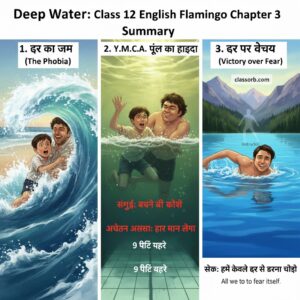
जब William O. Douglas सिर्फ तीन-चार साल के थे, तब उनकी ज़िंदगी में पानी से जुड़ी पहली डरावनी घटना हुई। उस समय वे इतने छोटे थे कि पानी के बारे में कुछ भी नहीं समझते थे।
एक दिन उनके पिता उन्हें California की beach पर ले गए। वहाँ खेलते-खेलते अचानक समुद्र की एक तेज़ और बड़ी लहर आई। उस लहर ने छोटे Douglas को अपनी चपेट में ले लिया और उन्हें पानी के अंदर धकेल दिया। कुछ पल के लिए वे पूरी तरह पानी के नीचे दब गए। साँस रुक गई, चारों तरफ सिर्फ पानी ही पानी दिख रहा था। वे बहुत डर गए।
शुक्र है कि वे सुरक्षित बाहर निकाल लिए गए और शरीर से कोई चोट नहीं आई। लेकिन उस छोटी सी घटना ने उनके मन पर बहुत गहरा असर छोड़ दिया। उसी दिन से पानी का डर उनके दिल में घर कर गया।
वे अब पानी देखते ही घबरा जाते थे। यह पहला अनुभव था जिसने Douglas के अंदर पानी के प्रति एक गहरा और अनचाहा भय पैदा कर दिया।
और यहीं से, Deep Water chapter की पूरी कहानी की शुरुआत होती है — पानी के डर की कहानी।
Part 2 — Y.M.C.A. Pool की घटना
जब William O. Douglas दस-ग्यारह साल के हो गए, तो उन्होंने सोचा कि अब इस पानी के डर को खत्म करना ही होगा। इसलिए वे Yakima के YMCA swimming pool में तैरना सीखने जाने लगे।
यह pool एक तरफ से काफी उथला था — सिर्फ दो-तीन फीट गहरा — जबकि दूसरी तरफ नौ फीट तक गहरा था। Douglas को लगा कि यह जगह तैराकी सीखने के लिए सुरक्षित रहेगी।
एक दिन वे pool के किनारे खड़े थे। तभी एक हट्टा-कट्टा, अठारह साल का लड़का मजाक में उन्हें अचानक उठाकर pool के गहरे हिस्से में फेंक दिया।
पानी में गिरते ही Douglas बहुत घबरा गए। उन्हें तैरना बिल्कुल नहीं आता था। वे तेज़ी से नीचे डूबने लगे।
उन्होंने तुरंत एक योजना बनाई — जैसे ही उनके पैर pool के तल से लगें, वे ज़ोर से छलांग लगाकर ऊपर आ जाएँगे। लेकिन बच्चों, योजना काम नहीं आई। हर बार वे ऊपर आने की कोशिश करते, लेकिन फिर से नीचे चले जाते।
धीरे-धीरे उनकी साँस फूलने लगी। फेफड़ों में तेज़ दर्द होने लगा, दिल की धड़कन बहुत तेज़ हो गई। हाथ-पैर सुन्न पड़ने लगे और पूरा शरीर भारी लगने लगा। घबराहट इतनी बढ़ गई कि वे कुछ भी समझ नहीं पा रहे थे। आखिरकार वे बेहोश हो गए।
किसी ने समय रहते उन्हें पानी से बाहर निकाल लिया और उनकी जान बच गई। लेकिन इस घटना के बाद पानी का डर उनके मन में और भी गहरा और मजबूत हो गया।
Deep Water Class 12th English Flamingo Chapter 3 Easy Summary, MP3 Audio Notes
Part 3 — The Impact of Fear (डर का असर)
उस दर्दनाक दिन के बाद William O. Douglas के मन में पानी का डर और भी गहरा और मजबूत हो गया। उन्होंने YMCA pool जाना तो पूरी तरह बंद कर ही दिया, बल्कि पानी को देखते ही उनका दिल घबरा जाता था। बस एक नज़र पानी की तरफ पड़ते ही बेचैनी और डर का अहसास होने लगता।
धीरे-धीरे यह डर उनकी रोज़मर्रा की ज़िंदगी पर भी छाने लगा। वे नदी में मछली पकड़ने जाना छोड़ दिए, नाव चलाना बंद कर दिया, और तैराकी जैसी कोई भी गतिविधि उनके लिए अब दूर की बात हो गई। जो काम पहले उन्हें बहुत मज़ा देते थे, वही अब डर का कारण बन गए थे।
पानी के इस डर ने Douglas को अपनी ज़िंदगी की कई छोटी-छोटी खुशियाँ छीन लीं। उन्हें लगने लगा कि यह डर उन्हें handicap बना रहा है। उनकी आज़ादी और खुशी दोनों को सीमित कर रहा है।
इसी वजह से बाद में उन्होंने एक दृढ़ फैसला लिया कि अब इस डर को हमेशा के लिए जड़ से खत्म करना है। अब और सहन नहीं करना है।
Part 4 — Victory Over Fear (डर पर जीत)
बच्चों, कई साल तक इस डर के साथ जीने के बाद William O. Douglas ने एक महत्वपूर्ण निर्णय लिया। उन्होंने सोचा — अब इस डर को हमेशा के लिए खत्म करना है। इसी उद्देश्य से उन्होंने एक professional swimming instructor की मदद ली, ताकि वे धीरे-धीरे और सुरक्षित तरीके से तैरना सीख सकें।
Instructor ने बहुत धैर्य और समझदारी के साथ Douglas को training देना शुरू किया। उन्होंने Douglas की कमर में एक belt बाँधी। उस belt में एक rope लगाई गई, जो ऊपर लगे pulley system से जुड़ी थी। इस तरीके से instructor Douglas को धीरे-धीरे पानी में आगे-पीछे ले जाते और उन्हें आत्मविश्वास दिलाते।
Douglas रोज़ एक घंटा practice करते और हफ्ते में पाँच दिन नियमित रूप से training लेते। शुरुआत में उन्होंने rope के सहारे pool में चलना सीखा। फिर उन्होंने मुँह पानी में डालकर साँस छोड़ना और ऊपर आकर साँस लेना सीखा। इसके बाद instructor ने उन्हें पैर मारना, हाथ चलाना और सही तरीके से तैरना सिखाया।
धीरे-धीरे Douglas का डर कम होने लगा और उनका आत्मविश्वास बढ़ने लगा। लगभग तीन महीने की लगातार practice के बाद Douglas ने तैरना सीख लिया। इस तरह उन्होंने अपने पुराने डर पर जीत हासिल कर ली और एक confident swimmer बन गए।
Part 5 — The Final Exam (आखिरी परीक्षा)
बच्चों, जब William O. Douglas के instructor ने कहा कि अब वे तैरना सीख चुके हैं, तब भी Douglas के मन में थोड़ा-सा डर बाकी था। वे पूरी तरह से आश्वस्त होना चाहते थे कि उन्होंने अपने पुराने डर पर सच में जीत हासिल कर ली है। इसलिए उन्होंने खुद अपनी परीक्षा लेने का फैसला किया।
सबसे पहले Douglas Lake Wentworth गए। वहाँ उन्होंने तैरना शुरू किया। शुरुआत में उन्हें हल्का-सा पुराना डर महसूस हुआ, लेकिन इस बार उन्होंने हिम्मत नहीं हारी। वे लगातार तैरते रहे और धीरे-धीरे उनका आत्मविश्वास बढ़ता गया।
इसके बाद Douglas Warm Lake गए। वहाँ उन्होंने diving board से पानी में छलाँग लगाई और पूरे आत्मविश्वास के साथ तैरने लगे। अब उनके मन में कोई डर नहीं था।
तैरने के बाद वे खुशी से चिल्लाए, क्योंकि अब उनका डर पूरी तरह खत्म हो चुका था। इस तरह Douglas ने अपने fear पर पूरी तरह विजय प्राप्त कर ली और आत्मविश्वास के साथ आगे बढ़े।
Chapter Summary — British English
‘Deep Water’ is a personal narrative taken from William Douglas’s autobiography ‘Of Men and Mountains.’ In this chapter, Douglas recounts how he developed a paralysing fear of water during his childhood and how, through sheer determination and professional guidance, he ultimately conquered that fear.
Part 1 — The First Encounter with Fear
When Douglas was about three or four years of age, his father took him to the beach in California. A powerful wave knocked him over and held him beneath the water momentarily. Although he survived unharmed physically, the experience left a deep psychological mark — an intense, irrational fear of water.
Part 2 — The Misadventure at the Y.M.C.A. Pool
Years later, at the age of ten or eleven, Douglas resolved to overcome his fear by learning to swim at the Y.M.C.A. pool in Yakima. The pool was shallow at one end (two to three feet) and nine feet deep at the other.
One day, a robust eighteen-year-old boy picked Douglas up and hurled him into the deep end of the pool. Douglas struggled desperately. He devised a plan — to jump off the bottom and propel himself to the surface — but each attempt failed. His lungs ached, his body grew rigid, and he eventually lost consciousness. He was rescued just in time.
Part 3 — The Consequences
Following this traumatic incident, Douglas’s fear of water intensified. He avoided rivers, lakes, and swimming pools entirely. Canoeing, fishing, and swimming — pleasures he had once enjoyed — were now denied to him on account of this overpowering terror.
Part 4 — Conquering the Fear
Determined to rid himself of this handicap, Douglas engaged a professional swimming instructor. The instructor employed a methodical approach — using a belt and pulley system — and trained Douglas for five days a week, one hour each day. Gradually, over several months, the fear began to subside.
Part 5 — The Final Test
Even after completing his training, a residual terror lingered within Douglas. To ensure he had truly overcome his fear, he tested himself at Lake Wentworth and subsequently at Warm Lake, where he dived from a board and swam confidently. He shouted with joy — the old terror had been vanquished entirely.
Deep Water Class 12th English Flamingo Chapter 3 की विशेषताएं
बच्चों, ये चैप्टर सिर्फ तैरने की कहानी नहीं है। इसके अंदर बहुत गहरा संदेश छुपा हुआ है। आओ, शिक्षक के साथ मिलके समझें हैं इस अध्याय की खास बातें –
1. Sachchi Kahani hai (Autobiographical)
बच्चों, ये चैप्टर विलियम डगलस की अपनी जिंदगी का सच्चा किस्सा है। उन्होंने खुद ये सब भोगा. इसलिए जब तुम पढ़ते हो – तो महसूस होता है कि ये सिर्फ कहानी नहीं, ये एक इंसान का दर्द है।
2. Darr ko bahut achche se describe kiya gaya hai
Jab Douglas pani mein doob rahe the — unka dil, unke phenphade, unke pair, unke haath — sab kuch describe kiya gaya hai. Itna sajeev ki padhte waqt khud darr lagta hai. Yahee great writing hoti hai baccho.
3. Theme — Darr par Jeet (Conquering Fear)
Is chapter ka sabse bada message hai — ‘Darr ko agar tum nazarandaaz karte raho, toh woh tumhari zindagi chheen leta hai. Lekin agar tum usका saamna karo, toh woh khatam ho jaata hai.’
4. Famous Quote
“All we have to fear is fear itself.” — President Franklin D. Roosevelt
Matlab — humein darr se nahi darna chahiye, kyunki darr khud hi sabse bada dushman hai.
5. Instructor ki bhumika
Instructor ne Douglas ko ek dum se deep end mein nahi dhakel diya. Step by step, dheeraj ke saath sikhaya. Yahee ek acha teacher karta hai — student ki himmat banata hai, ek dam se burden nahi dalta.
6. Nature ka chitran
Chapter mein rivers, lakes, mountains ka bahut sundar varnan hai. Pani ka darr ek aam cheez hai — lekin jab tum usse jeet lete ho, toh poori prakriti tumhari hoti hai.
Important Word Meanings — महत्वपूर्ण शब्दार्थ
Baccho, ab hum padhenge is chapter ke sabse important words. Exam mein aksar in mein se meanings pooche jaate hain. Teacher ne neeche ek table banaya hai — dhyaan se padho:
|
Word (English) |
British English Meaning |
Hindi Meaning (हिंदी) |
|
Misadventure |
An unfortunate or unlucky accident |
दुर्भाग्यपूर्ण घटना / दुस्साहस |
|
Bruiser |
A large, strong, aggressive person |
हट्टा-कट्टा / शक्तिशाली व्यक्ति |
|
Subdued |
Quiet; having controlled one’s feelings |
दबाया हुआ / शांत |
|
Overpowering |
Extremely strong or intense |
बेहद तीव्र / अत्यधिक |
|
Panicky |
Feeling sudden uncontrollable fear |
घबराहट से भरा हुआ |
|
Suffocating |
Feeling unable to breathe properly |
दम घुटना / गला रुंधना |
|
Exertion |
Physical or mental effort |
अत्यधिक परिश्रम |
|
Residual |
Remaining after most has gone |
बचा हुआ / अवशेष |
|
Exhale |
To breathe out air from the lungs |
साँस बाहर छोड़ना |
|
Ducked |
Pushed or plunged into water |
पानी में धकेलना / डुबकी लगवाना |
|
Canoe |
A narrow light boat paddled by hand |
डोंगी / छोटी पतली नाव |
|
Deprive |
To take away something from someone |
वंचित करना / छीन लेना |
|
Summoned |
Called or gathered (courage) |
बुलाया / आह्वान किया |
|
Tinge |
A slight trace of colour or feeling |
हल्की झलक / थोड़ी-सी मात्रा |
|
Dizzy |
Having a sensation of spinning |
चक्कर आना |
|
Stripped |
Removed clothing |
कपड़े उतारना |
|
Rigid |
Stiff; not able to move |
अकड़ा हुआ / जकड़ा हुआ |
|
Pulley |
A wheel used to lift or move things via rope |
घिरनी (रस्सी वाला पहिया) |
|
Terror |
Extreme fear |
भय / आतंक / खौफ |
MCQ — Multiple Choice Questions
Baccho, yeh woh questions hain jo board exam mein aksar aate hain. Har question ke saath teacher ki ek chhoti tip bhi hai — dhyaan se padhna!
Q1. Who is the author of the chapter ‘Deep Water’?
- A) Alphonse Daudet
- B) William Douglas
- C) Anees Jung
- D) Louis Fischer
Answer: B) William Douglas
Teacher ki tip: Yeh chapter ‘Of Men and Mountains’ se liya gaya hai jo William Douglas ne likhi.
Q2. At what age did Douglas first develop a fear of water?
- A) 10-11 years
- B) 3-4 years
- C) 18 years
- D) 15 years
Answer: B) 3-4 years
Teacher ki tip: California beach par wali ghatna 3-4 saal ki umra mein hui thi.
Q3. Why did Douglas choose the Y.M.C.A. pool to learn swimming?
- A) It was very deep
- B) It was safe and shallow at one end
- C) His friends went there
- D) It was near his home
Answer: B) It was safe and shallow at one end
Teacher ki tip: Pool ek taraf se 2-3 feet hi tha — isliye safe lagta tha.
Q4. How deep was the water into which Douglas was thrown?
- A) 3 feet
- B) 6 feet
- C) 9 feet
- D) 12 feet
Answer: C) 9 feet
Teacher ki tip: Pool ka deep end 9 feet gehraa tha — lekin Douglas ko 90 feet jaisa laga!
Q5. What was Douglas’s plan when he was thrown into the pool?
- A) To shout for help
- B) To jump off the bottom and come up
- C) To lie still at the bottom
- D) To swim to the side
Answer: B) To jump off the bottom and come up
Teacher ki tip: Plan acha tha lekin pani mein haqiqat mein kaam nahi aaya.
Q6. How did the instructor help Douglas learn to swim?
- A) By throwing him into the river
- B) By using a belt and pulley system
- C) By giving him medicines
- D) By teaching only theory
Answer: B) By using a belt and pulley system
Teacher ki tip: Belt → rope → pulley — yahi tha instructor ka method.
Q7. Who said ‘All we have to fear is fear itself’?
- A) William Douglas
- B) The Instructor
- C) President Franklin D. Roosevelt
- D) Douglas’s mother
Answer: C) President Franklin D. Roosevelt
Teacher ki tip: Yeh famous quote Roosevelt ka hai — exam mein zaroor aata hai!
Q8. Where did Douglas go to test if he had truly conquered his fear?
- A) Yakima River
- B) Lake Wentworth, New Hampshire
- C) California Beach
- D) Y.M.C.A. Pool
Join Now
Answer: B) Lake Wentworth, New Hampshire
Teacher ki tip: Pehle Lake Wentworth, phir Warm Lake — dono jagah khud ko test kiya.
Q9. What happened to Douglas at the end of his ordeal in the pool?
- A) He learned to swim instantly
- B) He became unconscious
- C) He swam to the side
- D) He shouted for help
Answer: B) He became unconscious
Teacher ki tip: Sab koshishein fail hone ke baad woh behosh ho gaye — kisi ne bahar nikala.
Q10. What is the central theme of the chapter ‘Deep Water’?
- A) Dangers of swimming
- B) Childhood memories
- C) Victory over fear through determination
- D) Friendship with an instructor
Answer: C) Victory over fear through determination
Teacher ki tip: Poora chapter ek hi baat kehta hai — darr se haarna nahi, usse jeeto!
FAQ — Frequently Asked Questions (With Answers)
Baccho, yeh woh questions hain jo examination mein 3-4 marks ke aate hain. Teacher ne yahan answers bhi likhe hain — aur saath mein exam tip bhi. Dhyaan se padhna aur yaad karna.
Q1. What is the ‘misadventure’ that William Douglas speaks about?
प्रश्न: वह कौन-सी दुर्घटना है जिसकी बात डगलस करते हैं?
Answer: Baccho, ‘misadventure’ woh ghatna hai jab ek 18 saal ke hatta-katte ladke ne Douglas ko mazaak mein Y.M.C.A. pool ke 9 feet gehre hisse mein phenk diya. Douglas ko tairna nahi aata tha. Woh doob rahe the. Kisi ne unhe bahar nikala — woh bache. Yahee hai woh ‘misadventure’.
Exam Tip: 3-4 lines mein likhna — ‘Douglas was thrown into the deep end of the pool by a big boy…’
Q2. How did the experience of drowning affect Douglas?
प्रश्न: डूबने के अनुभव ने डगलस को कैसे प्रभावित किया?
Answer: Woh kaafi dino tak theek nahi hue. Khaana nahi khaya. Nind nahi aayi. Paani dekhte hi dil ghabhrata. Pool mein kabi nahi gaye dobara. Nadiyon mein maach pakadna band, naav chalaana band. Khud ko handicapped samajhne lage kyunki darr unki poori zindagi par haawi ho gaya tha.
Exam Tip: ‘The experience left a deep psychological scar. He avoided water in all forms…’
Q3. Why was Douglas determined to overcome his fear of water?
प्रश्न: डगलस पानी के डर को दूर क्यों करना चाहते थे?
Answer: Baccho, woh dekh rahe the ki paani ka darr unhe bahut kuch karne nahi de raha — fishing band, boating band, swimming band. Unhone mahsoos kiya ki yeh darr unhe handicapped bana raha hai. Isliye unhone tay kiya ki ab is darr ko jad se khatam karna hai.
Exam Tip: ‘The fear deprived him of the joys of canoeing, boating, fishing and swimming…’
Q4. How did the instructor ‘build a swimmer out of Douglas?
प्रश्न: Instructor ने Douglas को swimmer कैसे बनाया?
Answer: Instructor ne bahut sabar ke saath kaam kiya. Pehle belt aur pulley se pool mein le gaye. Phir sir paani mein daalna sikhaya — saansi bahar chhodni sikhaayi. Phir pair maarney ki practice karayi. Fir haath chalaaney ka tarika sikhaya. Step by step — teen mahine mein ek swimmer ban gaya Douglas.
Exam Tip: ‘He used a methodical, step-by-step approach — belt, rope, pulley system…’
Q5. How did Douglas make sure he had conquered the old terror?
प्रश्न: डगलस ने कैसे निश्चित किया कि उन्होंने डर जीत लिया?
Answer: Instructor ke baad bhi ek chhota darr baaki tha. Douglas ne khud jaake Lake Wentworth mein tairna shuru kiya. Wahan crawl, breaststroke, backstroke — sab kiya. Phir Warm Lake mein diving board se chhalang lagayi. Pani mein taire aur zor se chillaye — darr poora khatam ho gaya.
Exam Tip: ‘He dived off a dock at Triggs Island and swam across the lake — the old terror had gone.’
Q6. What emotions did Douglas experience when he was thrown into the pool?
प्रश्न: Pool में फेंके जाने पर Douglas ने क्या-क्या महसूस किया?
Answer: Pehle ghabrahat, phir darna. Phenphade faTne lage. Dhadkan tez ho gayi. Sar bhaari. Pair-haath akad gaye jaise patthar. Rone ki koshish ki — paani mein awaaz bhi nahi aayi. Aankh kholne par sirf peela-peela andheraa dikha. Aur phir behoshi aagayi.
Exam Tip: ‘He was seized by terror — his lungs ached, he felt dizzy, his limbs froze…’
Q7. What is the significance of the quote ‘All we have to fear is fear itself’?
प्रश्न: ‘All we have to fear is fear itself’ — इस quote का क्या महत्व है?
Answer: Baccho, yeh quote President Roosevelt ka hai. Matlab yeh hai ki sachchi takleef darr mein nahi hoti — sachchi takleef darr ke darr mein hoti hai. Douglas ka bhi yahee hua — pani ne nahi mara unhe, darr ne mara. Jab unhone darr ka saamna kiya — sab theek ho gaya.
Exam Tip: ‘The quote underlines the chapter’s central theme — fear itself is the greatest enemy.’
Q8. Why does Douglas recount a childhood experience of terror as an adult?
प्रश्न: बड़े होकर Douglas ने बचपन का डरावना अनुभव क्यों लिखा?
Answer: Kyunki us ghatna ne unki poori zindagi badal di thi. Woh chahte the ki log jaanein — darr se bhagna nahi chahiye. Unhone is experience se seekha ki jab maut saamne ho toh woh peaceful hai — lekin maut ka darr hi insaan ko todta hai. Yahee bada sandesh hai is chapter mein.
Exam Tip: ‘He draws a larger lesson — death is peaceful; it is the fear of death that is terrifying.’
Q9. What role does nature play in this chapter?
प्रश्न: इस chapter में प्रकृति की क्या भूमिका है?
Answer: Pani yahaan sirf ek cheez nahi hai — woh ek dushman bhi hai aur dost bhi. Pehle Douglas ka dushman tha pani — unhe dobaata tha, daraata tha. Lekin jab unhone darr jeeta, toh wahi pani unka dost ban gaya — unhe khushi di, azaadi di. Nature humari feelings ka aaina hai.
Exam Tip: ‘Water symbolises both fear and freedom in this chapter…’
Q10. What larger meaning does Douglas draw from this experience?
प्रश्न: इस अनुभव से Douglas ने कौन-सा बड़ा सबक सीखा?
Answer: Baccho, sabse bada sach yeh hai — darr ko agar tum seene se lagake rakhoge, toh woh tum par haawi ho jaata hai. Lekin agar tum uska saamna karo — step by step, sabar ke saath — toh woh darr aakhir mein toot jaata hai. ‘Death is peaceful — it is the fear of death that is terrifying.’
Exam Tip: ‘One must face one’s fears directly; avoidance only strengthens them.’
Part 4 — Teacher’s Final Message (अंतिम संदेश)
About Deep Water Class 12th English Flamingo Chapter 3
बच्चों, Deep Water Class 12th English Flamingo Chapter 3 केवल एक chapter नहीं है — यह ज़िंदगी का एक महत्वपूर्ण सबक है। इस inspiring story में William O. Douglas हमें सिखाते हैं कि डर से भागने से समस्या खत्म नहीं होती, बल्कि वह और बड़ी हो जाती है।
Douglas ने अपने जीवन के अनुभव से यह समझाया कि जब हम अपने डर का सामना धीरे-धीरे और धैर्य के साथ करते हैं, तो वही डर कम होने लगता है। शुरुआत मुश्किल होती है, लेकिन step-by-step practice और confidence से हम किसी भी fear को overcome कर सकते हैं।
बच्चों, आपकी ज़िंदगी में भी कई तरह के डर आ सकते हैं — exam का डर, नई जगह पर जाने का डर, लोगों के सामने बोलने का डर, या नया काम शुरू करने का डर। ऐसे समय में इस chapter को याद रखना। Douglas ने मुश्किलों के सामने हार नहीं मानी, बल्कि हिम्मत और मेहनत से अपने डर को जीत लिया।
यह chapter हमें सिखाता है — डर से भागो मत, बल्कि उसे समझो, उसका सामना करो, और धीरे-धीरे उस पर जीत हासिल करो। अगर हम confidence और determination बनाए रखें, तो कोई भी डर हमारी सफलता के रास्ते में रुकावट नहीं बन सकता।
“All we have to fear is fear itself.”
— President Franklin D. Roosevelt
Book Exercise — Deep Water Question Answers
Question.1 What is the “misadventure” that William Douglas speaks about?
वह कौन-सा दुस्साहस है जिसके बारे में विलियम डगलस बोलता है?
Ans. Once, the author went to the pool when no one else was there. An eighteen-year-old boy picked him up and tossed him into the deep water. He was frightened as he might drown in the water. This was a misadventure.
What were the series of emotions and fears that Douglas experienced when he was thrown into the pool? What plans did he make to come to the surface?
जब डगलस को पूल में फेंका गया तो उसमें क्या भाव व डर थे? सतह पर आने के लिए उसने क्या योजनाएं बनाईं?
Ans. After being thrown in water, he landed at the bottom. He was frightened. The nine-foot depth seemed ninety feet to him. His lungs were ready to burst. He felt as if his legs paralysed and rigid. He planned to make a big jump as soon as his feet touched the bottom and come to the surface, lie flat on it and paddle to the edge of the pool. He made this effort several times but failed.
How did this experience affect him?
इस अनुभव ने उसको कैसे प्रभावित किया?
Ans. After this experience, he became weak and trembling. He could not eat that night. There was a haunting fear in his heart. He never went back to the pool. He feared water and avoided it whenever he could.
Why was Douglas determined to get over his fear of water?
Ans. The fear of water haunted him everywhere. He felt himself handicapped. It ruined his fishing trips and deprived him of the joy of canoeing, boating and swimming. Therefore, he was determined to get over his fear of water.
How did the instructor “build a swimmer” out of Douglas?
Ans. Douglas decided to get an instructor and learn to swim. He went to a pool and practised five days a week, an hour each day. The instructor put a belt around me. A rope attached to the belt went through a pulley that ran on an overhead cable.
He held on to the rope, and they went back and forth across the pool, hour after hour, day after day. Instructor relaxed his hold on the rope, and he went under. The old terror returned to him, and his legs froze. Gradually, his fear lessened. The instructor taught him to put his face under water and exhale, and to raise his nose and inhale. He repeated the exercise hundreds of times. In this way, the instructor “built a swimmer” out of Douglas.
UNDERSTANDING THE TEXT
How does Douglas make clear to the reader the sense of panic that gripped him as he almost drowned? Describe the details that have made the description vivid?
Ans. Douglas was thrown in water by a boy. He did not know how to swim. He reached the bottom of the pool. He thought that he would jump back and come to the surface. But he failed in doing so. Douglas describes the panic in detail. He was frightened. Nine feet of depth seemed ninety feet.
His lungs were ready to burst. He grew panicky. He was suffocating. He tried to yell, but no sound came out. His mouth did not come out of the water. He was choked. His legs were as if paralysed. He screamed, and only water heard him. His lungs ached, and his head was throbbing. He was getting dizzy. He opened his eyes. But there was water only. Then a terror seized him. He was shrieking underwater. He was trying to jump, but now he had no strength left. His legs and arms did not move. A blackness swept over his brain. The death stood before him.
How did Douglas overcome his fear of water?
Ans. Douglas had a fear of water. Two incidents in his life were responsible for that fear. This started when he was three or four years old. His father took him to the beach in California. A wave came and knocked him. He was buried underwater. His breath was gone. This caused a terror of water in him. In another accident, he was thrown into the water. He narrowly escaped drowning. The fear of water seized him.
He felt handicapped with this fear. He wanted to overcome that fear. He learned to swim from an instructor. His fear gradually lessened. He wanted to ensure that he had no more fear of water. He went to Lake Wentworth, dived off a dock at Triggs Island. He swam the crawl, breast stroke, side stroke, and back stroke. He put his face underwater. However, the old fear would return a bit. Finally, he dived into the Warm Lake. He shouted with joy. He had conquered his fear of water.
Why does Douglas, as an adult, recount a childhood experience of terror and his conquering of it? What larger meaning does he draw from this experience?
Ans. The author had a terror of water. In his childhood, he almost drowned in the pool. This terror of water remained with him for a long time in his life. The author recounts his experience because that experience had affected him deeply. It had a deep meaning for the author. He learned from the experience that there is peace in death. There is terror only in the fear of death.
TALKING ABOUT THE TEXT
Q.“All we have to fear is fear itself”. Have you ever had a fear that you have now overcome? Share your experience with others in the class.
Ans. Yes, I had once a fear that I have now overcome. I feared my father. He was a figure to be feared and avoided. Every morning before going to work, he came into my room and gave me a casual kiss, to which I responded with “Goodbye, Father.” I felt a great sigh of relief when I heard the noise of the carriage growing fainter and fainter along the road. I used to stutter before him. When I stared at him, he rebuked me, saying that I looked like an owl. After coming back from his office, my father would speak loudly. He would take complete rest on Sundays.
He would stretch himself out on the sofa and put his handkerchief on his face. This was a horrible sight for me. I considered my father very cruel and hard-hearted. I thought that he did not love me. I had a nightmare once—the smile, while I could not move, could only stand still, cry out, “Grandma! Grandma!”
I woke shivering to see Father beside my bed, a candle in his hand. He blew out the candle, bent down and caught me up in his arms, carrying me along the passage to his bedroom. A newspaper was on the bed—a half-smoked cigar was near his reading lamp. He put away those things and carefully tucked me up. I came to know that my father was also loving and kind. Although he did not show me all this. He was good at heart. From that day, I have overcome that fear.
Q. Find and narrate other stories about the conquest of fear and what people have said about courage For example, you can recall Nelson Mandela’s struggle for freedom, his perseverance to achieve his mission, to liberate the oppressed and the oppressor, as depicted in his autobiography. The story We’re Not Afraid To Die, which you have read in Class XI, is an apt example of how courage and optimism that helped the family survive under the direst stress.
Ans. In July 1976, the author, his wife Mary, son Jonathan, and daughter Suzanne set sail from Plymouth, England, to duplicate the round-the-world voyage made 200 years earlier by Captain James Cook. For the past 16 years, they had spent all their leisure time honing their seafaring skills in British waters. On their second day out of Cape Town, the weather became atrocious.
The waves were gigantic. The first indication of impending disaster came with an ominous silence. The author and his family were face-to-face with death. They made every effort to save their lives. Even the children didn’t lose their hearts. They were ready to fight death. The water got flooded in the ship. The mental condition of the voyagers became horrible. The decks of the ship were smashed, and they were full of water. Their hand pumps began to block up with the debris floating around.
The weather continued to deteriorate. The situation became desperate. The children didn’t bother their parents by telling them about their injuries. They were ready to die if they all could die together. Here, the proverb, ‘Where there is a will, there is a way’ is fully justified. Their firm determination helped them to overcome death as they reached the island of Ile Amsterdam. Their optimism helped them to “endure the direst stress.” Such hazardous experiences make one strong and firm in his approach.
THINKING ABOUT LANGUAGE
If someone else had narrated Douglas’s experience, how would it have differed from this account? Which style of narration would you consider to be more effective? Why?
Ans. Douglas had narrated his own experience. So, it is in first-person narration or direct narration. If someone else had narrated Douglas’s experience, he would have told it in an indirect mode of narration. Direct mode of narration is more effective as the speaker or the writer tells the first-hand experience.